




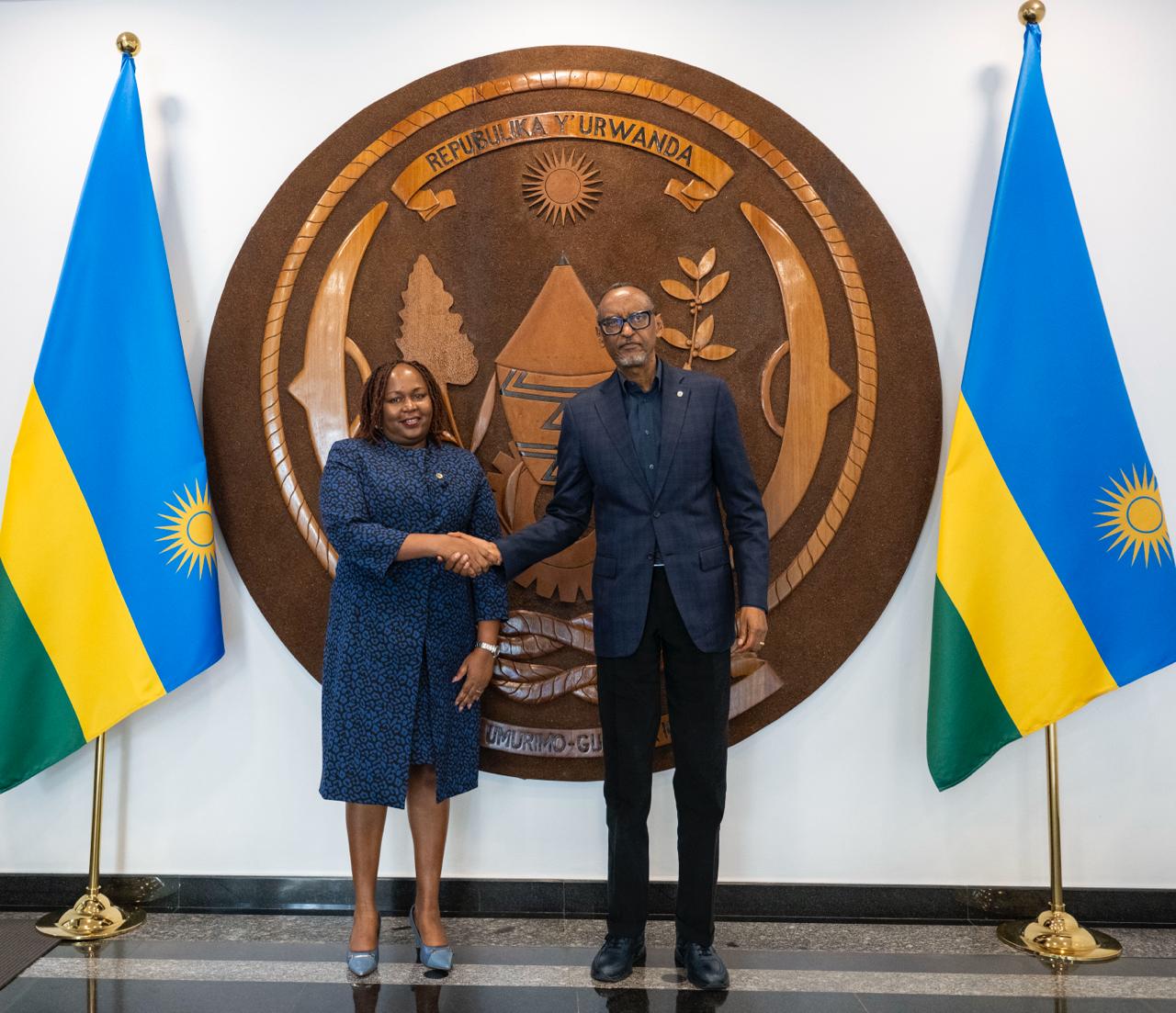
KIGALI — The Secretary General of the East African Community (EAC), Veronica Mueni Nduva, was in Kigali on Friday for high-level talks with President Paul Kagame, as the regional bloc confronts one of the most severe financial crises.
Nduva met Kagame in afternoon at Village Urugwiro, on the sidelines of the EAC Multi-Sectoral High-Level Dialogue, a gathering bringing together various organs of the eight-nation community.
Their discussions focused on strengthening regional trade and integration, and on key initiatives aimed at advancing shared prosperity across the East African Community, according to Urugwiro.
But behind the formal agenda lies mounting anxiety over the bloc’s finances — and its future.
A Community Under Financial Strain
The East African Community, which comprises Burundi, Democratic Republic of Congo, Kenya, Rwanda, Somalia, South Sudan, Tanzania and Uganda, is grappling with nearly $90 million in unpaid contributions from partner states.
As of January 31, 2026, arrears stood at more than $89 million, according to internal reports cited by regional officials.
Under the current equal-share model, each partner state is expected to contribute roughly $7 million annually to finance the bloc’s operations.
Only Kenya and Tanzania have fully met their obligations for the 2025/26 financial year.
DRC, which joined in 2022, accounts for the largest share of outstanding dues, with roughly $27 million unpaid.
Burundi owes $22.7 million. South Sudan must pay $21.8 million. Somalia (joined 2023) must give the Secretariat $10.5 million.
Rwanda’s burden is much smaller, as arrears stand at about $5.2 million, while Uganda owes just over $1 million.
The financial strain has effectively paralyzed key institutions headquartered in Arusha, Tanzania.
Salaries and gratuities for members and staff of the East African Legislative Assembly have reportedly gone unpaid for several months.
Legislative sittings have been suspended or postponed.
The East African Court of Justice faces a backlog of hundreds of cases, while other regional bodies — including agencies overseeing fisheries, civil aviation safety and university coordination — are struggling to function.
Regional officials warn that the crisis risks undermining the EAC’s broader ambitions: a common market of more than 300 million people, coordinated infrastructure development and deeper integration aligned with the African Continental Free Trade Area.
A Leadership Question Looms
Nduva, a Kenyan diplomat appointed in June 2024 to complete Kenya’s five-year rotational term, is preparing to leave office later this year.
Under the bloc’s rotation principle, the next Secretary General would typically come from South Sudan.
But South Sudan’s own substantial arrears have complicated that expectation.
EAC Lawmakers have openly questioned whether a nominee from one of the largest defaulters can credibly lead an institution struggling to secure its own funding.
Some member states have proposed revising the financing formula to include a component based on economic size, alongside enforcement mechanisms such as penalties or suspended voting rights for non-compliance.
An emergency summit of heads of state is scheduled for March 7 in Arusha, convened by Kenyan President William Ruto in his capacity as EAC chair.
The meeting is expected to address the funding impasse, consider reforms to the contribution model and appoint the next Secretary General.
Diplomacy Amid Tensions
The financial crisis unfolds against a backdrop of political tensions within the region, including ongoing security concerns in eastern Congo and strained bilateral relations among some member states.
For Rwanda, whose leadership has consistently championed regional trade and infrastructure connectivity, the health of the EAC carries both economic and strategic significance.
In Kigali, Friday’s meeting as part of a broader effort to reinforce cooperation at a time when the bloc faces existential questions.
Whether the EAC can overcome its funding paralysis — and preserve its integration ambitions — may depend on decisions taken in the weeks ahead.
