



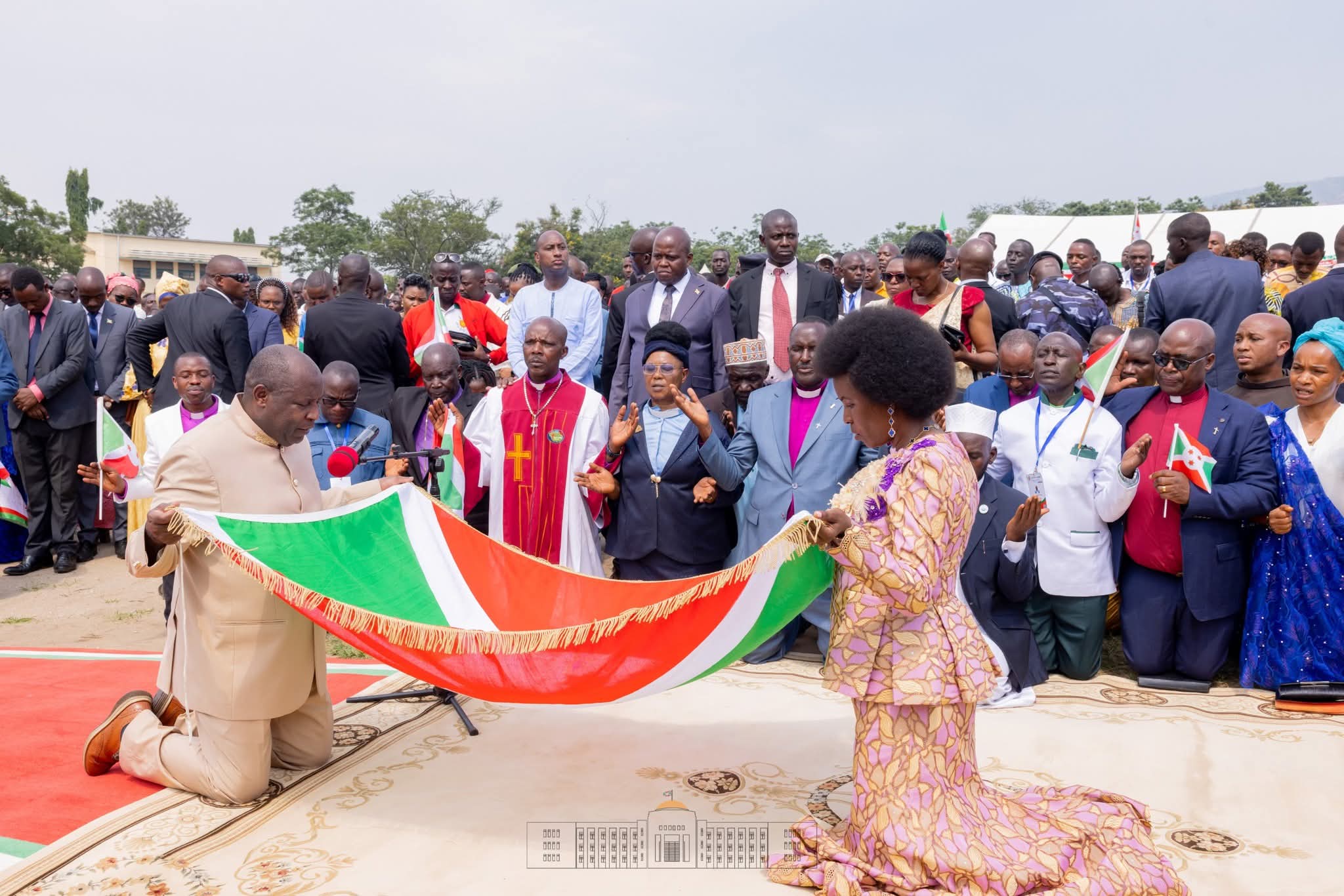
A country of God: Scenes like these are a common occurrence throughout the year, as President Ndayishimiye and First Lady seek divine intervention to deal with the country’s challenges
Majority of people seeking Rwandan nationality are Burundians, according to new official statistics.
Nearly 20,000 Burundians have emigrated to Arab countries by last year, choosing to endure some of the harshest working and living conditions abroad rather than remain at home.
At the same time, displacement is rising: between 2024 and last year, the number of Burundian refugees increased by 1,721, pushing the total to more than 52,000—accounting for over 38 percent of Rwanda’s refugee population.
In a country repeatedly described by its president as a biblical paradise, thousands of Burundians are quietly leaving in search of opportunity elsewhere.
President Évariste Ndayishimiye has often portrayed Burundi as the “Garden of Eden,” invoking religious imagery to highlight its natural beauty, fertile land, and untapped wealth.
Yet this optimistic narrative contrasts sharply with the reality on the ground, where economic hardship, unemployment, and limited prospects are driving many citizens to migrate—most notably northward to Rwanda or to Arab Gulf states.
While official speeches celebrate abundance and promise prosperity, Burundians are increasingly “voting with their feet.” The steady outflow of workers, professionals, and families reflects growing frustration and disillusionment, raising questions about the gap between political rhetoric and lived experience.
Presidential Optimism Meets Reality
President Ndayishimiye first publicly branded Burundi the “Garden of Eden” in a speech in February 2024, describing the country as a land where “nothing is lacking,” drawing directly from biblical descriptions of divine perfection.
He later repeated the metaphor during the 2025 election campaign, presenting it as proof of Burundi’s destined prosperity and resilience.
At times, the president went further, claiming that “even Americans drink water from Burundi,” a statement meant to emphasize the country’s rich natural resources, including lakes and rivers.
However, such remarks have drawn criticism from citizens and analysts alike, many of whom see them as disconnected from everyday hardship.
Burundi remains among the poorest countries in the world, with average annual income estimated at around $300 per person.
Poverty, food insecurity, inflation, and unemployment remain widespread. Even Ndayishimiye acknowledged in a 2021 address to the United Nations that poverty was Burundi’s “only remaining enemy” after years of conflict.
Critics argue that the “Eden” narrative functions more as political messaging—designed to boost national pride and deflect attention from governance challenges such as corruption, weak institutions, and economic stagnation.
Migration to the Gulf
A growing number of Burundians are seeking work in Arab Gulf countries, attracted by wages that far exceed what they can earn at home. Jobs in construction, domestic work, and hospitality are particularly appealing to young people facing limited options domestically.
According to official figures, 18,791 Burundians had migrated to Arab countries by December 30, 2025.
Addressing the Senate on January 13, 2026, Foreign Affairs Minister Dr Edouard Bizimana said the government does not block citizens from seeking work abroad.
“No one prevents anyone from going to earn money wherever they want,” he said, adding that authorities simply want to know where migrants are going so they can assist if problems arise.
Migrants are required to submit details about recruiters, destinations, and employment terms. This system was introduced amid rising concerns over exploitation, human trafficking, unpaid wages, and abuse.
Bizimana acknowledged the challenge posed by 34 unregistered recruitment agencies operating illegally, which often disappear when migrants encounter problems.
Notably, the exodus is not limited to low-skilled workers. Doctors, teachers, and other public servants are also leaving, deepening concerns about brain drain and weakening already strained public services.
Heading North to Rwanda
Closer to home, Rwanda has emerged as another key destination for Burundians seeking stability and opportunity. Official Rwandan statistics from 2025 show that people born in Burundi made up the largest group of new citizens.
By November 30, at least 27 out of 101 newly naturalized Rwandans were Burundian-born, accounting for more than a quarter of all approvals.
Over the full year, Burundi ranked ahead of Uganda and the Democratic Republic of Congo.
Many Burundians acquire Rwandan citizenship through family ties, long-term residency, or investment pathways. This trend is striking given the tense political relations between Kigali and Bujumbura.
President Ndayishimiye has repeatedly accused Rwanda of interference and plotting attacks—claims Rwanda has strongly denied.
Despite the diplomatic friction, Rwanda’s relative economic stability, investor-friendly policies, and strong regional integration make it an attractive destination.
Shared history, ethnic ties, and cross-border family connections also ease the transition for many Burundians seeking a fresh start.
Leaving “Paradise” to Survive
The growing exodus from Burundi highlights a deep irony: a country rich in natural resources but undermined by structural and political challenges.
High poverty levels, youth unemployment, food shortages, and limited economic mobility continue to push citizens outward.
Political grievances, including allegations of repression, favoritism, and lack of accountability within the ruling CNDD-FDD party, further erode public confidence.
While the government portrays migration as a matter of individual choice, the scale of departures suggests deeper systemic failures.
Registration policies may reduce risks abroad, but they do little to address the root causes driving people to leave.
As Burundi approaches potential political and economic turning points in 2026, the “Garden of Eden” metaphor risks losing credibility unless matched by tangible reforms.
For now, the steady movement north—toward Gulf labor markets or Rwandan citizenship—tells a clearer story than official speeches. Burundians are not fleeing paradise; they are pursuing survival, dignity, and opportunity beyond their borders.
