



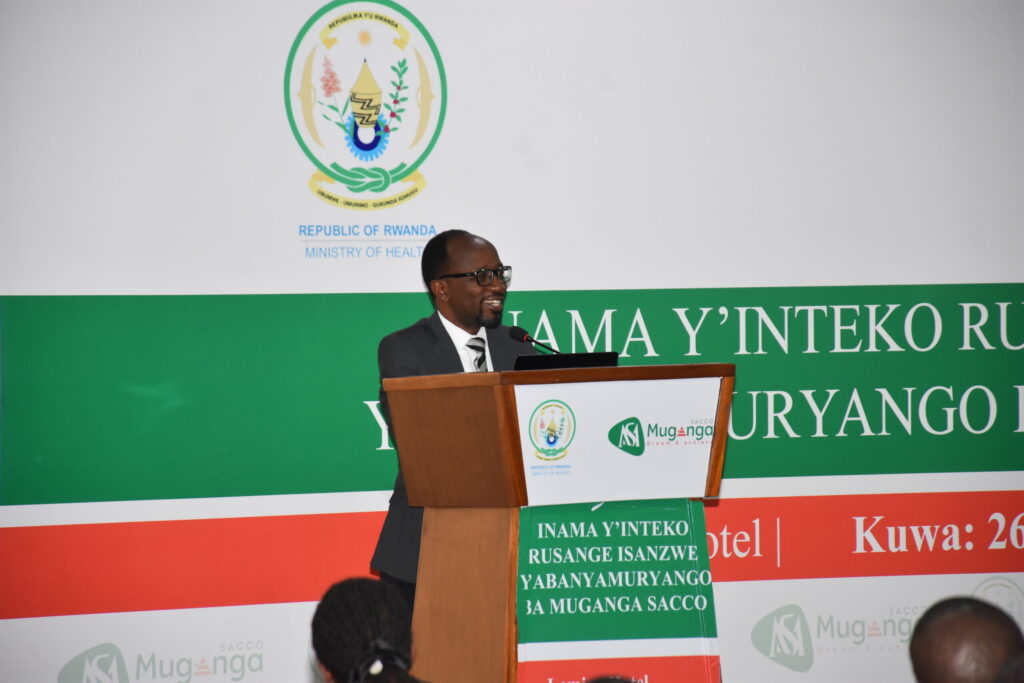
Jean Marie Vianney Ndayizigiye, the Permanent Secretary at the Ministry of Health, speaking to members of 10th Ordinary General Assembly to highlight CHW enrollment.
KIGALI — For years, Rwanda’s health system has leaned on the quiet resilience of community health workers. These men and women serve on the frontlines without formal salaries, yet they remain indispensable to the country’s public health success. Today, a new financial shift is beginning to match their contribution with opportunity.
This transformation is driven by Muganga SACCO, a fast-evolving financial institution that has steadily strengthened its footing while expanding its reach.
Muganga SACCO is a savings and credit cooperative in Rwanda mainly serving health workers, including doctors and nurses. It helps members save money and access affordable loans, operating as a member-owned financial institution aimed at improving financial stability.
Backed by solid governance and growing partnerships, the SACCO is now turning its attention to this long-overlooked group. The cooperative’s audited financial statements for 2025 affirm a stable and credible institution.
Auditors confirmed that its financial position fairly reflects its performance in line with international standards. This integrity has created a strong foundation for expansion, allowing Muganga SACCO to move beyond traditional membership and reimagine inclusion within Rwanda’s health sector.
Expanding the Vision for 2027
By the close of 2025, the SACCO had grown to 14,749 active members, including over 2,000 new entrants in a single year. Under its 2025–2027 business plan, the cooperative aims to enroll up to 90 percent of registered health professionals. Now, for the first time, that vision explicitly includes community health workers.
Dr. Philbert Muhire, Chairperson of the Board of Directors of Muganga SACCO, says this inclusion is both strategic and overdue. He explains that while community health workers may not earn conventional salaries, they are economically active.
Through their cooperatives and income-generating activities, they already participate in the economy. Bringing them into the SACCO strengthens their financial capacity and integrates them into a more structured system of growth.
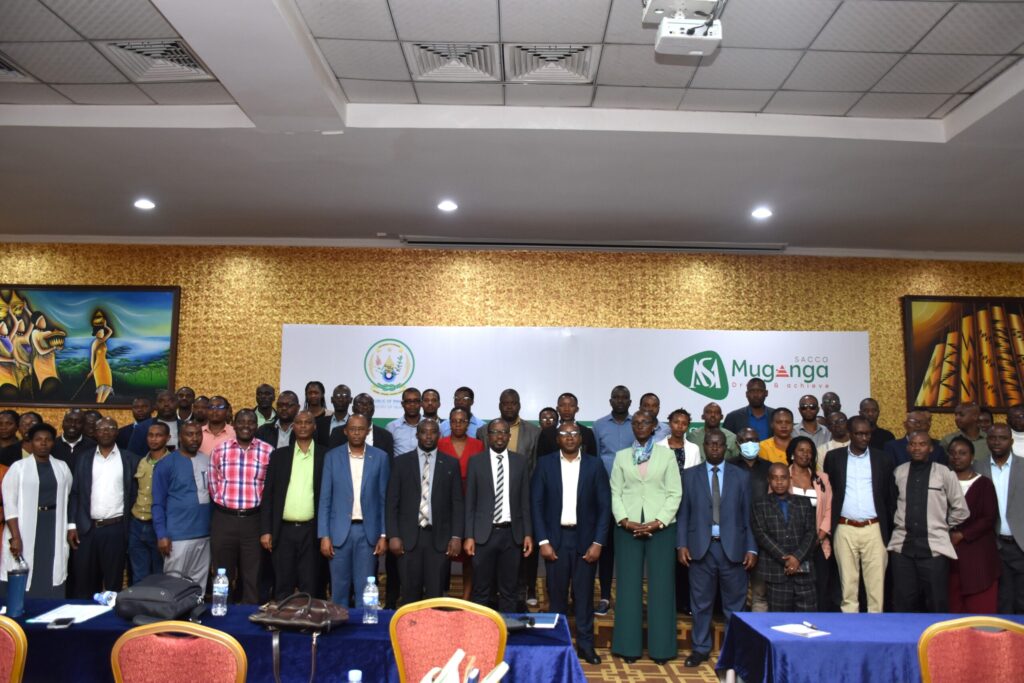
Members of Muganga SACCO pose for a group photo during the 10th Ordinary General Assembly.
Strengthening Livelihoods Beyond the Clinic
These financial benefits are now being extended to Rwanda’s 58,000 community health workers (CHWs). For many, this shift represents a historic turning point. Maxime Ngarambe, a veteran CHW from Kayonza and a national representative for the group, views the move as a long-awaited breakthrough.
He notes that while CHWs lack fixed salaries, they are industrious, often managing farms or small businesses. Access to low-interest credit allows them to scale these ventures and build sustainable livelihoods.
Ngarambe, who has served for 17 years, emphasizes that the SACCO’s low-interest structure is particularly significant. It offers a practical pathway for workers to invest in their futures without the burden of high financial risk.
A Policy Shift Toward Economic Empowerment
This transition is strongly backed by the Ministry of Health. Permanent Secretary Jean Marie Vianney Ndayizigiye emphasizes that the government’s role is to build systems that empower CHWs economically.
The Ministry is currently exploring specialized product development and identifying viable projects to support these workers financially, moving beyond direct government contributions.
Rather than fostering dependency on state funding, this approach amplifies the existing economic activities of CHWs. The Ministry is also considering providing seed capital to help the SACCO expand its reach, drawing inspiration from the support the Ministry of Education provided to Mwalimu SACCO. As Ndayizigiye notes, the goal is to provide strategic support that ensures long-term sustainability rather than dependency.
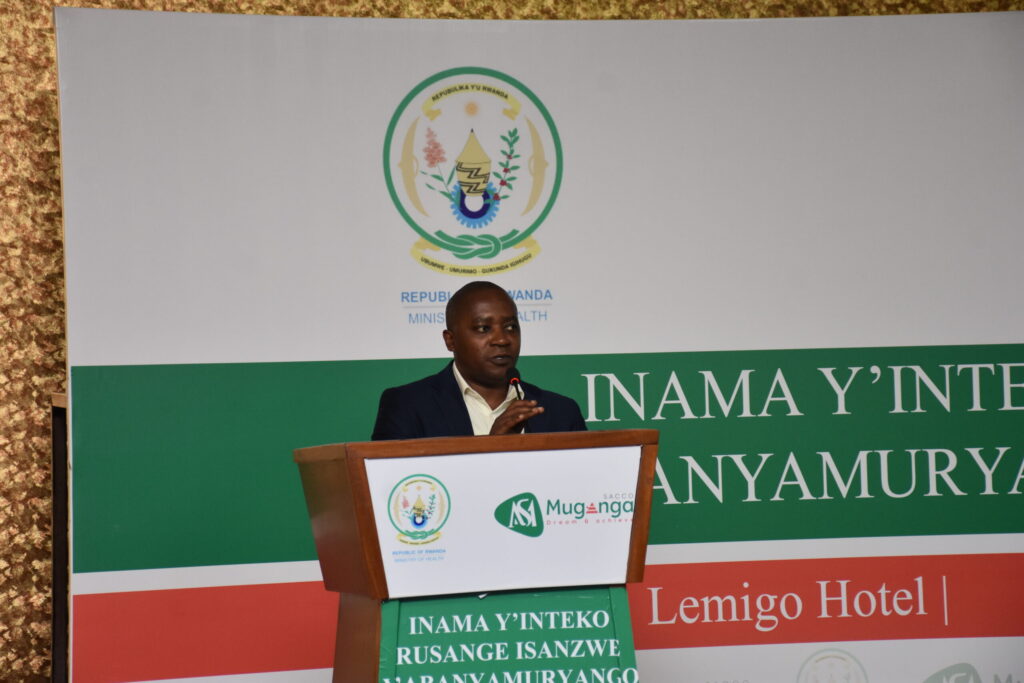
Dr. Philbert Muhire, Chairperson of the Board of Directors of Muganga SACCO speaking to delegates during the 10th Ordinary General Assembly.
Growth, Innovation, and Opportunity
Muganga SACCO’s readiness to absorb this new membership base is tied to its broader institutional growth. In 2025, the SACCO achieved 85 percent of its annual action plan targets, reflecting steady operational progress.
Digital transformation has been a key driver. Members now access services through multiple channels, including mobile banking, USSD platforms, internet banking, debit cards, and mobile lending solutions. These innovations are critical in reaching CHWs, many of whom operate in rural settings.
At the same time, the SACCO has expanded its loan portfolio. Performing loans grew by 27 percent, rising from Rwf 4.7 billion in 2024 to Rwf 6 billion in 2025. A major highlight is the Gira Iwawe initiative, developed in partnership with the Development Bank of Rwanda through which over Rwf 1 billion has already been disbursed to members to support their housing needs.
Muganga SACCO now boasts a Rwf 2 billion facility, enabling members to access loans of up to Rwf 60 million, repayable over 20 years. Dr. Muhire believes such initiatives will be transformative for CHWs.
“Gira Iwawe is not just a loan product; it is a platform for long-term investment. We want every member, including community health workers, to benefit from opportunities that create real economic value,” he says.
Ultimately, the inclusion of CHWs signals a broader shift in how Rwanda’s financial and health systems intersect. By recognizing the economic potential of these frontline workers, Muganga SACCO is redefining who qualifies for financial empowerment.
In doing so, it is planting the seeds for a more inclusive future, where those who have long sustained the nation’s health system can finally access the financial tools to sustain themselves.
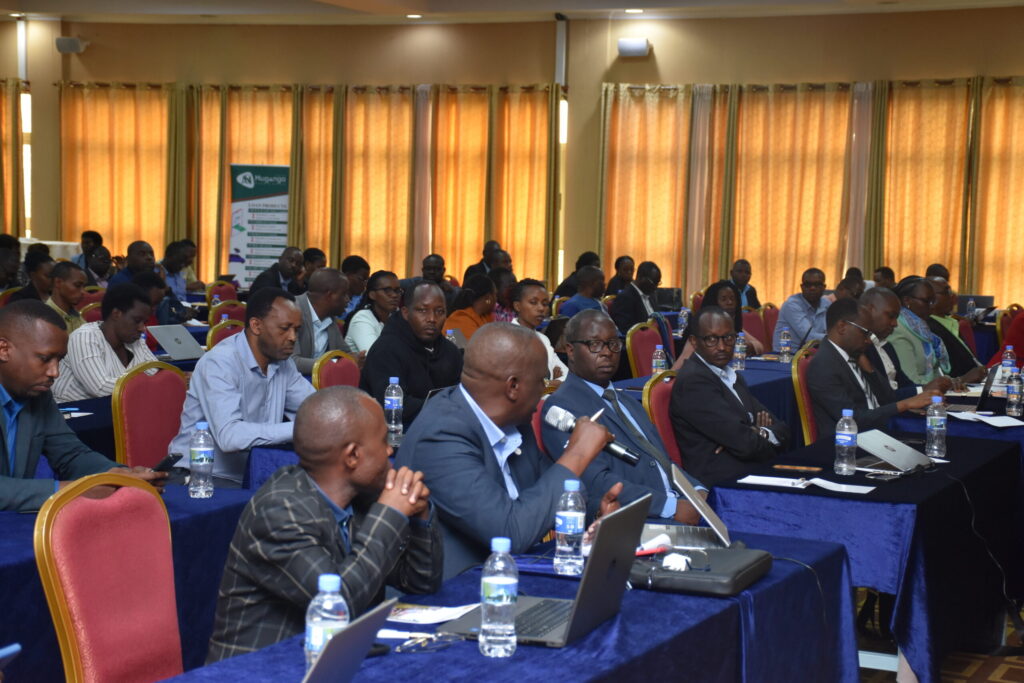
Members of Muganga SACCO hold an interactive discussion during the general assembly.