



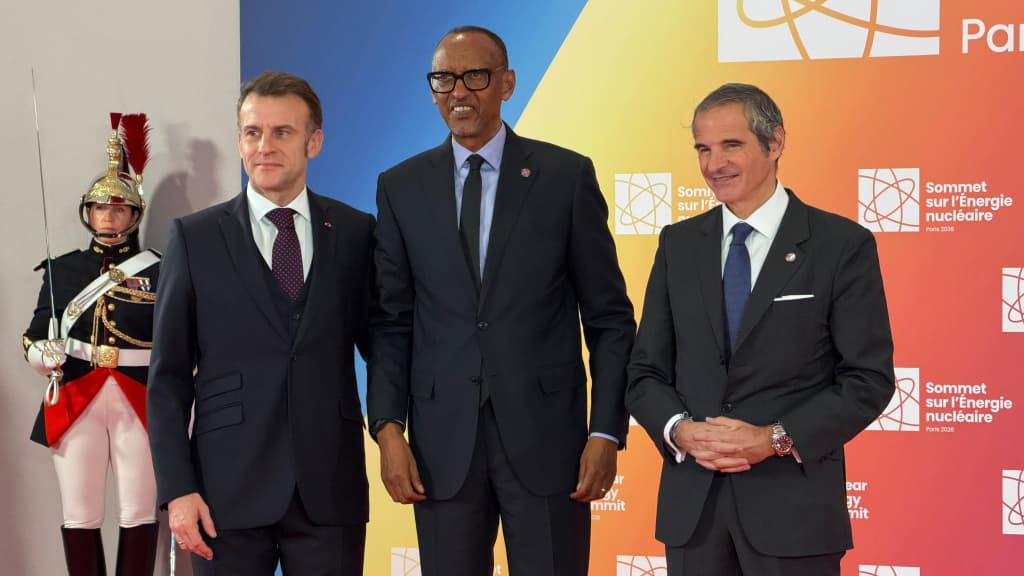
President Paul Kagame meets with French President Emmanuel Macron (Left) in Paris during the Second Nuclear Energy Summit to discuss global energy cooperation and Rwanda’s nuclear ambitions.
President Paul Kagame is in Paris this week for the Second Nuclear Energy Summit, joining global leaders in exploring how nuclear power can help meet rising energy demand and tackle climate change. The summit brings together around 60 heads of state, top international organisations, industry leaders, and nuclear experts, offering a platform for countries to share experiences, strategies, and innovations in nuclear technology.
Accompanied by officials from the Rwanda Atomic Energy Board (RAEB), President Kagame’s participation highlights Rwanda’s growing ambitions in nuclear energy, aimed at diversifying the country’s energy mix, strengthening industrial growth, and ensuring reliable power for future generations.
A Global Forum on Nuclear Solutions
The summit, held at La Seine Musicale in Boulogne-Billancourt, Paris, focuses on advancing nuclear energy projects, strengthening international cooperation, and improving nuclear waste management. Leaders and experts are also discussing financing mechanisms and regulatory frameworks that could accelerate the safe deployment of nuclear technology worldwide.
This is the second edition of the Nuclear Energy Summit, following the first meeting held in Brussels, Belgium, in 2024, which also emphasized global energy security and sustainable development.
“Nuclear energy is a key part of the global energy transition,” said one summit official. “It offers a reliable, low-carbon source of electricity that complements renewable energy and supports industrial growth.”
Rwanda’s Stage in Nuclear Energy
Rwanda has in recent years taken significant steps toward developing peaceful nuclear technology for energy, healthcare, and scientific research. The Rwanda Atomic Energy Board (RAEB) oversees the country’s nuclear programme, ensuring the development of legal, regulatory, and technical frameworks for safe nuclear use.
Rwanda’s ambitions include exploring the deployment of Small Modular Reactors (SMRs)—a new generation of reactors that are smaller, more flexible, and suitable for countries with smaller grids. SMRs can be constructed faster and with lower upfront costs compared to traditional nuclear plants, making them a practical option for emerging economies.
The government is also collaborating closely with the International Atomic Energy Agency (IAEA) and other international partners to train specialists, strengthen safety standards, and build local expertise in nuclear science and technology.
“Participation in global forums like this allows Rwanda to exchange knowledge and prepare for responsible nuclear development,” said an RAEB official.
Expanding Energy Access in Rwanda
Energy demand in Rwanda continues to grow as the country expands its industrial base and implements development strategies under the National Strategy for Transformation (NST2) and Vision 2050.
The government has made significant progress in increasing electricity access through hydropower, solar energy, methane gas from Lake Kivu, and regional power imports. However, officials stress that long-term energy security will require a diversified energy mix capable of providing stable, large-scale power generation.
Nuclear energy is being studied as a potential complement to renewable sources, particularly to ensure reliable electricity for industry, urban development, and digital infrastructure.
Nuclear Energy in the Global Context
Globally, nuclear power is increasingly recognised as a crucial part of the clean energy transition. Unlike fossil fuels, it produces minimal greenhouse gas emissions and offers consistent, large-scale electricity that can balance the variable output from solar and wind energy.
Yet, nuclear energy faces challenges, including high investment costs, safety concerns, and long-term radioactive waste management. Leaders at the Paris summit are sharing strategies to overcome these challenges through innovation, policy coordination, and international collaboration.
For countries like Rwanda, the discussions provide guidance on financing models, technology transfer, and regulatory measures that are vital for safely introducing nuclear technology.
Strengthening Cooperation and the Road Ahead
The summit underscores the need for global cooperation to harness nuclear energy responsibly. For Rwanda, engagement in such forums is part of a broader vision to build safe, reliable, and low-carbon energy systems that support economic growth and sustainable development.
As global demand for clean and reliable energy continues to rise, nuclear power is increasingly being seen as part of the solution to energy security and climate change. The outcomes of the Paris summit are expected to shape future collaboration, investment, and policy frameworks for countries at different stages of nuclear development.
For Rwanda, President Kagame’s presence signals both commitment and readiness to advance nuclear technology responsibly, paving the way for a future where nuclear energy complements the country’s renewable and conventional energy sources.