



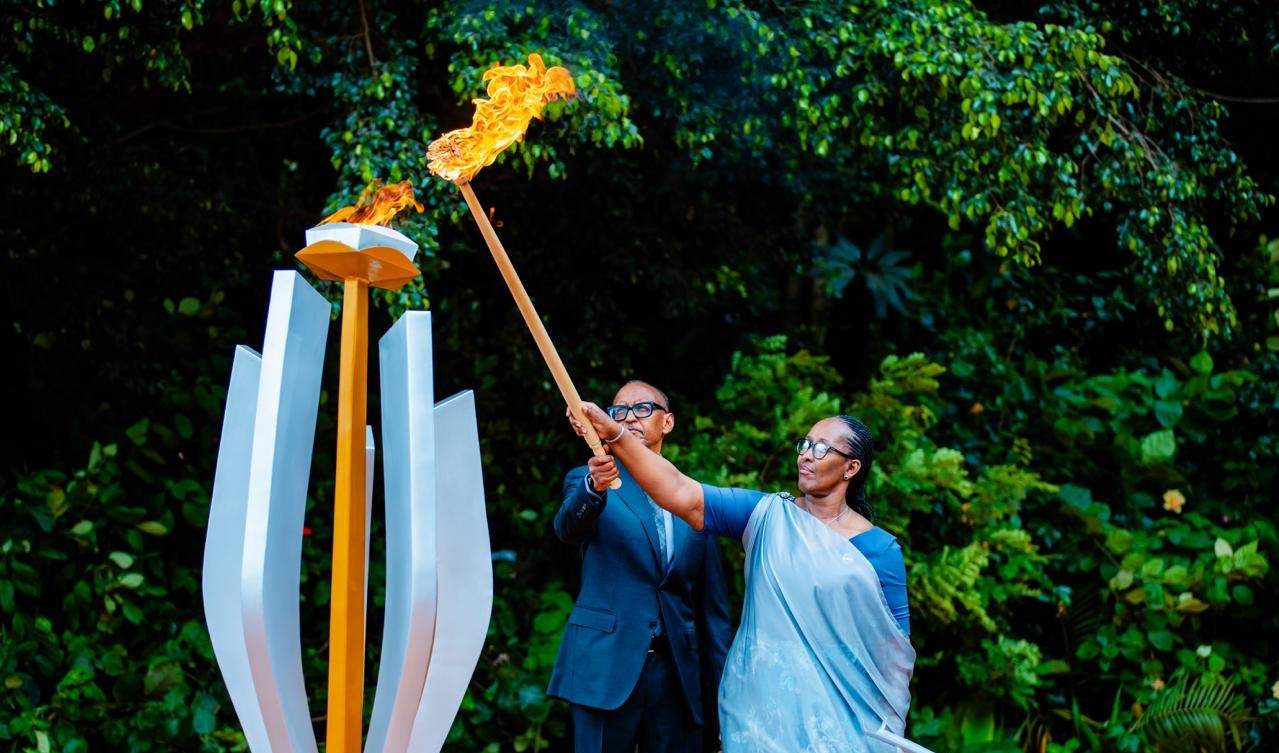
President Kagame and First Lady light the Memorial Flame which will stay on for the next 100 days
KIGALI — At the start of Kwibuka32, Rwanda’s 32nd commemoration of the 1994 Genocide against the Tutsi, President Paul Kagame delivered one of his most emotional and defining messages: that survivors are not only remembered—they are the moral foundation upon which modern Rwanda stands.
Speaking at the Kigali Genocide Memorial, Kagame centered his address on those who lived through the genocide, describing them as a source of strength not just for themselves, but for the entire nation.
“We draw from the strength of survivors who provide the reservoir of humanity that feeds our nation’s soul,” he said.
Kagame spoke directly to survivors in one of the most personal moments of the ceremony, offering reassurance that their pain is shared by the entire country.
“To all survivors, know that you are not alone. We stand with you always,” he said.
The message, delivered before a national and global audience, reflected a central pillar of Rwanda’s post-genocide recovery: that survivors are not isolated victims of history, but an integral part of a collective national journey.
For many, Kwibuka is both a period of mourning and a time when the nation visibly rallies around survivors—through remembrance events, testimonies, and community support.
Kagame emphasized that this solidarity is not symbolic, but foundational to Rwanda’s identity.
Survivors as Custodians of Memory
Kagame underscored the importance of survivor testimonies in preserving the truth of what happened in 1994.
“I thank the survivor who has just spoken. These testimonies keep memory alive for all of us and for those who will follow us,” he said.
He described these accounts as essential to ensuring that future generations understand not only the scale of the genocide, but also its human impact.
In Rwanda, survivor voices have long played a central role in commemoration—serving as living evidence against denial and distortion.
Kagame noted that remembering is not only about the past, but about shaping the future.
“Keeping memory alive” ensures that the lessons of genocide are passed on, strengthening resilience against the forces that once divided the country.
From Victims to Pillars of National Renewal
Kagame said survivors should not solely through the lens of suffering, but as key contributors to Rwanda’s recovery and transformation.
“This day empowers us all,” he said, linking the act of remembrance to the country’s broader journey of rebuilding.
He credited Rwanda’s progress to a collective effort in which survivors played a vital role—alongside other citizens—in choosing unity over division.
“Everything we have achieved was only possible because all Rwandans decided to join hands in common purpose,” Kagame said.
This framing reflects a broader national narrative: that survivors, despite unimaginable loss, became central to reconstructing the social fabric of the country.
Healing and Strength
While acknowledging the pain that accompanies Kwibuka, Kagame also presented remembrance as a source of strength.
“It is how we confront and overcome the divisions that nearly destroyed us,” he said.
For survivors, the commemoration period can reopen wounds, but it also creates space for recognition, dignity, and collective healing.
Kagame suggested that the act of remembering together transforms individual grief into shared resilience—turning memory into a unifying force.
“This day carries profound meaning for our nation,” he added, emphasizing that remembrance binds Rwandans across generations.
A Living Commitment
Kagame’s message ultimately extended beyond words of comfort to a broader national commitment: that survivors will continue to be supported, honored, and protected.
By placing survivors at the center of Rwanda’s identity, he reinforced the idea that Kwibuka is not just about those who were lost, but also about those who live with that history every day.
Their presence, their stories, and their resilience, he suggested, are what give meaning to remembrance itself.
As the Flame of Hope burns over the 100-day commemoration period, Kagame’s message was clear: survivors are not alone—not during Kwibuka, and not beyond it.
They are, in many ways, the conscience of the nation—and the reason it continues to move forward.
