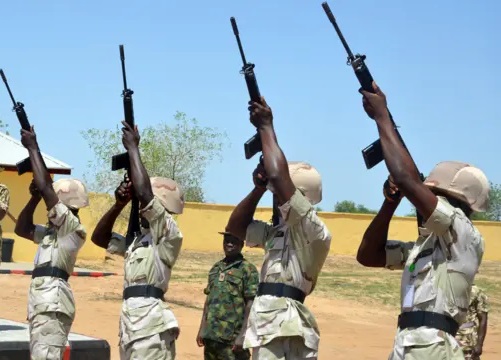
Shooting in the air while burying a fallen soldier is a symbolic farewell, a mark of honor, and a ritual rooted in
ancient warrior culture meant to respect the dead, comfort the living, and remind society of sacrifice.
It has deep historical and symbolic roots, and while it looks dramatic, it is not random violence but a ritual of honor,
farewell, and remembrance found in many cultures.
Ancient vs. modern traditions:
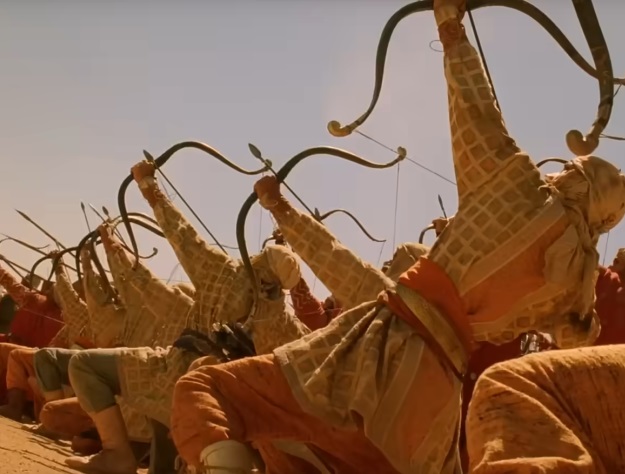
In ancient societies, warriors believed that noise, especially from weapons, helped guide the spirit of the fallen to the afterlife and scared away evil spirits. Spears, arrows, and later guns were fired skyward as a final escort for the soul.
In modern military tradition, firing guns into the air is a salute, similar to standing at attention or lowering a flag.
It symbolizes respect and bravery while marking the soldier’s final duty completed. It also shows that the person did
not die in vain.
Over time, the tradition evolved into what many armies now call the rifle salute with three shots.
Why Three Shots?
In many armies (especially Western ones), a three-volley salute is common.
During early wars, fighting would stop to collect the dead. Three shots signaled that the fallen had been recovered, and the army was ready to resume battle, and with time, those three shots eventually became a symbol of honor, closure, and sacrifice.
In parts of Africa, the Middle East, and Central Asia, shooting into the air during burial has both military and cultural meaning:
– Declares the fallen as a hero
– Publicly acknowledges courage and loyalty
– Serves as a warning that the community remains strong
Among armed groups and militias, it may also reinforce unity and resistance while on a human level, the act simply represents grief expressed through power, not silence, a final way to say: “You fought, you are honored, rest.” It is
also a reminder to the living of the cost of war.
Modern Restrictions:
Today, many countries restrict or ban firing live ammunition into the air due to safety risks. As a result, blank rounds are used, and ceremonial salutes are tightly controlled while in some cultures gunfire is replaced with drums, horns,
or chants.
Religious perspective:
Some religions discourage shooting into the air during funerals or burials because it conflicts with their theology, ethics, and understanding of death. The reasons are not only about safety but about how death should be honored.
Many religions discourage shooting into the air during burials because death is sacred, weapons symbolize violence, and true honor is shown through prayer, restraint, and care for the living.
The main reasons include the following: Sanctity of Life and Non-Violence- Many religions teach that weapons are instruments of harm, and introducing them into sacred moments like burial pollutes the holiness of death rituals.
Christianity (many denominations) emphasizes peace, humility, and prayer at death. “Blessed are the peacemakers” (Matthew 5:9). So, for Christianity, gunfire contradicts the idea of laying down arms before God.
Death Is a Moment of Silence and Reflection- Religions often teach that death requires solemn quiet, not noise or aggression. In Islam, for instance, funerals are simple and calm, so loud displays, chanting, or gunfire are discouraged (makruh or haram).
The Prophet Muhammad (Peace be upon him) emphasized dignity and quick burial. Gunfire is seen as prideful or showy, distracting from remembrance of God (dhikr).
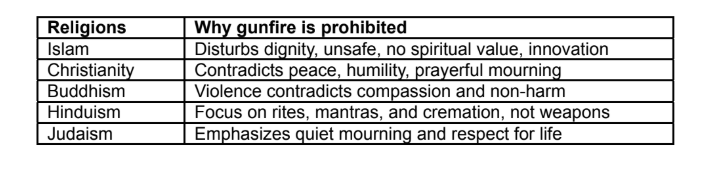
Some religions teach that death equalizes all people. Gunfire can elevate one person as a “hero” above others, and some religions like Islam stress that honor comes from faith and deeds, not status or arms. See table below for a general comparison.