


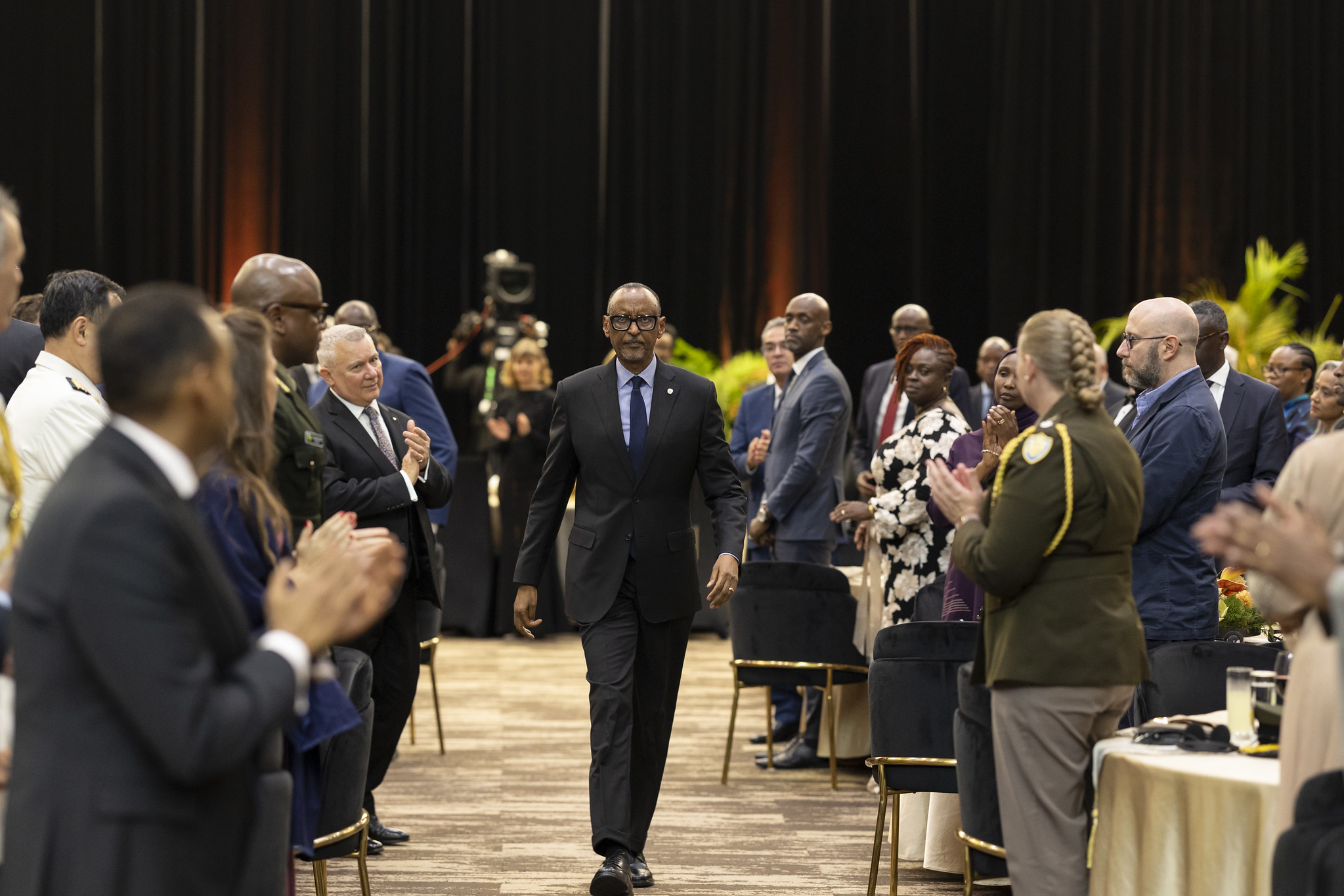
President Kagame arrives at the Diplomatic Dinner on Friday Evening at Kigali International Convention Center
In the closing moments of a speech that ranged from regional security to international diplomacy, President Paul Kagame turned to an allegorical story about a lion, a deer and a tortoise to illustrate what he described as the dynamics of power, blame and responsibility in global politics.
Addressing diplomats and representatives of international organizations in Kigali on Friday, Kagame said he had recently experimented with asking an artificial intelligence system a question about the world’s political realities. Instead of revealing the question, he shared the answer it generated — a short fable set in the jungle.
“In the jungle, a lion king coveted a plush deer grazing unaware,” Kagame recounted. “The deer, blinded by sweet grass, didn’t see the jaws closing in.”
In the story, the lion seeks to satisfy its own desire, while a tortoise is wrongly accused of eating crops that the king himself had destroyed.
“Meanwhile, a wise old tortoise stood tall, accused of eating the king’s crops — crops the king knew were devoured by his own pride,” Kagame said.
The allegory ends with the deer falling victim to the king’s greed while the tortoise, burdened by blame, remains dignified in the face of accusations.
“The deer fell for the king’s greed. The tortoise’s shoulders burdened, faced the hungry shadows dignified,” Kagame said.
Although Kagame did not explicitly identify the characters in the story with specific countries or actors, the parable echoed many of the themes that ran through his speech.
Earlier in the address, Kagame had spoken at length about Rwanda’s security concerns in eastern Democratic Republic of the Congo and what he described as persistent threats from the militia Democratic Forces for the Liberation of Rwanda (FDLR), a group linked to perpetrators of the 1994 Genocide against the Tutsi.
MORE PHOTO FROM Diplomatic Dinner | Kigali
He argued that Rwanda has repeatedly warned about the dangers posed by the group and the broader regional dynamics that sustain the conflict.
“We have consistently raised these issues in any relevant forum,” Kagame said earlier in the speech, adding that the underlying causes of the conflict are often ignored.
The president also criticized what he called selective pressure from the international community, saying Rwanda is frequently blamed for developments in eastern Congo while other actors receive less scrutiny.
In that context, the allegory appeared to reflect Kagame’s view that some powerful actors pursue their interests while assigning responsibility to others.
“The jungle whispered: one met the king’s desire, the other his blame,” Kagame said as he concluded the story.
Kagame suggested that Rwanda may sometimes find itself in the position of the tortoise — bearing accusations or pressure despite what he sees as legitimate security concerns.
“That’s where we are,” he said after recounting the fable.
But he added that Rwanda intends to respond to such pressures with resilience rather than confrontation.
“We will have our shoulders burdened and remain dignified,” Kagame said.
The metaphor brought together several strands of the president’s speech, including his criticism of double standards in international responses to regional conflicts and his argument that Rwanda’s actions are driven by the need to protect its citizens.
Throughout the address, Kagame emphasized that Rwanda’s policies are shaped by the lessons of the genocide and the country’s determination never to allow extremist ideologies to threaten its security again.
By closing with the allegory, Kagame appeared to frame Rwanda’s position within a broader narrative about power and responsibility in international affairs — suggesting that smaller nations can sometimes carry the burden of blame even when larger forces shape the circumstances around them.
The story also echoed a more personal section of the speech in which Kagame questioned how countries are judged internationally, saying that perceptions about wealth, influence or other factors can affect how nations are treated on the global stage.
In the end, the allegory served as both a reflection on international politics and a message about Rwanda’s response to criticism.
Despite the pressures it faces, Kagame suggested, the country intends to remain steady.
The burden may be heavy, he said, but dignity remains a choice.
