



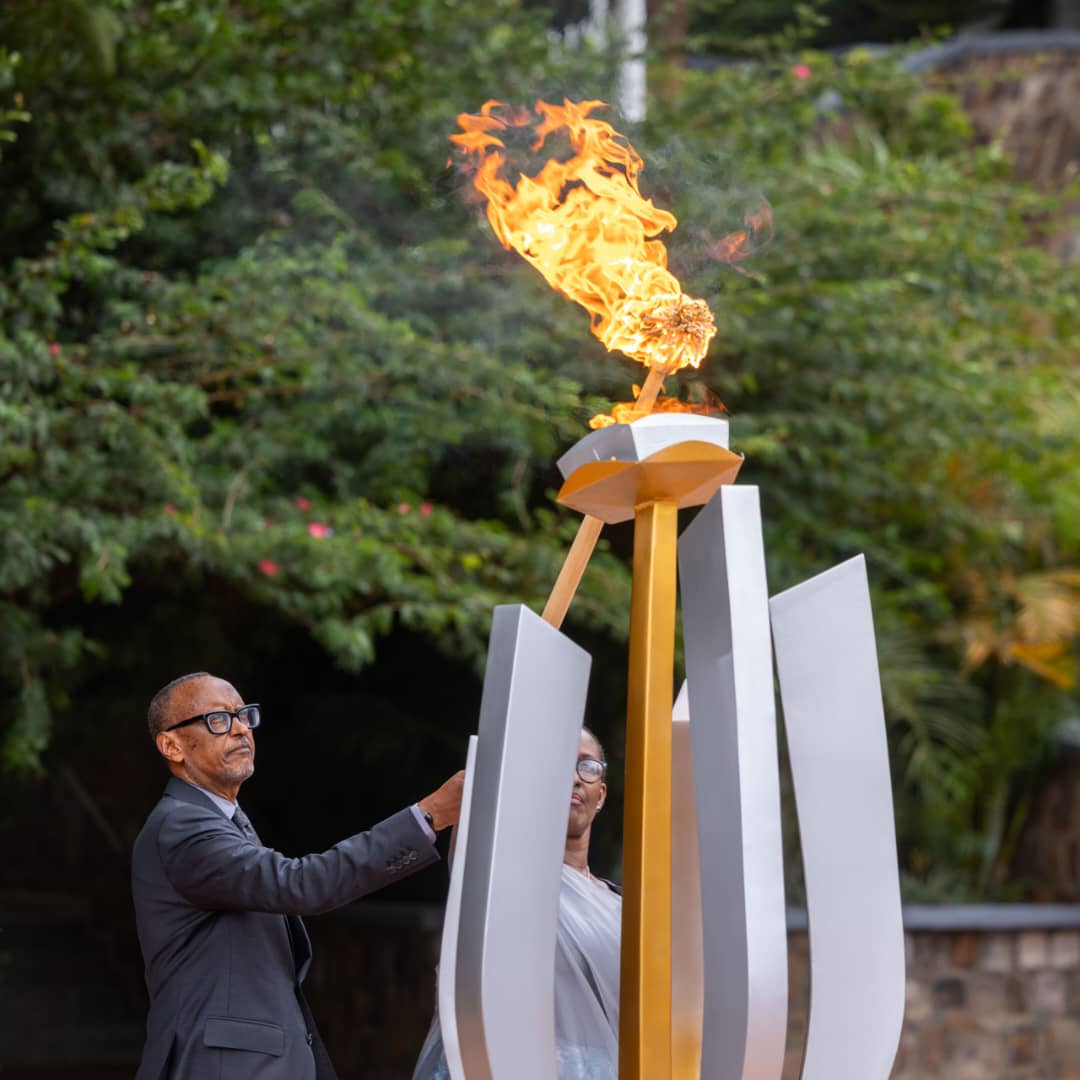
Presiddnt Kagame and First Lady Jeannette Kagame light the Memorial Flame at the Kigali Genocide Memorial Center. It will remain burning for next 100 days
KIGALI — President Paul Kagame used his Kwibuka32 address to deliver a defiant message against what he described as persistent efforts to distort Rwanda’s history and question its intentions, warning that genocide ideology and denial remain active threats both within the region and globally.
Speaking at the Kigali Genocide Memorial, Kagame said Rwanda has faced “constant criticism” and deliberate attempts to twist the narrative of the 1994 Genocide against the Tutsi—but insisted that such efforts will not succeed.
“You can never silence us,” he declared, emphasizing that Rwanda will continue to speak out against falsehoods and defend the truth.
Kagame framed the struggle over how the genocide is understood as an ongoing battle—one that extends beyond history into present-day politics.
“Along the way, Rwandans have faced constant criticism and many attempts to twist our history,” he said.
He noted that Rwanda’s strength lies in its ability to rely on its own understanding of events, rather than external narratives shaped by political interests.
“The power we will always have is to use our minds to see the truth, and our voices to speak up when something is not right,” Kagame said.
This, he suggested, is both a right and a responsibility—particularly in the face of denial and revisionism.
Claims of Exaggeration
Kagame directly addressed a recurring criticism: that Rwanda exaggerates security threats or invokes genocide history for political purposes.
“There are those who claim that Rwanda exaggerates these concerns, or that we have ulterior motives,” he said.
He dismissed such claims as not only inaccurate, but dangerous.
“This is not only false, it exposes the deep cynicism that led to the tragedy we commemorate today,” Kagame added, linking present-day skepticism to the same attitudes that enabled the genocide in 1994.
According to Kagame, minimizing threats or questioning Rwanda’s concerns risks normalizing the very ideologies that led to mass violence.
Continuing Threat
A central theme of Kagame’s remarks was that genocide ideology did not end in 1994—it continues to evolve and spread, particularly if left unchallenged.
“We must be clear about the dangers that remain,” he said, warning that hate speech, extremism, and denial still pose risks in the region.
He stressed that confronting these dangers requires vigilance, clarity, and a willingness to call out harmful narratives before they escalate.
Kagame linked this to Rwanda’s broader message during Kwibuka: that remembrance is not only about honoring victims, but about identifying and resisting the forces that led to their deaths.
A Form of Defense
For Kagame, the act of speaking out—whether against denial, distortion, or extremism—is itself a form of protection.
“You can never silence us in whatever form,” he added, reinforcing the idea that Rwanda will not be intimidated into abandoning its position or muting its voice.
This stance reflects a broader national approach: confronting difficult truths openly, even when they are contested or uncomfortable.
Kagame suggested that silence, in contrast, creates space for dangerous ideas to take root.
Beyond Rwanda
While rooted in Rwanda’s experience, Kagame’s remarks carried a wider implication for the international community.
The persistence of genocide denial and distortion, he suggested, is not unique to Rwanda—and requires a global response.
By defending its own narrative, Rwanda is also asserting a principle: that historical truth must be protected, and that those who experienced atrocities have the right to define and defend their own history.
As Kwibuka32 unfolds, Kagame’s message on this theme was unequivocal: Rwanda will not retreat in the face of criticism, nor will it allow its history to be rewritten.
The country’s voice, shaped by one of the darkest chapters in modern history, will remain active and assertive.
Because, as Kagame made clear, silence is not an option—and truth is not negotiable.
In the context of remembrance, that position is not just about the past. It is about safeguarding the future.
