



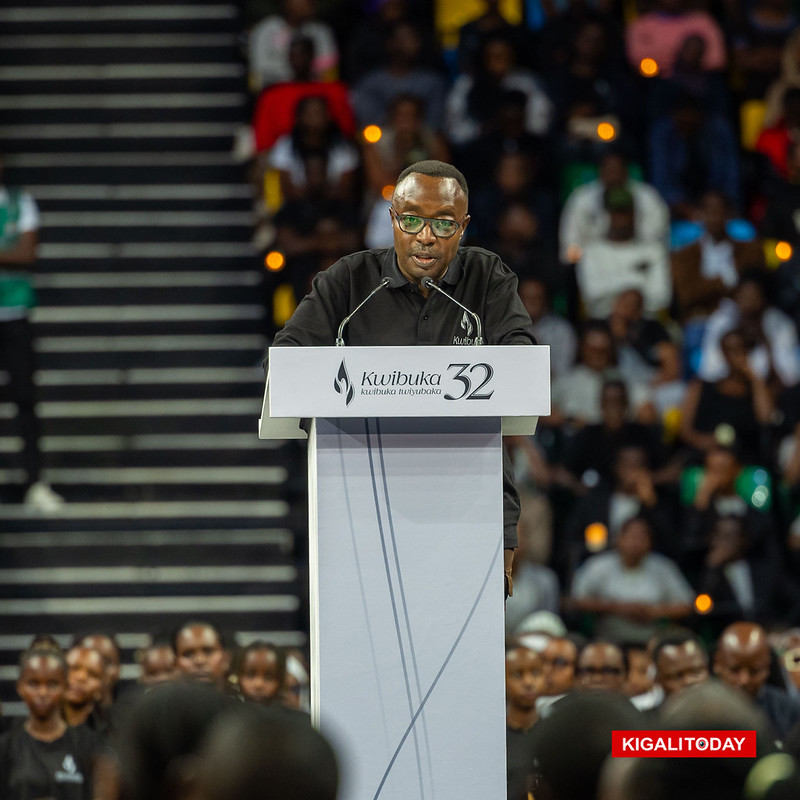
Jean Marie Vianney Karangwa, a survivor of the 1994 Genocide against the Tutsi, shares his harrowing testimony during the 32nd commemoration (Kwibuka 32) at BK Arena on April 7, 2026.
KIGALI — For Jean Marie Vianney Karangwa, the 1994 Genocide against the Tutsi did not begin with the sudden explosion of violence in April. It began decades earlier, woven into a childhood defined by state-sponsored exclusion and a system that had marked him for death long before he reached adulthood.
Karangwa, who survived the slaughter in the Muhima neighborhood of Nyarugenge District, was just 21 years old when his world collapsed. Speaking during the 32nd commemoration (Kwibuka 32) at the BK Arena on April 7, 2026, he recounted a harrowing journey of betrayal, a point-blank execution, and the chilling transformation of the country’s premier medical institution: the University Teaching Hospital of Kigali, known as CHUK.
The Architecture of Hate
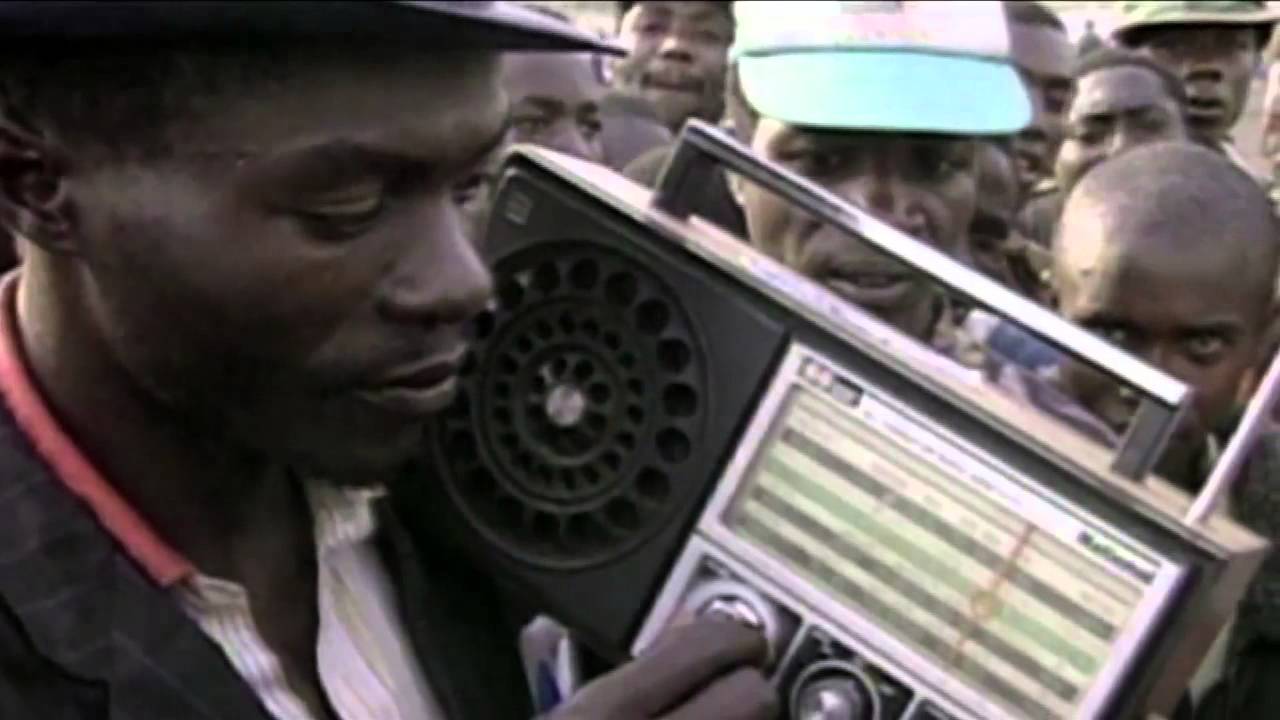
The Airwaves of Hate: Radio was weaponized to incite communal violence and mobilize killers during the 1994 Genocide against the Tutsi. / File Photo.
Growing up in the 1980s, Karangwa learned that his identity as a Tutsi was a liability. Under the regime’s ethnic quota system, access to education and jobs was strictly rationed. When his parents joined others to establish the APACOPE School in Muhima to provide an alternative for Tutsi children, the state responded with systematic sabotage.
Karangwa recalls how the Minister of Education falsely accused top-performing students of cheating—a pretext used to deny them the diplomas they had earned and effectively stall their futures.
By 1990, the “soft” persecution of quotas turned into direct military intimidation. Soldiers would stage late-night “attacks” by firing into the air, only to raid Tutsi homes the next morning under the guise of searching for rebels. During one such raid, Karangwa watched as soldiers searched his family home and labeled his parents’ modest savings as “enemy funds.” It was a prelude to the total dehumanization that would follow in 1994.
Left for Dead
The night of April 7, 1994, brought the final escalation. After hiding in the drainage channels of Kinamba alongside the late journalist André Kameya, Karangwa eventually found himself cornered. While trying to blend in with a group of men to evade a patrol, a neighbor pointed him out to the Interahamwe.
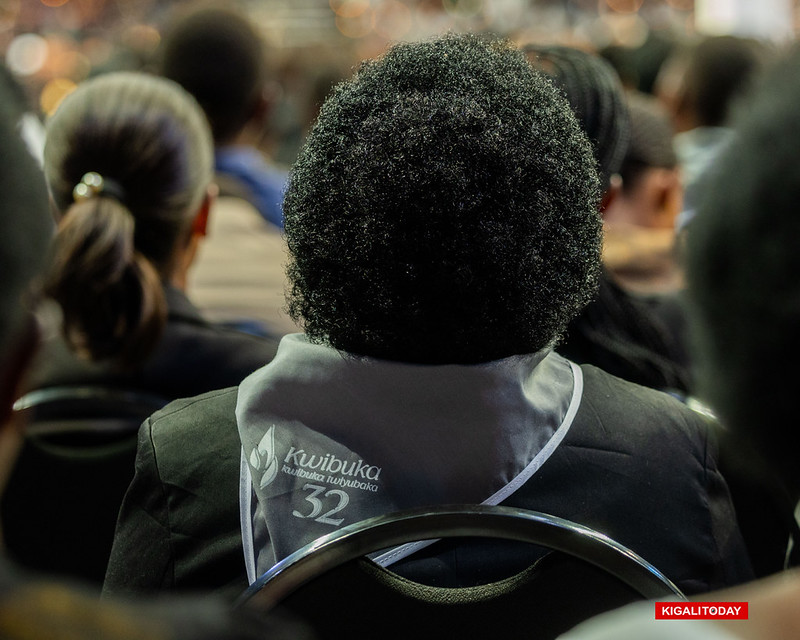
A participant listens to a genocide survivor’s testimony during the 32nd commemoration of the Genocide against the Tutsi (Kwibuka 32) at BK Arena in Kigali.
The encounter was brief and brutal. A soldier ordered him to sit down and told a comrade to “kill him quickly.” Karangwa was shot through the back at point-blank range, the bullet exiting through his neck. He collapsed, blood pooling around him. The killers, convinced he was dead, moved on to their next target, leaving him in the dust.
The Betrayal of CHUK
Miraculously, Karangwa survived. A priest, Father Anaclet, discovered him and rushed him to the University Teaching Hospital of Kigali. As the city’s largest referral center, CHUK (Centre Hospitalier Universitaire de Kigali) should have been a neutral sanctuary. Instead, Karangwa found a facility where the staff had been weaponized against their own patients.
Inside the hospital, a terrifying hierarchy emerged. While some medical staff risked their lives to provide clandestine care, others—including doctors and nurses—patrolled the wards alongside soldiers to identify Tutsi patients. Even the hospital cleaners were recruited into the killing machine, using their access to the wards and the overcrowded tents on the grounds to point out survivors for execution. Many victims were selected from their beds and taken just a few yards away to be killed within the hospital’s own perimeter.
The betrayal reached a peak when a young woman who recognized Karangwa through his late father offered him “help,” promising that her soldier brother would drive him to safety. Instead, she led the killers directly to him. He was only saved when his primary caregivers physically stood between him and the soldiers, risking their own lives to refuse his removal.
A Legacy of Resilience
Through a series of narrow escapes and the payment of bribes to gendarmes, Karangwa was eventually moved to the Hôtel des Mille Collines. The uncertainty of the hotel ended only when UN vehicles transported him to the safety of the RPF-controlled zone in Kabuga. “For the first time in months, we were told to be calm,” Karangwa told the assembly. “They treated us and gave us everything we needed.”
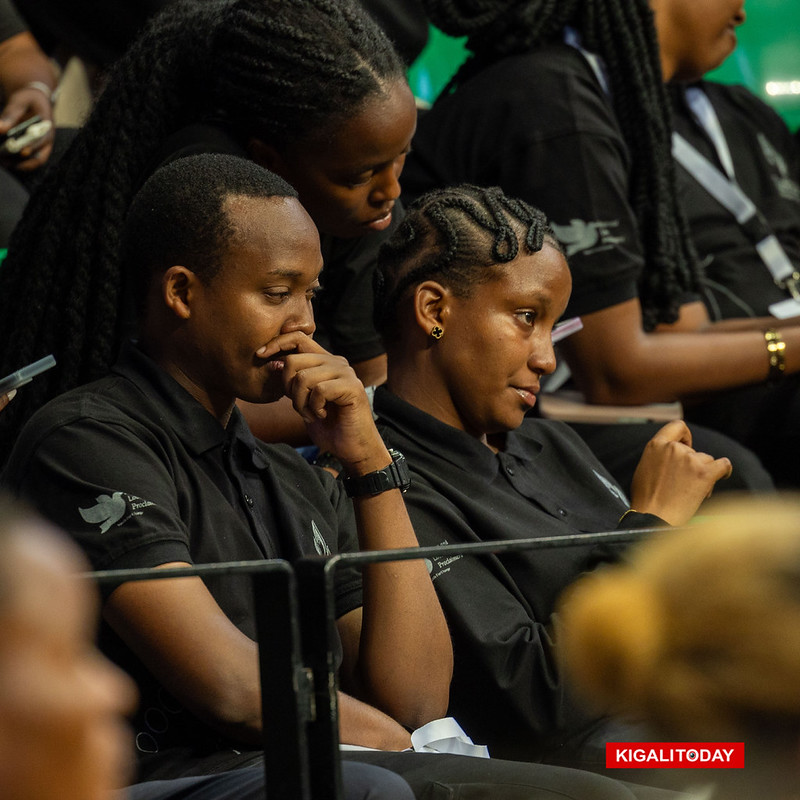
Participants listen to a genocide survivor’s testimony.
Today, Jean Marie Vianney Karangwa’s life is a living rebuke to the system that tried to erase him. A university graduate, a husband, and a father of three, he stands as a testament to the resilience of the human spirit. He expressed profound gratitude to the RPF soldiers who stopped the genocide, noting that the fear that once defined his existence has been replaced by the security of a home and a country that no longer asks him to hide.
