



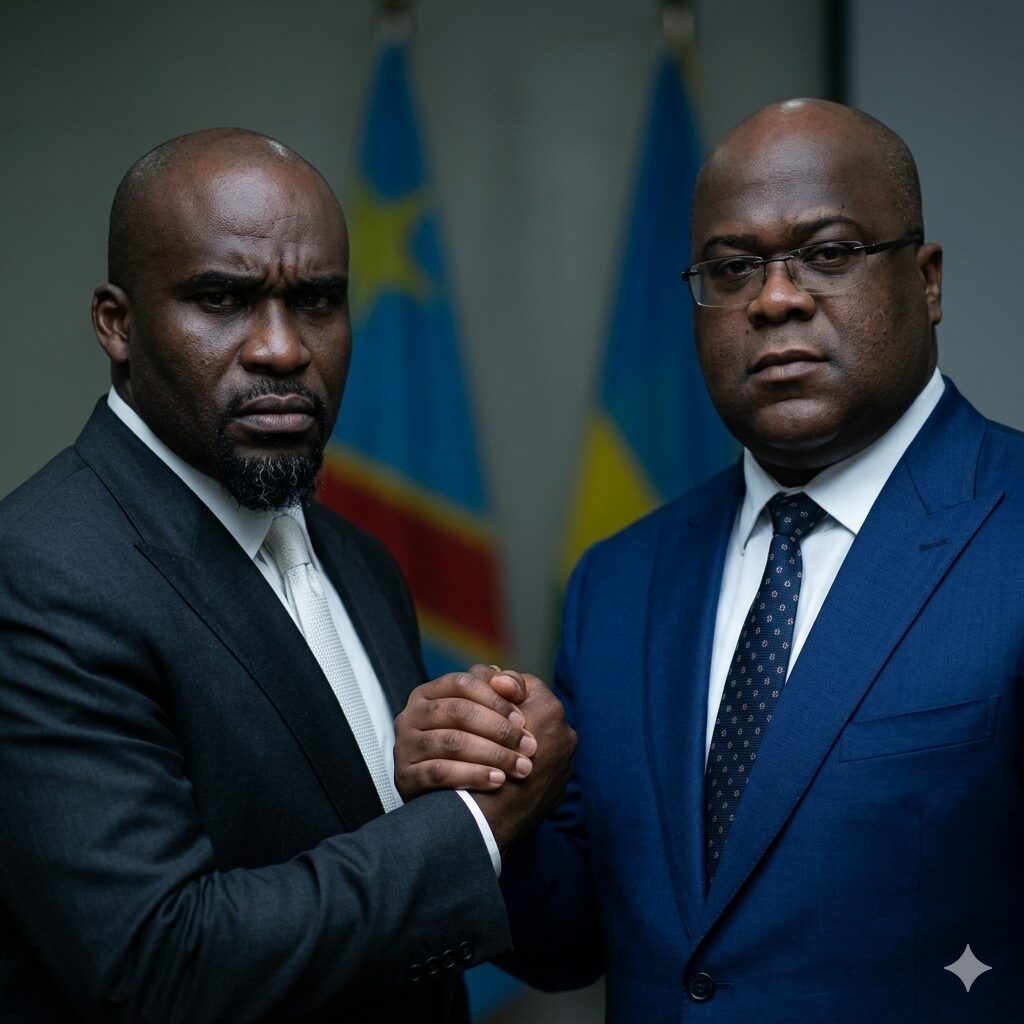
A meeting of genocide planning cult: Jean-Luc Habyarimana met DRC President Félix Tshisekedi’s government in Kinshasa on recent visit
The continued political agitation by members of the family of former Rwandan President Juvénal Habyarimana is not about justice, reconciliation, or historical truth.
It is about power—lost power—and a persistent refusal to accept that Rwanda has moved on without them.
Three decades after the 1994 Genocide against the Tutsi In Rwanda, the Habyarimana family clings to a dangerous fantasy: that the ideology which once elevated them—Hutu Power—can be revived through genocide denial, deception, and regional destabilization. It cannot. And it will not.
Victims by convenience, architects by history
The Habyarimana family has perfected the art of selective victimhood. Whenever accountability approaches, they recast themselves as persecuted, misunderstood, or unfairly targeted. Agathe Kanziga Habyarimana, in particular, has been persistently portrayed as an innocent widow—despite extensive historical documentation linking her to Akazu, the extremist inner circle that helped engineer the genocide against the Tutsi.
This is not ignorance. It is strategy.
By presenting themselves as victims, the family seeks to obscure the moral clarity of the genocide and dilute responsibility. This narrative is aimed almost exclusively at external audiences—foreign courts, Western media, and politically disengaged observers—because within Rwanda it collapses instantly.
Rwandans do not debate whether Hutu Power was destructive; they lived its consequences and buried its dead.
Playing the victim card is not a pursuit of truth. It is a political survival tactic deployed by those unwilling to confront their own legacy.
When politics fails, violence becomes the tool
Unable to secure legitimacy through ideas or public support, the Habyarimana family and its ideological allies have repeatedly turned to armed proxies. FDLR—a UN- and U.S.-sanctioned terrorist group formed by remnants of the perpetrators of the 1994 genocide—is not an incidental association. It is the logical extension of a worldview that has always relied on fear, ethnic mobilization, and violence.
Efforts to rehabilitate or politically shield the genocidal militia —through lobbying, propaganda, or coordination with actors in the Democratic Republic of Congo and Burundi—reveal the true objective: to destabilize Rwanda externally because internal control is no longer possible.
There is nothing “oppositional” or “democratic” about supporting a group born of genocide. Alignment with FDLR is not resistance; it is ideological continuity.
The fatal miscalculation
The Habyarimana family’s fundamental error is the belief that Rwanda remains the Rwanda of 1993.
It does not.
Contemporary Rwanda is governed by laws that criminalize genocide ideology and ethnic extremism. Its population—particularly its youth—has no appetite for recycled hatred repackaged as political grievance. The state has demonstrated repeatedly that existential threats to national security will be neutralized, not negotiated.
The international environment has also shifted. Genocide denial and armed militancy no longer provide viable paths to political relevance. Instead, they invite sanctions, surveillance, and isolation. The family’s alliances do not expand their influence; they constrict it.
History is not a reusable weapon
The Habyarimana family treats history as a political instrument—something to be reshaped and redeployed. But history is not malleable, and genocide is not a matter of competing narratives. Attempts to rehabilitate Hutu Power—whether openly or by proxy—are not only morally indefensible, they are strategically delusional.
Rwanda’s future is not hostage to the nostalgia of a discredited elite.
The ideology that once empowered the Habyarimana family collapsed under the weight of its own violence.
No amount of denial, performative victimhood, or regional intrigue will resurrect it.
Hutu Power is not dormant. It is defeated. And that is a reality the Habyarimana family will have to live with—whether they accept it or not.
