




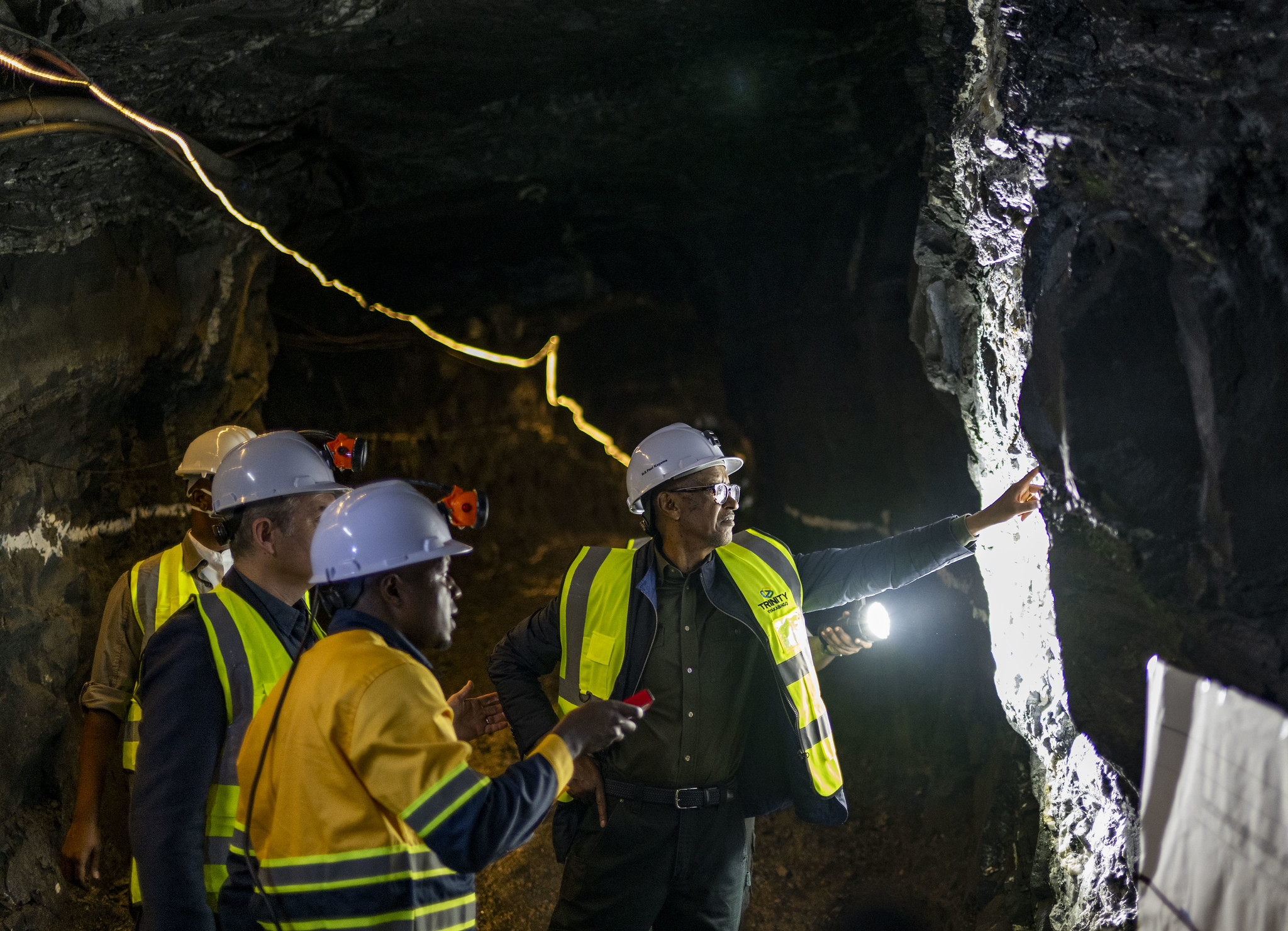
Inside Nyakabingo Mine, Rulindo District, 23 May 2025, President Kagame tours Africa’s biggest producer of Tungsten
Kigali, Rwanda — Rwanda’s mining and quarrying sector has made a strong comeback, becoming one of the fastest-growing parts of the economy in the first quarter of 2025, according to the latest GDP figures.
Yes, in the form of monetary revenue, the numbers are have been considerable. But the sector’s contribution to the overall growth has been low. Now, that has changed.
The National Institute of Statistics of Rwanda (NISR) latest data released yesterday shows that mining grew by 14% between January and March 2025 compared to the same period last year.
This is a sharp turnaround from recent years, when mining’s growth was sluggish or even negative due to lower global commodity prices and reduced export demand.
For example, in Q1 2024, the sector’s growth was only 3.1%, and in Q4 2023 it actually fell by 2.5%. In Q3 2023, growth was just 1.8%.
In some quarters of 2023, production volumes for key minerals — tin, coltan, and wolfram — actually declined.
Situation is different now. This was driven mainly by increased production of tin ore (up 20%), coltan (up 15%), and wolfram (up 12%), responding to higher international demand and better global prices.
Non-metallic minerals, such as quarry stones and sand for construction, also rose by 11%, supported by local infrastructure projects.
Compared to services and agriculture, mining has historically contributed relatively little to GDP growth because of its smaller size and volatility.
But the current double-digit growth means its contribution this quarter is much greater than in the past. The sector is also boosting exports, helping to improve Rwanda’s trade balance.
Rwanda’s overall economy grew in Q1 2025, with other sectors such as manufacturing, construction, and services also performing well.
Still, analysts say mining’s strong rebound stands out after several weak quarters, showing that it is becoming a more important driver in Rwanda’s growth story and helping diversify the economy beyond agriculture and services.
In 2023, Rwanda’s mineral export earnings reached approximately $1.1 billion, marking a 43% increase over 2022 .
The momentum continued into 2024, with export revenues rising further to $1.75 billion, representing a substantial boost and setting the country on track toward its target of $2.17 billion in annual mineral export earnings by 2029 under the NST-2 strategy.
In the overall from the GDP data released yesterday, Rwanda’s economy grew by 7.8% in the first quarter of 2025 compared to the same period in 2024, driven by strong performances in industry, services, and agriculture.
The services sector remained the largest contributor, expanding by 8% on the back of gains in wholesale and retail trade, transport, and information and communication.
Industry grew by 9%, supported by robust manufacturing, construction, and mining activity, while agriculture expanded by 6%, helped by improved production of export crops like coffee and tea.
