




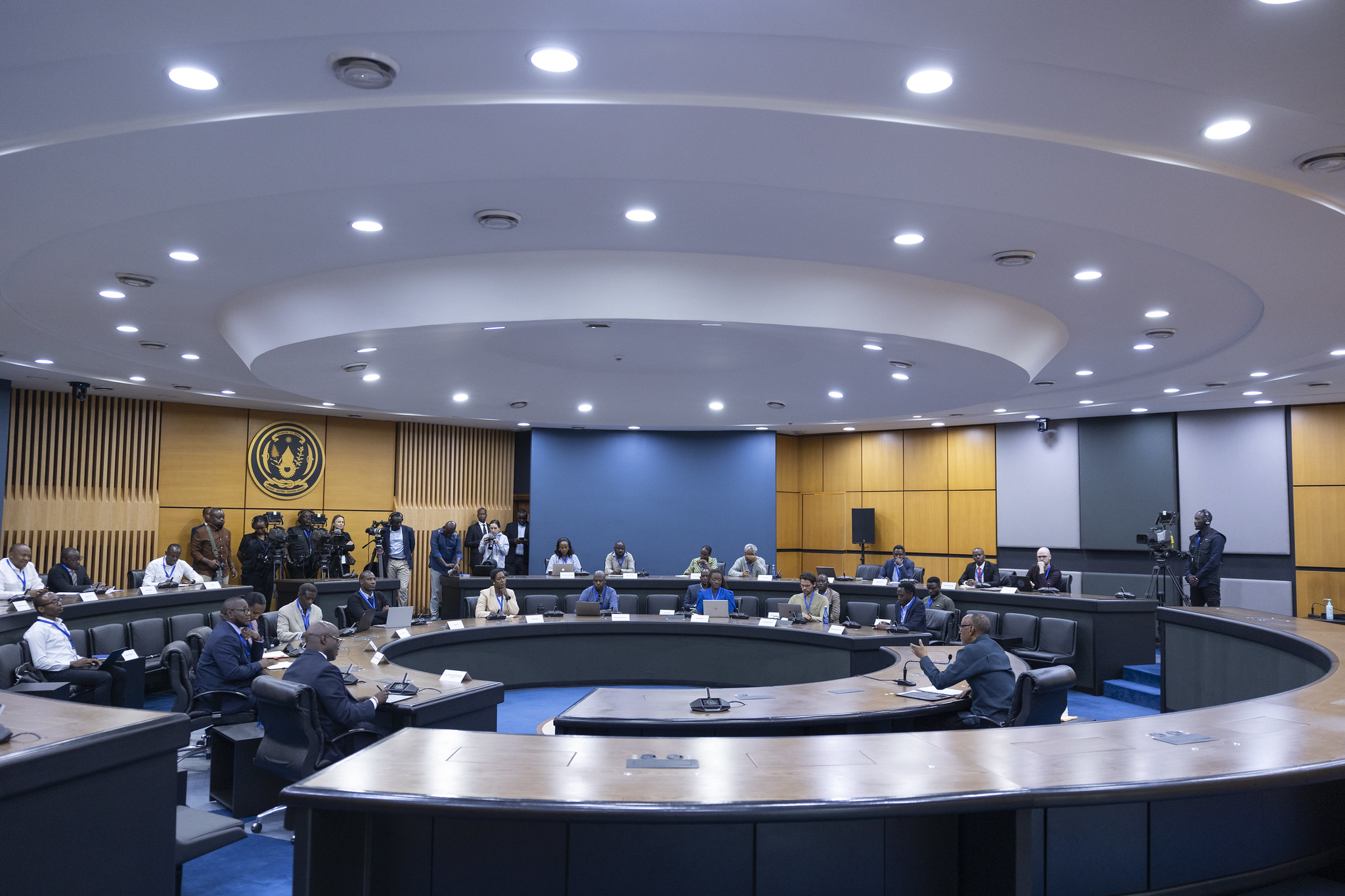
President Paul Kagame speaking to the press on Thursday, November 27, 2025
Some years back, an incident shook the core of Rwanda’s leadership during the National Dialogue, Umushyikirano, which President Paul Kagame was chairing.
The event, which brings together key stakeholders including Cabinet Ministers, Members of Parliament, Local Leaders, the Diaspora, Civil Society Organizations, and Youth representatives, was not just a policy forum, but was nearly marred by a terrifying and life-threatening failure of basic service.
During a press conference at Village Urugwiro on Thursday, November 27, 2025, President Paul Kagame recounted the chilling near miss.
The President was lucky he had lunch somewhere not at the venue. Upon his return, the President found a significant number of government officials already suffering from severe food poisoning.
The fate of the nation’s core leadership was put at risk, not by political or economic factors, but by a contaminated meal delivered by the very providers hired for excellence.
The President’s concern, shared during the press conference, underscores a fundamental and enduring challenge in Rwanda: poor service delivery, even at the highest levels, and the lack of citizen resistance to it.
The candid mirror: Numbers and the new normal
Rwanda is globally recognised for its ambitious developmental goals and infrastructural progress. However, when it comes to the tangible, human element of service, a duality persists. While policies are excellent and digitisation (like Irembo) is advancing, the promptness, professionalism, and basic dignity of service execution often lag behind.
Current data from key governance indicators confirms this long climb toward service excellence. The Rwanda Governance Scorecard (RGS) and the Citizen Report Card (CRC) consistently place citizen satisfaction with service delivery around 60% for some vital services like health, even though reaches beyond 90% for security agencies.
This remaining 40% gap represents significant friction—a space where dignity is compromised, time is wasted, and the potential for efficiency is lost.
The silent complicity: Why Rwandans pay for failure
President Kagame’s strongest criticism centered not just on the service providers, but on the citizens who endure poor treatment. He expressed alarm at how Rwandans often suffer poor service in silence, repeatedly patronize the same deficient venues, and effectively pay for their own mistreatment.
The President noted a “worrying trend of normalizing failure,” stating: “Rwandans remain silent and even return to the same venues and receive the same services,” This silence grants poor service providers a implicit contract of indemnity.
For service excellence to become a reality, citizens must shift their attitude and become the primary mechanism for enforcement. The President’s message delivers two non-negotiable mandates to the public:
Financial resistance: Rwandans must refuse to accept poor service delivery and, crucially, do not pay for it. Paying for a deficient or dangerous product, like the contaminated food at Umushyikirano, funds the continuation of failure.
Vocal accountability: Citizens must strongly voice out poor services everywhere they go. Silence shields negligence; only assertive, public complaints can compel a fundamental change in attitude and operational standards.
The awakening roar: A network of resistance
Fortunately, a movement is already growing from the grassroots. Pioneers like Ignatius Kabagambe have tapped into this national frustration through the Good Service Initiative (GSI).
Kabagambe established a vast network, notably via WhatsApp, where thousands of people daily report poor service experiences spanning hospitality, public offices, and transportation.
This network, channeling the frustrations of an estimated 5,000 plus citizens daily, is a real-time barometer of the service culture. GSI’s mission is to elevate service from a mere transaction to a core pillar of national transformation, demonstrating that citizens are ready to demand accountability, echoing the President’s call to action.
It is time to break the silence. Your Agaciro (dignity) is tied to the quality of service you receive. Demand the refund. Refuse the cold meal. Lodge the complaint. You are the accountability mechanism the system needs; do not fund the failure.
To the service provider
Change your attitude. The mentality of viewing the customer as a burden must end. Service excellence is not a cost—it is the essential investment that builds trust, reputation, and a robust economy.
The food poisoning incident at the National Dialogue must serve as an ultimate wake-up call, exposing a sickness in our service culture that requires immediate remedy.
Let us all heed the warning from the poisoned plate and commit to delivering and demanding nothing less than excellence, ensuring that the dignity we aspire to in our national policies is reflected in every interaction across the beautiful land of Rwanda.
The Writer is the Managing Director of Kigali Today Ltd, the parent company of KT Radio 96.7FM, KT Press, KigaliToday.com and Kigali Today TV (YouTube Channel)