




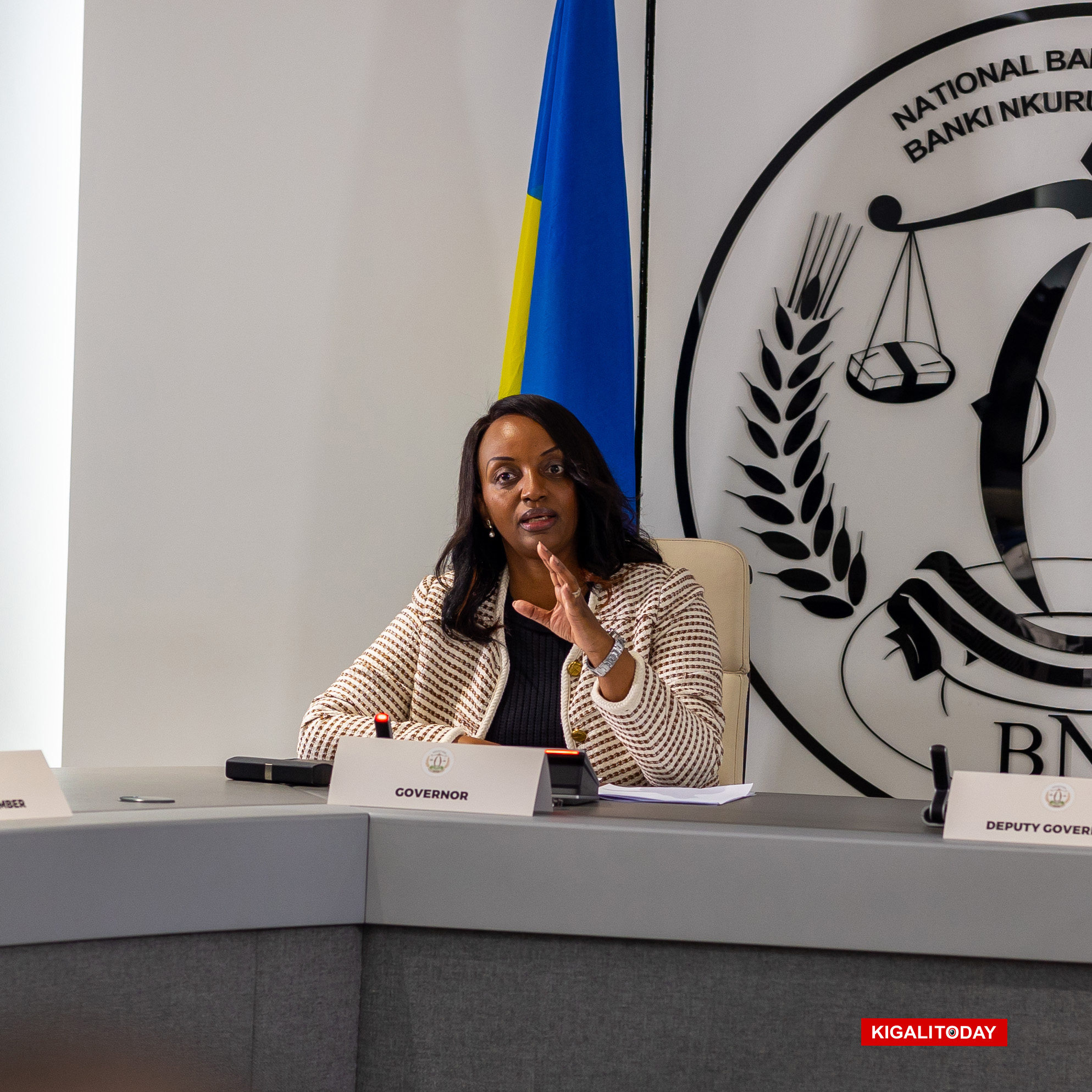
Central Bank Governor Soraya Hakuziyaremye
KIGALI — Rwanda’s National Bank announced on Wednesday that it has completed a technical proof-of-concept for a potential digital version of the Rwandan franc.
This digital money is called the e-Franc or e-FRW. The bank will now start a 12-month pilot with real users in select locations.
Unlike cryptocurrencies such as Bitcoin, a central bank digital currency (CBDC) is issued and backed by the central bank. It would be legal tender in digital form.
The goal is to complement existing payment methods. Mobile payment platforms, which already reach over 96 percent of the population, will continue to serve most daily needs.
The proof-of-concept ran from May to October 2025. It tested the technology in a controlled environment with banks, fintech firms, mobile operators, and government institutions.
The tests showed that payments could be made instantly, online or offline, using basic phone codes (USSD) on feature phones. This is especially important in rural areas where internet access is limited.
The pilot, starting now and expected to run through early 2027, will involve a small, diverse group of participants.
They will come from Kigali, at least one other city, and selected rural communities.
Participants will test real-world uses like merchant payments, person-to-person transfers, and offline transactions.
All transactions will be monitored closely. Privacy, security, and financial stability safeguards will be in place.
BNR Governor Soraya M. Hakuziyaremye emphasized that “no decision has been made regarding the issuance of the e-FRW.”
Any public rollout will depend on the pilot showing clear benefits, such as faster, safer payments and greater financial inclusion. Risks, including privacy concerns or disruptions to banks, will also be considered.
For ordinary Rwandans, widespread access to the e-Franc will take sometime. Only selected participants will use it under controlled conditions.
If the bank decides to issue it, full public availability will require further development, regulatory approval, merchant onboarding, and integration with existing mobile money systems.
Rwanda’s careful approach reflects its focus on evidence-based policymaking. The country aims to build a stronger cashless economy while protecting financial stability.
The full proof-of-concept report is available on the National Bank of Rwanda’s website at www.bnr.rw.
In Plain Language: What This Means for You
The e-Franc is not ready for daily use. Ordinary Rwandans cannot yet buy groceries, airtime, or pay for transport with it.
Only a few people in the pilot will try it in limited locations under controlled rules. Think of it as a closed beta test.
Widespread public use could take 2–5+ years, if the central bank decides to issue it.
The goal: faster, safer, more inclusive payments—even in rural areas or when internet is unavailable—without replacing existing tools.
