



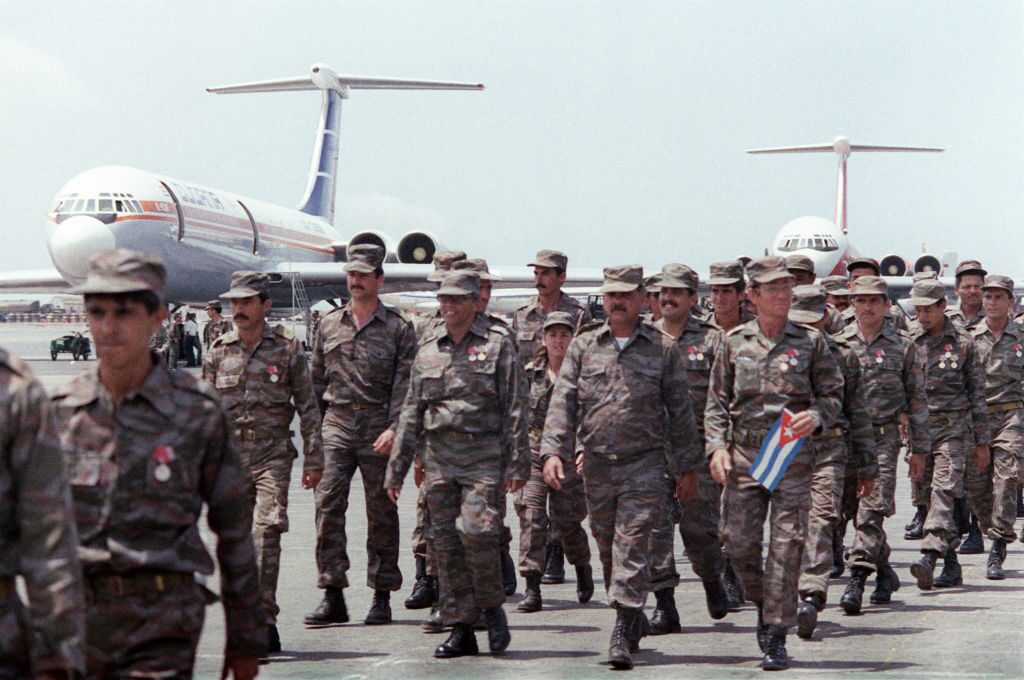
Cuban troops were instrumental in the liberation of some countries in Africa.
The African Union (AU) strongly condemns the blockade on Cuba by the United States of America (USA) and calls for it to be ended, but the condemnation is unlikely to be seen as even warranting a response. What does it say about Africa’s position in the world that it can be so lightly disregarded, and how should it respond?
The world is in many ways as out of balance as it has ever been. Wars on the African continent itself, in the Middle East and Europe, are raging with a savagery as extreme as any of the past that the world believed it had left behind.
Celebrated commentators and academics like former adviser to the United Nations (UN), Professor Jeffrey Sachs of Columbia University in the USA, talk of the possibility of a world war.
And although highly unlikely, there are even suggestions from such commentators that a nuclear weapon could be used against Iran in the Israeli and US war against the country. Regard for international law, never high in the first place, has rarely been lower, with an unacknowledged but increasing acceptance that might makes right.
Through it all, Africa has little, if anything, to say about how the world might be brought back into some sort of balance. The continent seems too ineffectual to bring any real weight to bear on even the wars on its own soil, instead resorting to outsourcing its responsibilities to Western powers.
A Friendship Tested in Crisis
What then becomes of a friend of Africa who desperately needs help? A friend in need is a friend indeed, so the saying goes, and the African Union has shown willingness to stand by Cuba, but to what effect?
The USA has all but blockaded Cuba from everything the people of Cuba need their government to import, most notably oil for energy. The country has effectively been cut off from the rest of the world. Countries that break the blockade, or embargo as the US prefers to call it, themselves face US sanctions.
Electricity blackouts have become the norm; people cannot travel to work because the transport infrastructure has broken down for lack of fuel; hospitals have had to halt operations for lack of electricity, and they face a shortage of essential medicines. Schools have had to close, and there is a shortage of food because what there is cannot be easily transported around the country.
A number of countries, notably Mexico and some Caribbean countries, are sending essential supplies of food and medicine to Cuba, but so far Africa has offered only political support. Part of the reason may, of course, be distance. Cape Verde, or Cabo Verde, the nearest African country to Cuba, is over six thousand kilometres away.
The friendship between Cuba and virtually every African country stems from the Cuban people’s unparalleled support during Africa’s struggle for liberation from colonialism. Between 1987 and 1988, for instance, Cuban forces famously fought alongside Angola at the Battle of Cuito Cuanavale to defeat apartheid South African forces.
Considered the biggest battle in Africa since World War II, the victory forced apartheid South Africa to withdraw from Angolan territory, leading to the liberation and independence of Namibia, and contributing to the eventual defeat of apartheid in South Africa itself.
In a now famous speech to the First Congress of the Communist Party of Cuba in 1975, Fidel Castro explained the philosophical reason for Cuba’s sacrifice on behalf of Africa:
“Imperialists wonder why we help Angola,” he said. “What interests we have there? They are used to thinking that when a country helps another, it’s because they are looking for oil, copper, diamonds, natural resources. No. We don’t have any material interest in Angola, and it’s natural that the imperialists don’t understand this…”
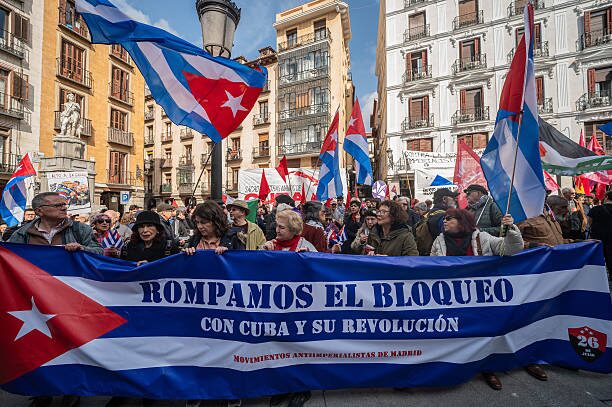
Cubans protest against the US blockade
Cuba famously boasts one of the best healthcare systems in the world, sending volunteer teams of doctors around the world, including Africa. That system is now under severe strain thanks to the US blockade.
Africa’s Voice and Global Standing
Africa can only stand by, seemingly helpless. Angola, one of Africa’s largest oil producers, has stood by Cuba and consistently condemned the US embargo but is limited in what it can do.
It would be the height of naivety and absurdity to expect Africa to stand up to the might of the USA and break the chokehold on Cuba. And diplomatic and political support can normally lead to a change of course—except, it seems, when it comes from Africa.
When an entire continent’s voice can be so easily dismissed by the rest of the world, that continent must surely question its standing in the world. If Africa takes that lesson to heart through its suffering now, Cuba will once again have contributed to the advance of Africa.
