



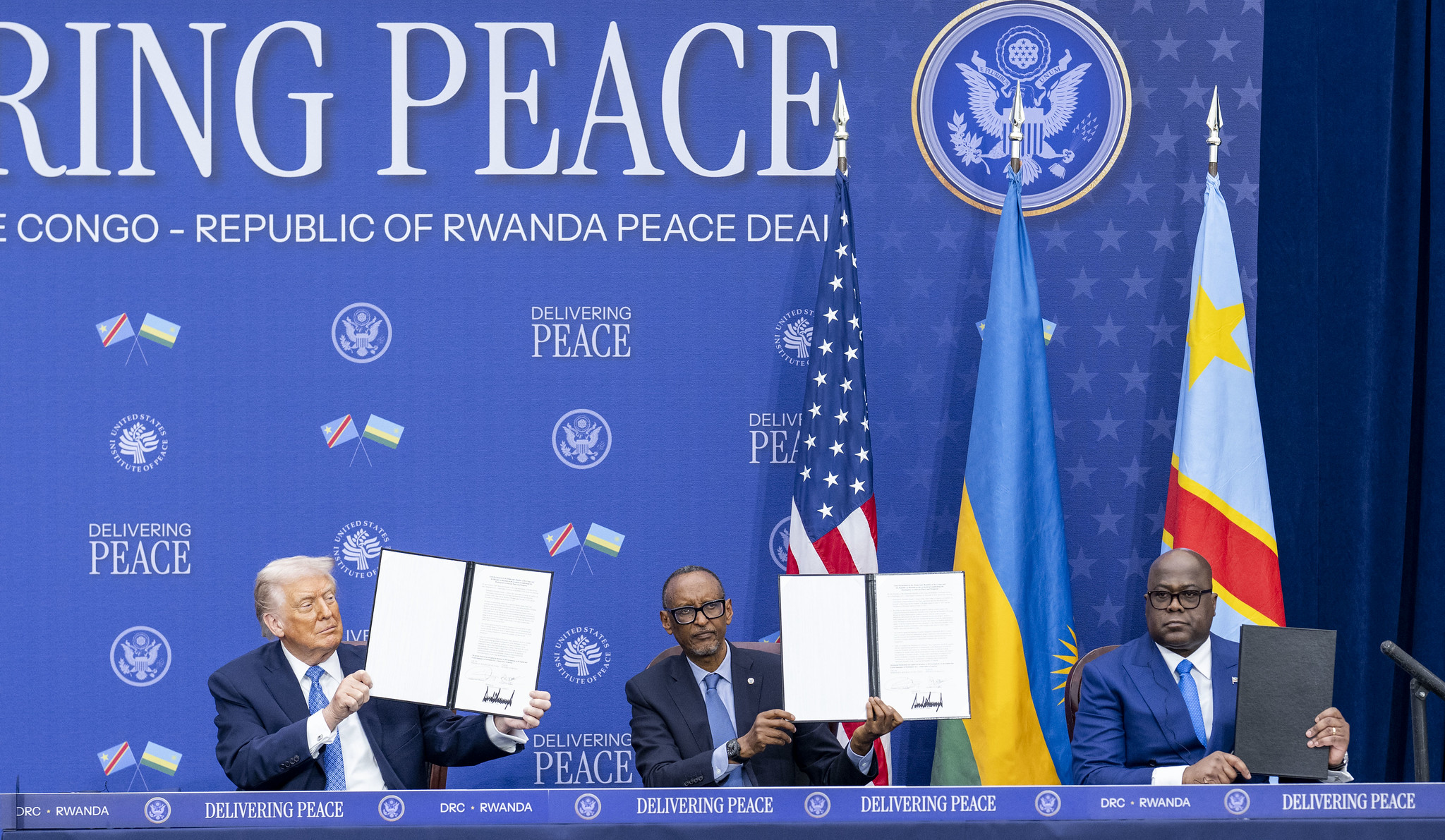
Dec 4, 2025: U.S. President Donald Trump, President Kagame and DRC’s Félix Tshisekedi display the Washington Accords documents after signing. But clearly Tshisekedi didn’t even bother opening it for the cameras.
On December 4, 2025, the cameras in Washington captured what diplomats usually work hardest to hide: discomfort, distance and disdain.
At the ceremony where Rwanda and the Democratic Republic of Congo signed what was presented as a major peace accord, Félix Tshisekedi did not look like a leader arriving at a breakthrough. He looked like a man carrying a grievance.
Months later, that mood no longer seems accidental.
The images from that day now read less like random body language and more like political evidence.
At the time, the visual story seemed incomplete but unmistakable. Tshisekedi sat heavily, stern-faced and unsmiling, as if participating in an obligation rather than a resolution. Even the way he held the signed document stood out. While Paul Kagame and Donald Trump raised theirs in a clear, outward-facing gesture meant to signal closure and commitment, Tshisekedi appeared detached — almost reluctant, almost irritated, as though the ceremony itself was something to be endured rather than embraced.
And it was not only in the final photographs.
There were also the small but telling gestures that often reveal more than official speeches ever can. At one point, Tshisekedi reportedly declined to pass draft documents directly to Kagame, despite the two men sitting side by side, instead calling over a White House protocol official to do it for him. It was a small act, almost juvenile in diplomatic terms, but politically revealing. It suggested not merely coldness, but a deliberate performance of distance.
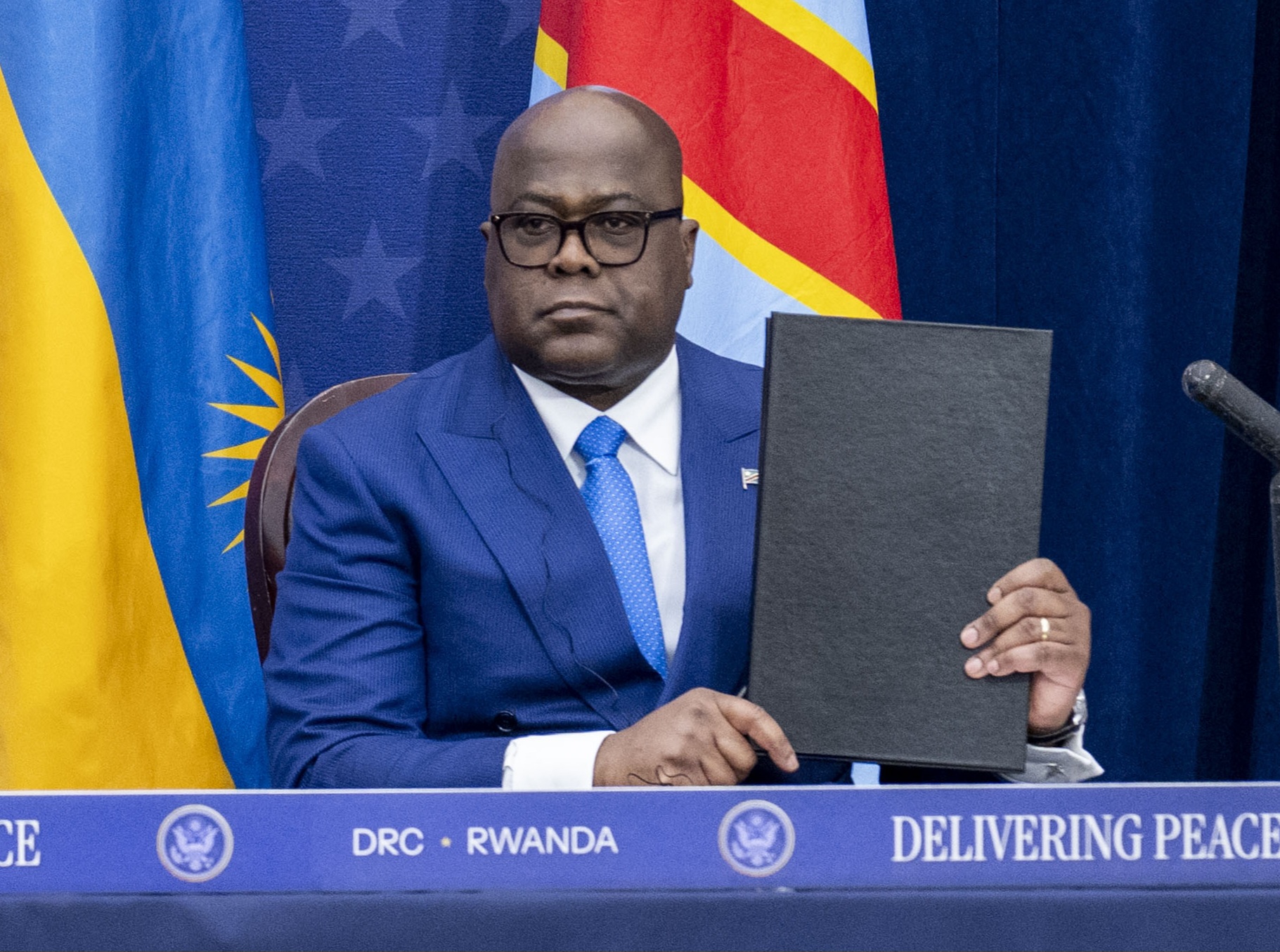
Now, courtesy of French magazine Jeune Afrique’s later reconstruction of what happened that day, the mood around Tshisekedi’s posture is easier to understand.
According to the magazine’s account, before the signing ceremony itself, there had already been an awkward encounter earlier at the White House. Tshisekedi had reportedly arrived first and taken the middle of a couch where the two leaders were expected to sit. When Kagame entered and greeted him in English — “Hello, Mr. President, how are you?” — Tshisekedi is said to have remained seated, extending his hand while looking downward, without making eye contact. Kagame, according to the account, remained standing after declining a chair offered by his foreign minister.
That detail matters.
Because it suggests that by the time the two men later appeared publicly at the peace-signing event, the tension had not just been brewing — it had already become visible behind closed doors.
And that, in turn, helps explain why Tshisekedi appeared less like a peacemaker than a man visibly annoyed to be there at all.
What Washington seems to have forced upon him that day was not simply a diplomatic appearance. It was a political contradiction.
For years, Tshisekedi has built much of his domestic political posture around confrontation with Rwanda. Kigali has not only functioned as a foreign policy rival, but also as a useful political instrument — a convenient external enemy onto whom eastern Congo’s failures, frustrations and insecurities could be projected. In that script, Tshisekedi is not just a president handling a regional crisis; he is cast as a nationalist defender standing firm against Rwanda.
That narrative has served him well in domestic politics. It rallies emotion. It simplifies a deeply complex war. And it gives Kinshasa a powerful public relations frame: whatever goes wrong in the east can always be placed, at least partly, at Rwanda’s door.
But diplomacy requires a different grammar than campaign politics.
It requires compromise, sequencing, mutual obligations and, above all, the willingness to take politically uncomfortable decisions. That is where Tshisekedi’s public posture has often looked strongest on symbolism and weakest on substance.
Which is why his gloom in Washington may have reflected something deeper than anger.
It may have reflected discomfort.
Because peace — or even the serious performance of peace — is politically inconvenient for a leader whose public legitimacy has often depended on appearing perpetually wronged and perpetually defiant.
That is the contradiction now laid bare.
Tshisekedi has repeatedly tried to occupy the role of aggrieved victim in the Rwanda-DRC crisis — the besieged leader confronting external aggression. Yet his own political behavior has often suggested something else: a man who wants the emotional and diplomatic benefits of grievance, while resisting the harder responsibilities that come with resolving conflict.
That is why the optics in Washington matter.
He appeared to be performing for two audiences at once. In the room, he had to sign what the Americans wanted sold as a peace framework. But back home, he still needed to look hard, wounded, unbending — still needed to signal to Congolese audiences that he had not softened, had not compromised, had not “gone easy” on Rwanda.
So he acted out resistance in the only way still available to him in that moment: through posture, coldness and visible displeasure.
That is not diplomacy. That is political theatre.
And theatre has too often replaced statecraft in the handling of eastern Congo.
The crisis in the east is far too old, too bloody and too regionally entangled to be managed through emotional posturing. It requires difficult decisions from Kinshasa — especially on the issues it has repeatedly preferred to dramatize rather than solve: the treatment of Congolese Tutsis, the unresolved political dimensions of the M23/AFC rebellion, the long-standing presence and usefulness of the FDLR, and the recurring habit of relying on armed proxies when formal military strategy fails.
These are not easy questions. They are politically costly. They demand leadership, not choreography.
And this is where the broader significance of the Jeune Afrique interview lies.
What emerges from the exchange is not just Kagame’s familiar hard line, but a clearer picture of the broader diplomatic stalemate: one side being pressed to make concessions, while the other still appears to want the symbolism of peace without the political burden of implementing it.
That is why Tshisekedi’s body language now looks less mysterious and more revealing.
He did not look like a triumphant statesman because he was not walking into a triumphant moment. He was walking into a politically uncomfortable one. He was being made to sit through a process that constrained the very political script he has relied on for years.
Because the harder truth for Kinshasa is this: it is easier to dramatize Rwanda than to reform Congo.
Easier to denounce Kigali than to discipline the FARDC.
Easier to rage at M23 than to confront why rebellion in eastern Congo keeps regenerating.
Easier to sell grievance than to solve governance.
That is why Tshisekedi’s mood in Washington now makes sense.
He was not simply angry.
He looked like a leader irritated by the fact that peace, even performative peace, was demanding from him what permanent victimhood never does: seriousness, compromise and accountability.
And perhaps that is what unsettled him most.
Because in the end, what Washington exposed was not just a diplomatic chill between two presidents.
It exposed the discomfort of a leader who has long preferred confrontation as political language — and who, for one very public day, was forced to pretend he was ready for something harder.
Now we know why Tshisekedi was gloomy in Washington.
He was not just attending a peace event.
He was being dragged into a political reality he has spent years resisting.
