



At the Campaign Against Genocide Museum, RPA soldiers did not only battle the genocidal forces but they also undertook risky operations to rescue people. RPA soldiers took care of the wounded; both civilians and combatants
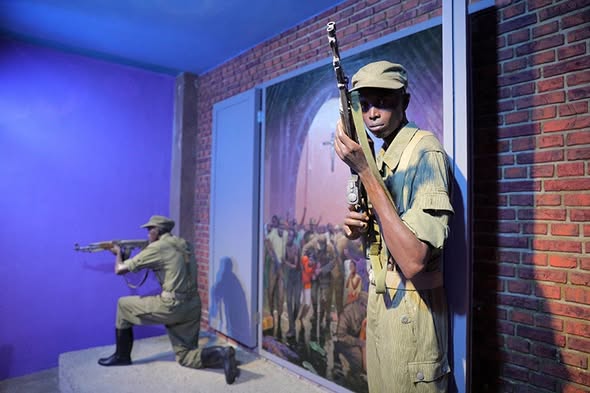
At the Campaign Against Genocide Museum, RPA soldiers did not only battle the genocidal forces but they also undertook risky operations to rescue people. RPA soldiers took care of the wounded; both civilians and combatants
In a deeply reflective moment during his Kwibuka32 address, President Paul Kagame acknowledged one of the most enduring and painful truths of Rwanda’s history: that even as the Rwandan Patriotic Army (RPA) stopped the 1994 Genocide against the Tutsi, it could not do so soon enough to save all those who were killed.
Speaking at the Kigali Genocide Memorial, Kagame described this as a lasting source of grief—not only for those who fought to end the genocide, but for the nation as a whole.
“Our deepest source of grief was always that we could not arrive earlier,” he said.
Kagame emphasized that the RPA, which he was the commander, ultimately brought the genocide to an end, halting the mass killings that had devastated the country over 100 days.
“It had to be the Rwandan Patriotic Army that led the campaign against the genocide and ended it,” he said.
But even in that achievement, he noted, there remains a profound sense of loss—an awareness that more lives could have been saved if intervention had come sooner.
The statement reflects a complex historical reality: while the RPA is widely credited with stopping the genocide, the speed and scale of the killings meant that hundreds of thousands had already perished by the time the advance reached different parts of the country.
For Kagame, this is not a point of pride, but one of enduring sorrow.
A Burden Carried Over Time
Kagame suggested that this regret is not something that fades with time, but rather a burden that continues to shape how Rwanda understands its past—and approaches its future.
“This is a simple truth of history,” he said, noting that it is sometimes overlooked or resisted by those unwilling to fully acknowledge the circumstances under which the genocide ended.
The remark appeared to allude to ongoing debates about the narrative of 1994, particularly among those who question or reinterpret the role of different actors during the genocide.
For Rwanda, Kagame implied, confronting this truth is part of honoring those who were lost.
Time of Collapse
Kagame’s comments also underscored the broader context in which the RPA operated.
As the genocide unfolded, state institutions had collapsed, militias were carrying out coordinated killings across the country, and international intervention was largely absent.
In that environment, the RPA’s advance represented the only effective force capable of stopping the violence.
Yet the scale and speed of the killings meant that even a determined military campaign could not prevent all atrocities.
The regret expressed by Kagame highlights the tragic reality that, in such circumstances, even decisive action can come too late for many.
Shaping Rwanda’s Determination Today
Kagame linked this historical experience to Rwanda’s present-day mindset, particularly its emphasis on acting early and decisively in the face of threats.
The lesson, he suggested, is clear: waiting carries consequences.
The inability to “arrive earlier” in 1994 has reinforced Rwanda’s commitment to ensuring that similar situations are never allowed to unfold again—whether within its borders or in its region.
This perspective helps explain Rwanda’s strong stance on security, prevention, and intervention, themes that ran throughout Kagame’s address.
Honoring the Lives That Could Not Be Saved
While Kwibuka is a time to remember those who were killed, Kagame’s remarks added another layer to that remembrance: acknowledging those who might have been saved under different circumstances.
The statement serves as a reminder that the cost of delay—in action, in recognition, in response—is measured in human lives.
It also reinforces the urgency behind Rwanda’s repeated message of “Never Again.”
Kagame’s reflection was notable for its tone—less defiant than other parts of his speech, and more introspective.
It did not seek to assign blame, but rather to recognize a painful reality and its implications.
In doing so, it added depth to the broader message of Kwibuka32: that remembrance is not only about honoring the past, but also about confronting it honestly, including its most difficult truths.
As Rwanda marks 32 years since the genocide, this acknowledgment stands as both a tribute and a warning—that even those who act to stop violence may carry the weight of what could not be prevented.
And that, perhaps, is why the commitment to act earlier, faster, and more decisively remains so central to Rwanda’s story today.
