



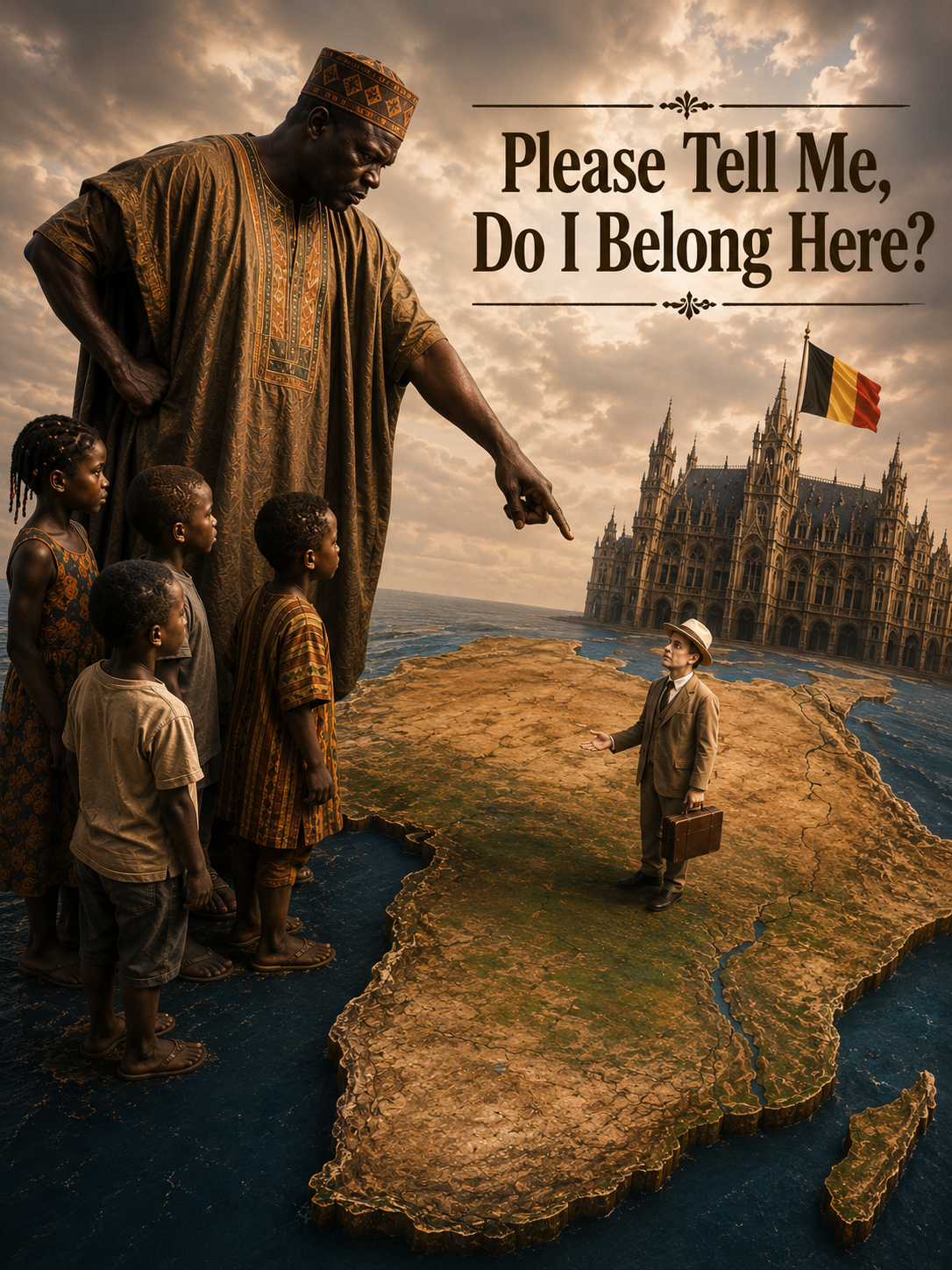
The Africans now confirm whether they are from the continent using a European Record
There is something profoundly disturbing about Africans in the 21st century holding up a Belgian administrative document from 1909 as if it were the final authority on who belongs in Congo.
The issue is not whether the document is authentic. It almost certainly is.
The issue is why, more than six decades after independence, Africans have allowed a colonial administrative list produced in Brussels to become part of the argument over the identity, citizenship and belonging of people who live in Congo today.
That is a much bigger failure than the document itself.
The 1909 document was a colonial administrative inventory. Produced by the Belgian Ministry of Colonies from reports by territorial officials in the Kivu district, it listed ten “indigenous tribes” recorded by colonial administrators at the time.
It was not a constitution.
It was not a citizenship register.
It was not a scientific census of every population living in Kivu.
And it certainly was not a verdict handed down by history determining which communities would forever qualify as Congolese.
It was an administrative document produced by a colonial state that had only recently taken control of the Congo Free State.
Its value today is therefore historical, not judicial.
Yet Africans continue to drag such documents into modern political disputes as though colonial administrators had been appointed by history to settle questions that independent African states have failed to settle for themselves.
That is the real humiliation.
When the colonial archive becomes the court
The tragedy is not that colonial records exist. They are valuable historical sources.
The tragedy is that African political debates so often treat them as the highest court of appeal.
A community appears on a Belgian list, and that becomes evidence of belonging.
A community does not appear, and suddenly its historical presence is questioned.
This is an extraordinary surrender of intellectual authority.
African societies existed before European administrators arrived with notebooks, maps and filing systems. Communities had genealogies, oral traditions, systems of land tenure, political authorities, migration histories and relationships with neighboring societies.
None of those disappeared simply because a Belgian official failed to write a group’s name on a particular piece of paper in 1909.
Nor should the absence of a name from one administrative list be transformed into proof that a population did not exist in the territory.
Colonial administrators were not omniscient. Their surveys were incomplete. Their categories were often inconsistent. They were primarily interested in governing territory, collecting taxes, organizing labor and dealing with chiefs. Mobile pastoral communities were particularly difficult to fit into an administrative system designed around fixed territories and sedentary populations.
The colonial archive is therefore evidence.
It is not revelation.
The deeper failure is African
The more uncomfortable question is why African states have not built institutions capable of answering these questions themselves.
After independence, African governments inherited colonial borders and administrative systems. That was understandable.
What is harder to defend is the failure, decades later, to build credible systems of citizenship, land registration, demographic records and historical scholarship capable of replacing colonial classifications.
The result is predictable.
When citizens dispute belonging, they reach backwards.
They search Belgian archives.
They search missionary records.
They search colonial maps.
They search documents produced by people who ruled them.
And then they fight over what those documents supposedly mean.
That is not simply a colonial legacy.
It is a post-colonial failure.
Congo’s Banyamulenge question illustrates the problem
The controversy surrounding the Banyamulenge demonstrates how dangerous this failure has become.
The historical presence of Kinyarwanda-speaking populations in the territories around the Ruzizi Plain and the highlands of what is today eastern Congo cannot sensibly be reduced to a single document.
Migration in the Great Lakes region occurred over centuries and in different directions. Borders between what are now Rwanda, Burundi and Congo did not exist in their modern form for much of that history.
There were movements of pastoralists, farmers, refugees, traders and political communities.
Oral history passed on from generations after generations confirm that the people we know today as “Banyamulenge” have been living in those high Plateaux mountains of South Kivu from as far back as 1600. Until they settled there, the vast mountain range was uninhabitted, uncultivated and empty. (I will tell more of this story in the next episodes)
There were also later migrations, including those associated with colonial labour policies and the movement of people from Rwanda and Burundi during the upheavals of the 20th century.
The result is a region in which ancestry, language, residence, political allegiance and citizenship cannot always be squeezed neatly into the rigid ethnic boxes created by colonial administration and later political movements.
That complexity should have demanded better African scholarship and better African institutions.
Instead, it has been turned into political ammunition.
“Who was here first?” became a weapon
The question of who arrived first has become one of the most dangerous political instruments in eastern Congo.
It sounds historical.
In practice, it is often about power.
If one group can establish that it was “indigenous” and another was a “migrant,” the argument can be used to determine who has legitimate claims to land, customary authority, political representation and even citizenship.
That is an extraordinarily dangerous principle for Africa.
Almost every African community has a migration story.
Almost every border contains communities whose histories predate the borders themselves.
If citizenship is reduced to an archaeological competition over who can prove that their ancestors arrived first, there is hardly a country on the continent that would emerge unscathed.
The question should therefore not be: Who was here first?
The question should be: Who is a citizen today, and what legal rights does citizenship provide?
That is what functioning states are supposed to determine.
A continent trapped by categories it did not create
There is an even broader irony.
Africans fought colonialism partly to recover political sovereignty.
But in many places, independence did not produce a comparable intellectual liberation.
Colonial ethnic classifications survived.
Colonial borders survived.
Colonial administrative structures survived.
And, in some cases, the political logic behind them survived too.
The colonial administrator classified Africans into tribes.
The post-colonial politician learned that those classifications could be used to mobilize voters, distribute patronage and exclude rivals.
The result is that categories originally created to make Africans easier to govern have sometimes become instruments through which Africans govern — and exclude — one another.
That is the bitter paradox.
The problem is not simply that Europeans once divided Africans.
The problem is that Africans subsequently discovered that the divisions were politically useful and chose to preserve them.
The failure of the African state
This is where the debate ultimately becomes much larger than the Banyamulenge question.
A state that cannot reliably establish who its citizens are will eventually allow identity to become a political weapon.
A state that cannot maintain credible land records will allow ethnicity to become a proxy for land ownership.
A state that cannot produce trusted demographic data will allow politicians to manufacture competing versions of history.
A state that cannot protect equal citizenship will encourage communities to seek security through ethnic solidarity.
And a state that cannot produce its own credible historical scholarship will eventually find its citizens fighting over interpretations of colonial paperwork.
This is not Brussels’ failure anymore.
It is Africa’s.
The continent has had generations since independence to build institutions capable of recording citizenship, documenting land ownership, preserving archives, conducting serious historical research and settling disputes through law.
Too often, political elites have found it easier to exploit uncertainty than to resolve it.
The Banyamulenge should not need Brussels to validate their existence
The answer is not to replace one colonial document with another.
Nor should the answer be to accept every historical claim made by every community without scrutiny.
Historical claims should be investigated rigorously, using colonial archives alongside oral histories, archaeology, linguistics, demographic evidence, genealogy and other sources.
But the final question in a modern state should not be decided by which ethnic group can produce the oldest piece of paper.
Citizenship should be governed by law.
Land rights should be governed by law.
Political representation should be governed by law.
And historical disputes should be investigated by credible African institutions rather than settled through political propaganda.
The Banyamulenge question is therefore not merely a dispute over a Belgian document from 1909.
It is a mirror.
And what it reflects is uncomfortable.
It reflects a continent that won political independence but has often failed to complete the harder work of institutional and intellectual independence.
It reflects states that inherited colonial categories and, instead of dismantling their political power, sometimes turned them against their own citizens.
And it reflects the extraordinary situation in which Africans, generations after independence, can still point to a Belgian official’s handwriting and ask:
Who belongs here?
The most damning part is that Brussels no longer needs to answer.
Africans should have built institutions capable of answering that question themselves.
