



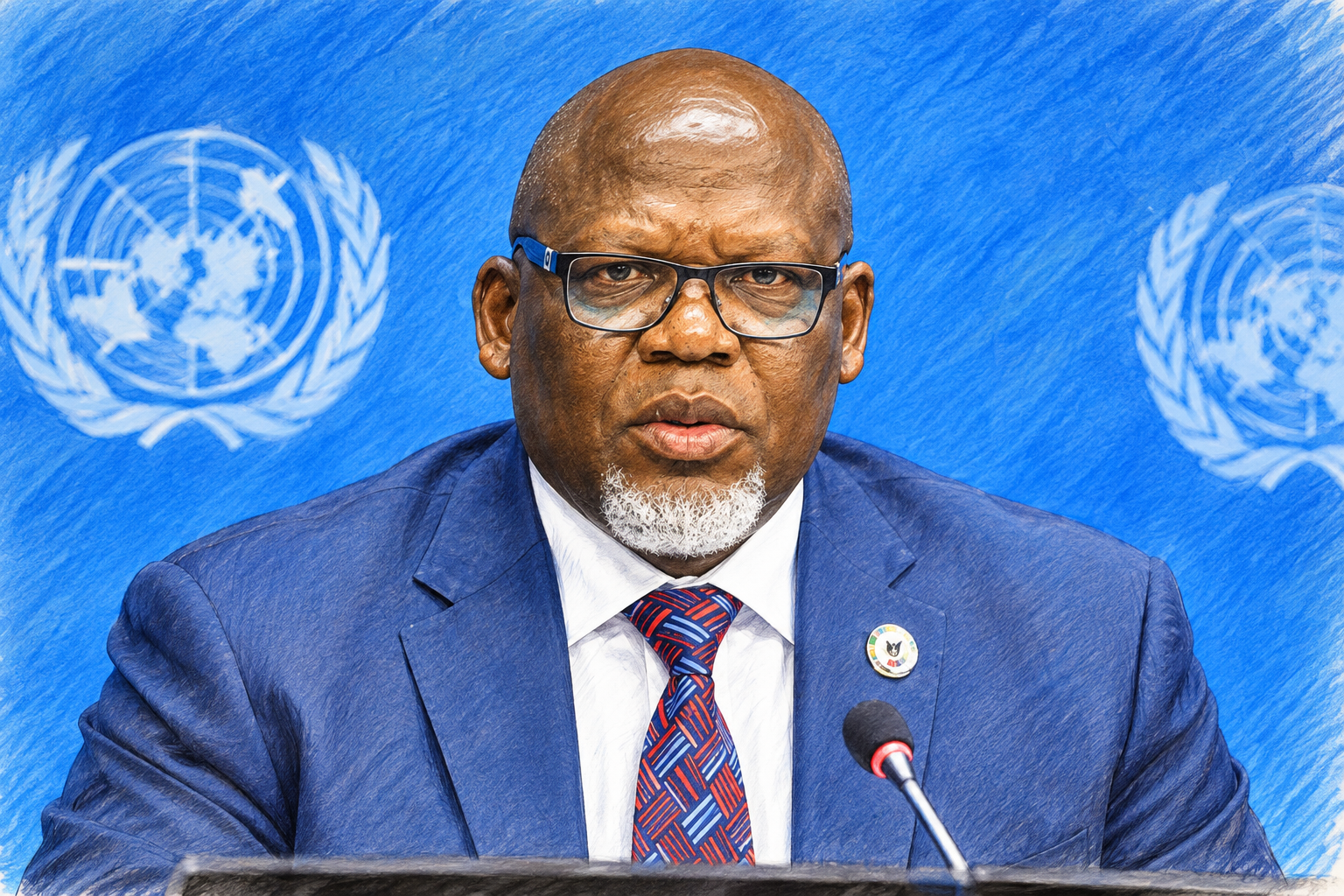
The Congolese diplomat representing FDLR genocidal militia at the UN
A disturbing statement by the Democratic Republic of the Congo’s Permanent Representative to the United Nations, Ambassador Zénon Mukongo Ngay, has once again exposed Kinshasa’s dangerous narrative about Rwanda’s history and its support for the FDLR.
Speaking before the United Nations Security Council, Ambassador Mukongo described the FDLR as “Hutu who were in power before 1994 and fled Rwanda after the Tutsi came to power.”
Yet in presenting this account, he conspicuously failed to mention the defining event of that period: the 1994 Genocide Against the Tutsi. That omission is significant in several respects.
By portraying those genocidaires who fled Rwanda after 1994 primarily as people who had simply lost political power, Kinshasa effectively turns the historical facts upside down. The genocide disappears, while the forces responsible for it are presented as victims of political persecution. This framing echoes a central element of the FDLR’s own political narrative.
The United Nations has extensively documented the 1994 Genocide Against the Tutsi. More than one million people were killed. The International Criminal Tribunal for Rwanda subsequently prosecuted individuals responsible for the genocide and other serious crimes. The FDLR cannot simply be separated from this history.
The United Nations Security Council has repeatedly documented the presence of individuals linked to the 1994 genocide within the FDLR and has treated the organization as an armed group whose activities pose a threat to peace and security in the region. Yet Kinshasa continues to portray the FDLR essentially as a constituency seeking political participation in Rwanda.
This should be unacceptable rhetoric in the chambers of the United Nations. Yet it appears to be tolerated when it comes from the DRC. Has the UN Security Council become a platform for genocide denial and the rehabilitation of perpetrators?
The similarities between Kinshasa’s narrative and the FDLR’s political messaging are increasingly difficult to ignore. The FDLR has historically sought to portray Rwanda’s post-1994 political order as illegitimate and to cast perpetrators as victims.
When a senior Congolese diplomat repeats essentially the same framing before the United Nations while omitting the genocide against the Tutsi, Kinshasa is effectively giving diplomatic legitimacy to a narrative that has long been associated with the FDLR. There should be no ambiguity when genocide ideology is involved.
If the DRC government is prepared to advance such a narrative before the United Nations, it inevitably raises concerns about what this political framing means for Congolese Tutsi communities living in areas such as Minembwe and Masisi, where Banyamulenge and Congolese Tutsi more broadly are the targets of ethnic cleansing.
If such rhetoric can be expressed openly in the Security Council, what happens to vulnerable communities far from the international spotlight? This is why historical revisionism cannot simply be dismissed as ordinary diplomatic rhetoric.
Ambassador Mukongo’s intervention was not merely an unfortunate choice of words. It fits into a broader political environment in which Kinshasa maintains its alliance with a genocidal militia while portraying Rwanda as the principal source of instability in the region. And frankly, the ambassador’s presentation did little to inspire confidence. His visibly unpolished appearance, including his apparent difficulty even buttoning his suit properly, became an unfortunate visual metaphor for the quality of the representation he delivered: a poorly presented narrative built around a profoundly distorted account of history.
But beyond appearances lies something far more serious. History is repeating itself in the DRC. Former UN adviser on genocide prevention Alice Wairimu Nderitu warned about this. The denial of the Genocide Against the Tutsi in Rwanda, combined with the alliance between perpetrators of yesterday and those of today, is further evidence that, if the international community fails to act, the principle of “Never Again” risks being trampled once more.
