



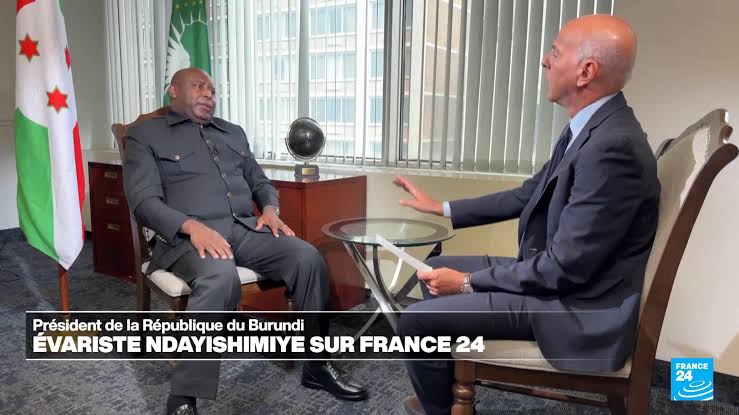
Burundi President Evariste Ndayishimiye appearing on French broadcaster France 24
On the sidelines of the UN General Assembly, Burundian President Évariste Ndayishimiye sat down with France 24 and portrayed himself as a victim of Rwandan aggression, a man simply asking for restraint. While the interview was polished and the tone measured, the substance was, in its essential architecture, a lie.
Ndayishimiye has been running an influence operation, and that day, France 24 was its vehicle. His goal is simple: bury the context of his own aggression, rewrite the timeline of the conflict, and convince the world that Rwanda is the threat while Burundi is merely collateral damage.
To understand what Ndayishimiye is doing now, one must remember what he said in January 2024. Standing in Kinshasa at an event held under his role as African Union Champion for Youth, Peace and Security, Ndayishimiye presented himself as a liberator.
He told a crowd of Congolese youth that Rwandan youth were “prisoners” in their own country. He pledged his active support for Rwandan youth seeking to topple the government in Kigali. The speech was delivered weeks after Félix Tshisekedi had promised to seek parliamentary approval for an invasion of Rwanda. This context, which Ndayishimiye wants everyone to forget, matters a lot.
At that moment, Burundian troops were already deployed in North Kivu. They were positioned alongside the Congolese army, SADC troops, European mercenaries, the FDLR, a sanctioned genocidal militia, and Wazalendo militias. Back then, Ndayishimiye was not pleading for peace. He was positioning himself as a co-belligerent in a war whose stated objective was regime change in Kigali. Burundian troops were deployed in and around Goma, a city that sits directly on Rwanda’s border. They were not there to defend Burundi.
The interview on France 24 would have viewers believe that Ndayishimiye’s concerns about Rwanda are defensive, born of a sudden fear of aggression. But clearly, both the timeline and the geography tell a different story.
It was only after Goma and Bukavu fell that Ndayishimiye suddenly discovered the vocabulary of victimhood. The defeat of the forces he had joined transformed him, rhetorically, from an aggressor into a target. This was a complete inversion of roles, executed precisely when the military reality turned against him.
Ndayishimiye’s most audacious claim is that Burundian forces have no relationship with the FDLR. He acknowledges the group’s presence in Congolese territory. He simply insists that wherever Burundian troops operate, the FDLR is absent. This is a logical impossibility, and the United Nations has said so.
The UN Group of Experts has documented persistent collaboration between FARDC units and the FDLR, including co-location and joint operations. Burundian forces are embedded within the FARDC-led coalition. The idea that they are somehow operating in a hermetically sealed zone free of FDLR presence, while fighting alongside the same FARDC units that the UN says are co-located with the FDLR, is a fairytale.
Ndayishimiye also wants the world to believe that Rwanda has harbored a long-standing plan to attack Burundi, and that the current tensions stem from Kigali’s alleged support for a group linked to the 2015 coup attempt against his predecessor. But this narrative collapses under the weight of recent history.
Burundi and Rwanda had normalized relations. Borders were reopened in 2022. Ndayishimiye himself benefited from Rwandan intelligence cooperation in surviving a coup attempt by his own prime minister, Alain Guillaume Bunyoni. Burundian troops deployed to Goma as part of the East African Community Regional Force, transiting through Rwanda to get there. All of this happened while the issue of the coup plotters was ostensibly unresolved.
Obviously, the coup plotters were never Ndayishimiye’s priority. They are a convenient retroactive justification, dusted off only after his own decision to join the war against Rwanda backfired.
Perhaps the most telling moment in the France 24 interview came when Ndayishimiye outlined his vision for peace. The only path forward, he suggested, was the lifting of Rwanda’s defensive measures and the cantonment of the M23. This is not a peace proposal. It is a demand for surrender.
The M23 now controls territory larger than Burundi itself, and Rwanda’s defensive measures address a threat that remains active, supported by two states and armed to destabilize the country. To suggest that the only acceptable outcome is for M23 to lay down its arms and canton itself, while Rwanda lays down its guard, while Burundian troops and the FDLR remain in the field, is a call for the continuation of the war.
SADC troops have withdrawn from the conflict to give peace a chance. Only Burundi refuses to de-escalate. The intractability of Ndayishimiye’s position is itself evidence of his intentions.
The France 24 appearance was an influence operation. The world should not be fooled. Ndayishimiye made his choice in Kinshasa in January 2024. He chose to align himself with a coalition whose objective was the overthrow of the Rwandan government. He chose to fight alongside the FDLR. He chose war.
Now, having suffered military setbacks, he wants to be seen as a victim. The mask is thin. And the only question that remains is whether France 24’s viewers will look past the performance to the facts beneath it.
