



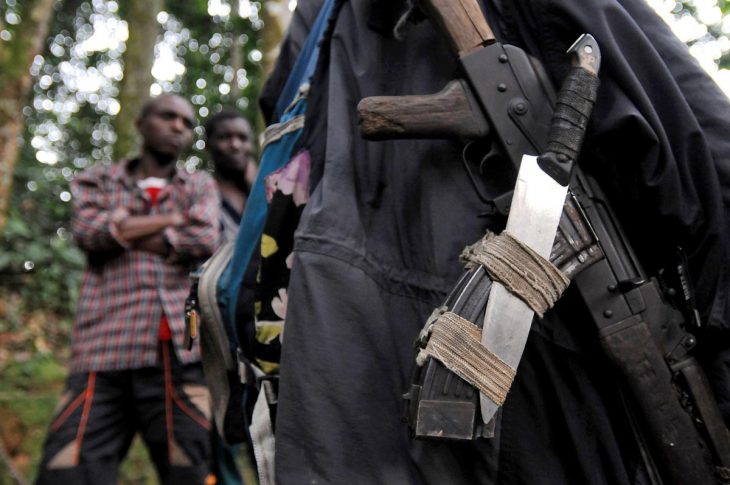
FDLR combatants in their forest hideout in eastern Congo
In a stark illustration of the contradictory narratives fueling the ongoing conflict in eastern Democratic Republic of Congo (DRC), the Democratic Forces for the Liberation of Rwanda (FDLR) – a group frequently downplayed by Kinshasa as a diminished or exaggerated threat – issued a strongly worded press communiqué on December 17, 2025, warning of impending “destabilization” and accusing Rwanda of orchestrating false-flag attacks.
This episode underscores the profound inconsistencies in Kinshasa’s position on the FDLR, which President Félix Tshisekedi and DRC officials have repeatedly portrayed as a weakened, residual force engaged primarily in banditry—posing no real threat to Rwanda and serving merely as a “pretext” for Kigali’s alleged aggression and support for the M23 rebels.
Despite formal commitments under the U.S.-brokered Washington Peace Agreement signed in June 2025 to neutralize the FDLR through disarmament and repatriation, progress has been minimal, with reports indicating continued collaboration between elements of the Congolese armed forces (FARDC) and the militia, including joint operations against AFC-M23.
Disarmament Commitments Versus Reality on the Ground
Moreover, the FDLR’s December 17 statement directly contradicts Kinshasa’s claims of advancing disarmament and sensitization efforts to encourage the group’s surrender and repatriation.
For instance, in October 2025, the FARDC issued a communiqué explicitly calling on FDLR fighters to disarm and surrender unconditionally to Congolese authorities or MONUSCO, framing this as a key step in the peace process.
This was followed by joint U.S.-facilitated statements in November 2025 acknowledging DRC’s “information operations” – essentially sensitization campaigns – conducted to raise awareness in accessible communities and urge FDLR members to lay down arms as part of Phase One of the neutralization plan.
UN Reports and the Question of Compliance
UN reports from December 2025 further highlight MONUSCO’s ongoing support for voluntary disarmament, demobilization, and repatriation (DDR) of FDLR elements, including small-scale repatriations of ex-combatants throughout the year.
Yet, the FDLR’s communiqué reveals no such compliance; instead, it portrays the group as a cohesive entity still operating from bases like Rutshuru, rejecting any implication of surrender by reiterating their attachment to “inter-Rwandan inclusive and pacific dialogue” and demanding transparency in MONUSCO transit centers to prevent escalation.
Sensitization Efforts and Alleged FARDC-FDLR Alliances
This defiance not only undermines DRC’s narrative of progress but also exposes the ineffectiveness of sensitization activities, as the FDLR accuses Rwanda of manipulating defectors for false-flag operations rather than engaging in voluntary disarmament.
Critics argue this resistance stems from Kinshasa’s own inconsistencies, such as alleged FARDC-FDLR alliances that provide the group with operational space, making genuine neutralization challenging without dismantling broader militia coalitions like Wazalendo.
Diplomatic Commitments Versus Militia Activity
In essence, while Kinshasa promotes these efforts diplomatically – including through the Joint Security Coordination Mechanism’s meetings in October and November 2025 that reaffirmed commitments to the Concept of Operations (CONOPS) for FDLR neutralization – the militia’s active propaganda and refusal to demobilize highlight a stark gap between rhetoric and reality, further stalling peace implementation.
Kinshasa’s actions have consistently undermined the peace process, stalling implementation of the agreement’s core provisions.
While the deal required DRC to take concrete steps toward eradicating the FDLR threat—starting with voluntary measures and sensitization—the group remains active, integrated in some areas, and capable of issuing defiant statements rejecting surrender.
UN and independent reports highlight FARDC’s reliance on FDLR fighters in battles against M23, even as DRC officials deny state-level support and accuse Rwanda of fabricating the threat to justify territorial ambitions and resource exploitation.
Escalatory Rhetoric and Regional Stability
Further eroding trust, Tshisekedi has engaged in belligerent rhetoric that directly threatens regional stability. On multiple occasions throughout 2024 and 2025, the DRC president has publicly vowed to invade Rwanda or orchestrate regime change in Kigali, including threats to “march on Kigali,” bomb the capital, or declare war if re-elected and provocations continue.
In interviews and rallies, he has compared Rwandan President Paul Kagame to Adolf Hitler, promised to seek parliamentary authorization for military action at the “slightest skirmish,” and insisted that Rwanda’s concerns over the FDLR are a false justification for aggression.
A Widening Gap Between Rhetoric and Reality
Such inflammatory statements, coupled with Kinshasa’s failure to dismantle alliances with the militia, have fueled accusations that DRC is not committed to genuine peace but rather to militarized confrontation.
These inconsistencies—downplaying the FDLR while relying on it operationally, signing peace accords while issuing invasion threats—have stalled diplomatic efforts, prolonged civilian suffering in eastern DRC, and heightened the risk of broader regional escalation.
As the FDLR continues to operate and propagandize from Congolese soil, Kinshasa’s narrative of a “nonexistent” threat rings increasingly hollow, raising serious questions about its sincerity in pursuing lasting stability in the Great Lakes region.

2 comments
That is explaining how Rwanda Government is stragglering with, many times accused whle RDC considered right
Trump and the entire international community should knows the realty
Comments are closed.