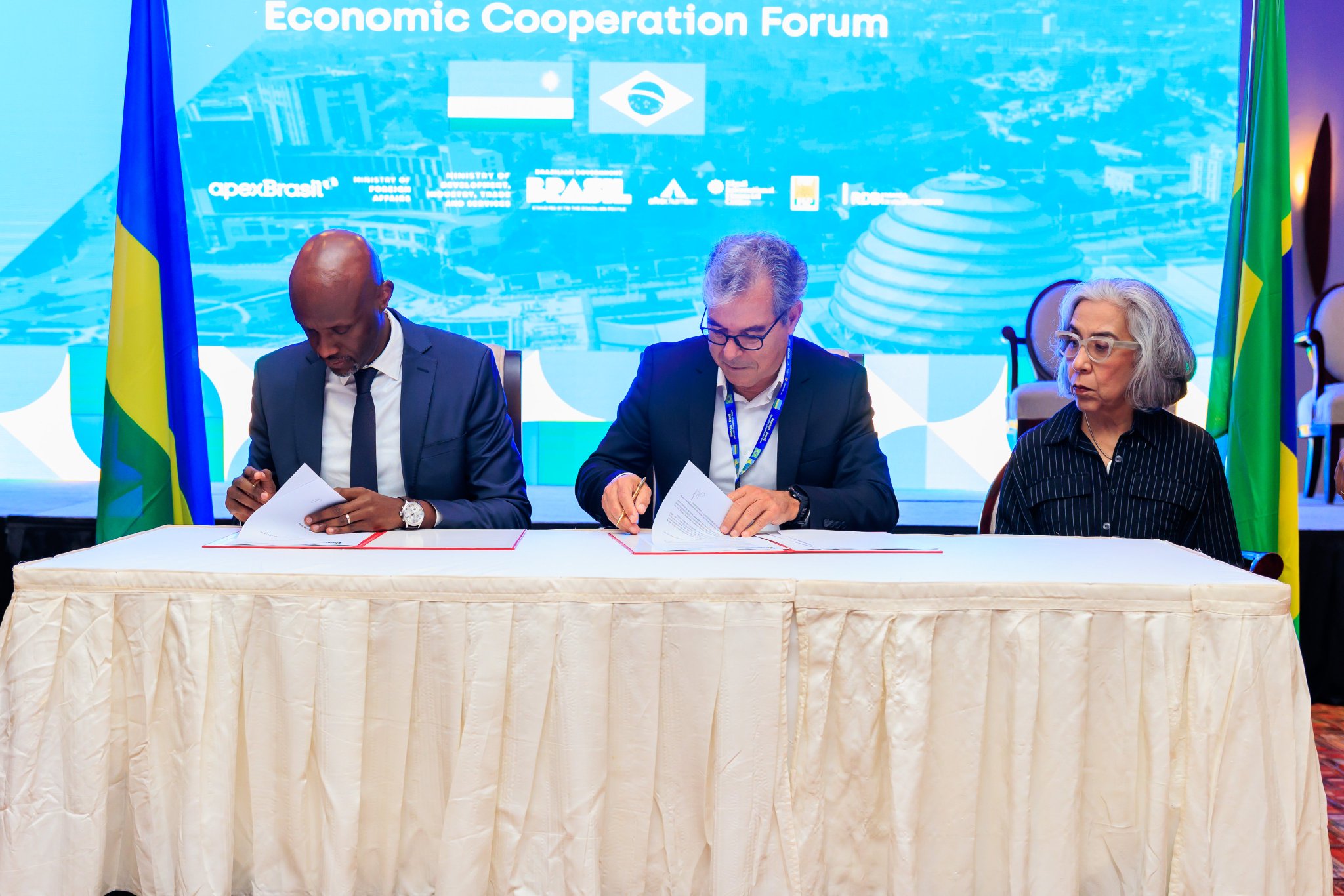
Brazil’s deepening engagement with Rwanda is not simply an act of diplomatic goodwill, but a calculated strategic shift shaped by economics, geography and timing, as the South American nation recalibrates its approach to Africa amid changing global trade dynamics and the growing search for reliable, rules-based partners.
As global trade patterns continue to fragment and emerging economies search for dependable markets and production bases, Brazil is adjusting how it engages with the African continent.
Rather than dispersing its efforts across multiple markets, Brazil is anchoring its strategy in Rwanda — a country that has quietly built the institutional credibility increasingly demanded by international investors.
“There is a reason for this. The Government of Brazil looked and decided that this is where we need to be,” Brazil’s Ambassador to Rwanda, Vida Gala, said on Wednesday, after the signing of agreements aimed at strengthening economic cooperation between the two countries.
Her remarks reflect a deliberate shift, with Rwanda offering predictability in a region that is often viewed through the lens of risk rather than opportunity.
Over the past three decades, Rwanda has positioned itself as a rules-based economy, where policy consistency and regulatory clarity help reduce uncertainty for foreign capital.
For Brazil — whose companies are strong in long-term, capital-intensive sectors such as agribusiness, manufacturing, renewable energy and large-scale infrastructure — such an environment is critical.
The cooperation framework signed between the Rwanda Development Board (RDB) and Brazil’s Export and Investment Promotion Agency (ApexBrasil) signals a move away from transactional diplomacy towards structured economic engagement.
The focus is not simply on increasing trade volumes, but on facilitating investment flows, coordinated business missions and partnerships in priority sectors.
RDB Chief Executive Officer Jean-Guy Afrika described the approach as one driven by mutual value rather than incentives alone.
Rwanda’s attractiveness, he said, lies in the speed and transparency of its investment processes, backed by a legal framework designed to curb corruption and accelerate decision-making.
“This forum was organised to connect businesses, identify viable projects and create investment pathways that generate real value for both economies,” Afrika said.
While Brazil brings industrial depth and technological capacity, Rwanda offers a stable gateway into East and Central Africa. As regional integration advances and consumer markets expand, Kigali’s role as an entry point for investors is becoming increasingly difficult to ignore.
At the same time, ApexBrasil’s decision to formalise cooperation with Rwanda’s Private Sector Federation is intended to shorten the distance between policy and production.
Through this partnership, access to Brazilian expertise could accelerate domestic value addition in agriculture, strengthen food-processing industries, and support growth in healthcare and manufacturing.
These sectors are central to Rwanda’s ambition to transition from a service-led economy to one anchored in productive capacity.
Less than a year after Brazil opened its embassy in Kigali, the relationship is already evolving into a more substantive and consequential economic partnership.
Beyond Brazil, Rwanda has signed similar economic and investment cooperation frameworks with several partners, including China, Türkiye, the United Arab Emirates, South Korea, the United Kingdom and the European Union.
Collectively, these agreements reflect Kigali’s wider strategy to position itself as a predictable investment and trade hub linking global firms to regional markets.
In international trade terms, this growing network of partnerships strengthens Rwanda’s integration into global value chains, supports export diversification and enhances the country’s ability to leverage the African Continental Free Trade Area as a gateway to the broader East and Central African region.