


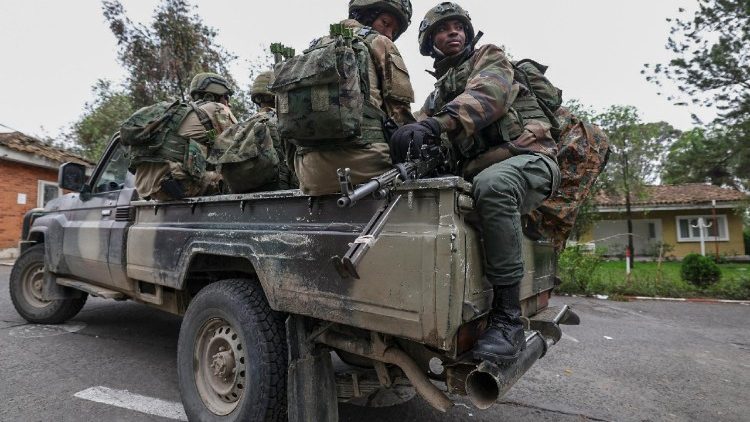
The AFC/M23 say they will withdraw from some of their positions, including the town of Walikale, to allow the peace process to proceed. (Net photo)
The fragile path toward peace between the Democratic Republic of Congo (DRC) and Rwanda has come under renewed scrutiny this week, as U.S. Congressman Chris Smith called for swift and full implementation of the Washington Accords, warning that recent violence in the region underscores the urgency for all parties to honour their commitments.
Signed by DRC President Félix Tshisekedi and Rwandan President Paul Kagame in December 2025, the Washington Accords established a formal framework for cooperation and dialogue aimed at ending decades of conflict that have claimed millions of lives and destabilised the Great Lakes region.
Speaking this week at a House Foreign Affairs Subcommittee on Africa hearing titled “Advancing Peace in DRC and Rwanda through President Trump’s Washington Accords — Part II,” Smith described the agreement as a historic breakthrough.
“My engagement in supporting peace between Rwanda and DRC spans more than three decades,” Smith said, recalling his work dating back to the 1994 Genocide against the Tutsi. He described the Washington Accords as a “skillfully and brilliantly brokered peace deal” that signals a new chapter for the Great Lakes region.
Smith said bringing both governments to the negotiating table under a single, unified framework was historic and unprecedented in the context of the long-running conflict. He added that the significance of the Accords lies not only in their symbolism, but also in the economic and security dividends they promise for the DRC, Rwanda and international partners.
“The economic and security benefits they will unleash are extraordinary,” he said, stressing that implementation is essential for the millions affected by prolonged violence. He recalled nearly six million victims of the conflict, describing the human toll as “staggering and intolerable.”
Smith said recent violent incidents in the region highlight the continued threat posed by spoilers seeking to derail the peace process.
“We cannot allow the progress we have made to be hijacked by those who profit from chaos,” he warned, underscoring the need for sustained oversight and political will.
The Washington Accords provide for a Regional Economic Integration Framework requiring both governments to pursue structured cooperation in infrastructure development, energy connectivity, tourism and shared management of natural resources. The agreement also includes a four-phase “concept of operations” to guide security and political implementation.
Smith said lasting peace depends on the DRC fully dismantling the FDLR militia in line with an agreed, synchronised timetable. The FDLR, formed by elements linked to perpetrators of the 1994 Genocide against the Tutsi, remains Rwanda’s principal security concern.
He added that expectations also extend to M23, which must demobilise fighters under its control, stressing that accountability must apply across the spectrum.
Beyond state commitments, the hearing highlighted the central role of civil society in sustaining peace. Smith praised the National Episcopal Conference of Congo and the Church of Christ in Congo for stepping in when political processes faltered.
He cited their mediation of the 2016 Saint-Sylvestre Agreement and the 2025 Social Pact for Peace as examples of faith-based leadership that helped prevent state collapse and mitigate humanitarian crises.
“Durable peace cannot be built by governments alone. Inclusive dialogue involving religious leaders, political actors and civil society movements is essential to national cohesion,” Smith said.
He confirmed meeting church leaders ahead of the hearing and expressed hope that an inclusive national dialogue, supported by African Union leadership and Angolan President João Lourenço, would begin soon.
The stakes extend beyond policy frameworks, encompassing the credibility of international mediation, the protection of vulnerable communities and the prospect of finally ending one of Africa’s longest-running conflicts.