



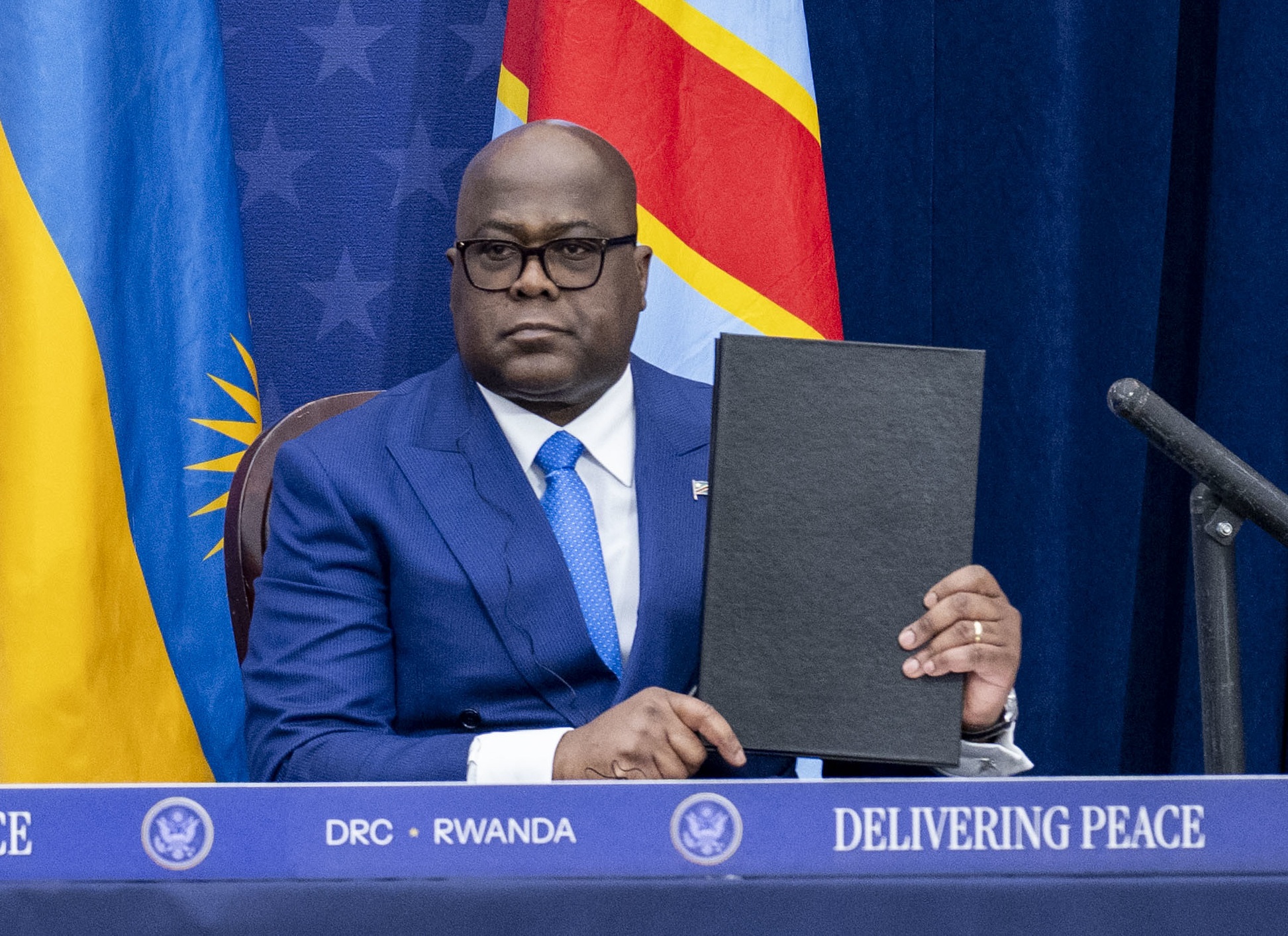
At the signing of the Washington Accord, President Tshisekedi awkwardly forgot to open the Accord document along with President Trump and Kagame
President Félix Tshisekedi has finally agreed to a ceasefire in eastern Democratic Republic of Congo, raising cautious hopes for peace—but also fresh questions about whether the commitment will truly hold on the ground.
In an statement released Friday, the government of the Democratic Republic of the Congo confirmed that Tshisekedi accepted the principle of a ceasefire following his latest diplomatic engagement in Angola, where talks were facilitated by Angolan President João Lourenço.
Kinshasa praised Lourenço’s mediation efforts, describing Angola as a consistent partner in seeking lasting peace and stability across the Great Lakes region.
According to the communiqué, Tshisekedi agreed to the ceasefire “in a spirit of responsibility, calm, and the search for a peaceful solution to the conflict.” The move is framed as part of a broader regional effort to end months of fighting that have displaced civilians and deepened insecurity in eastern Congo.
Conditions Attached
The ceasefire falls under a monitoring and verification mechanism signed on October 14, 2025 in Doha between Kinshasa and the AFC-M23 movement.
Authorities say the framework is designed to ensure a real, controlled, and lasting halt to hostilities.
Under the agreement: All military positions must be frozen immediately; Any reinforcement of troops is prohibited; Rotation or offensive resupply of forces must stop; No party is allowed to change the status quo on the ground; and Civilians must be protected, and international humanitarian law respected.
Tshisekedi has said that any unilateral attempt to strengthen military positions during the ceasefire period would seriously undermine the credibility of the process and weaken prospects for peace.
Bombing Campaign
Yet even as Kinshasa speaks of peace, reports from South Kivu point to an ongoing aerial bombing campaign that local sources say is hitting civilian areas, particularly those inhabited by the Banyamulenge.
Community leaders allege that Congolese forces, operating alongside Burundian troops and reportedly with the involvement of Rwandan-linked militias, have carried out air and ground operations around Banyamulenge strongholds, including the Minembwe highlands.
While authorities frame the strikes as counter-insurgency measures, critics argue they amount to collective punishment, displacing civilians, restricting humanitarian access, and deepening fears of targeted ethnic violence—developments that sharply contradict the spirit of the newly announced ceasefire.
Skepticism Remains
While the latest Tshisekedi announcement marks a significant diplomatic step, many observers and international forums remain skeptical.
Previous ceasefire commitments in eastern Congo have repeatedly collapsed, often amid accusations of hidden troop movements, Kinshasa’s continued support to Rwandan FDLR militia, and renewed clashes.
For communities caught in the conflict, the question now is simple but heavy with history: after finally accepting a ceasefire, will Tshisekedi keep his promise—or will this become another fragile agreement lost to renewed fighting?
