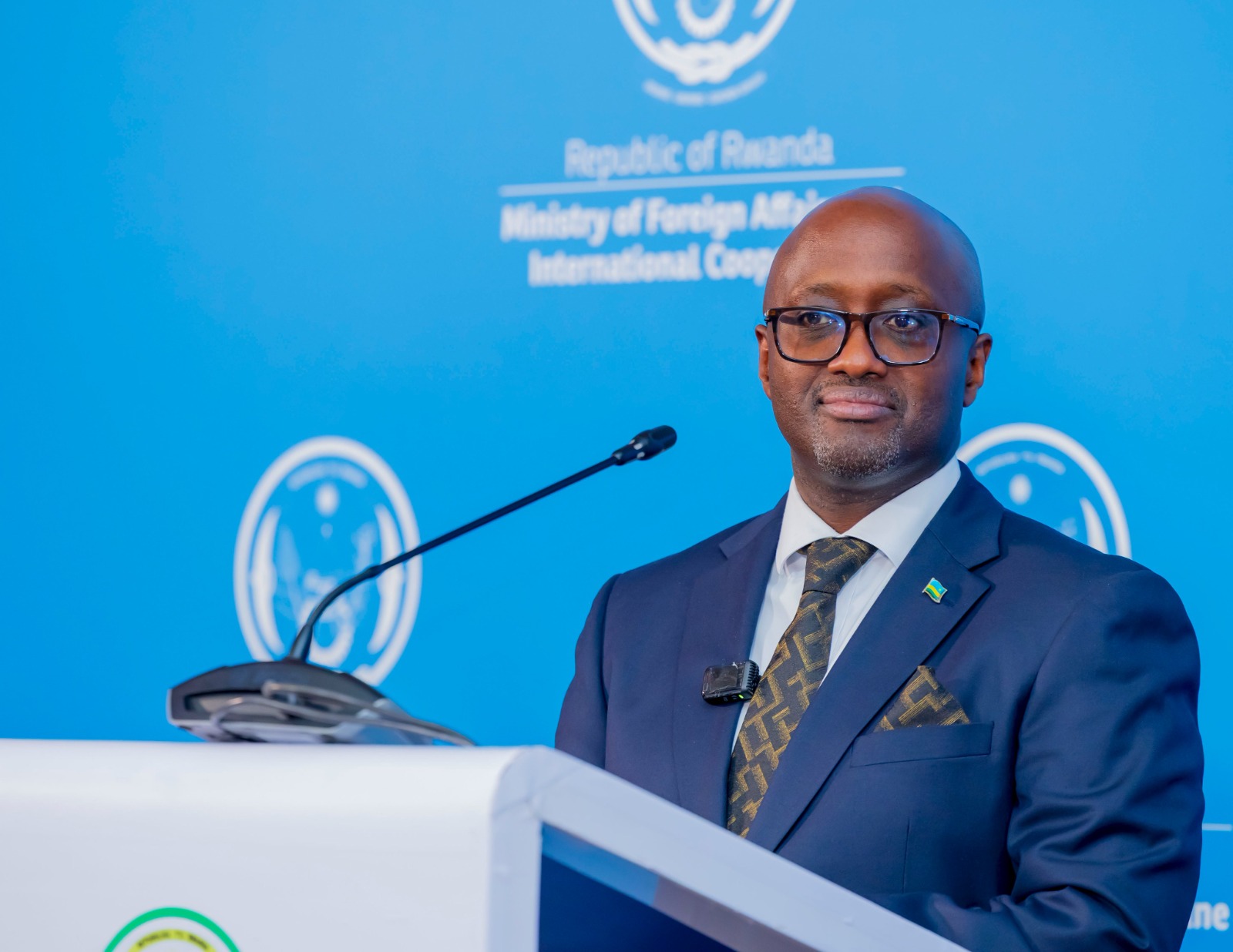
Foreign Affairs Minister Olivier Nduhungirehe addresses reporters on Thursday. He says the newly appointed chair of the African Union, Burundi’s President Évariste Ndayishimiye, may not be impartial due to Burundi’s military presence in Eastern Congo, particularly in South Kivu.
KIGALI — Rwanda on Thursday cast doubt on Burundi’s ability to serve as a neutral broker in efforts to resolve the conflict in eastern Democratic Republic of Congo, even as the European Union pressed regional leaders to prioritize a political settlement to stem a deepening humanitarian crisis.
Speaking at a joint press conference in Kigali with **Hadja Lahbib**, the European Commissioner for Preparedness and Crisis Management, Rwanda’s Foreign Minister, Olivier Nduhungirehe, questioned whether Burundi could credibly help mediate a conflict in which it is directly involved.
“In this context, it is difficult for Burundi — although it has assumed AU chairmanship — to get involved in the mediation,” Mr. Nduhungirehe said, referring to President Évariste Ndayishimiye, who recently assumed the rotating chair of the African Union.
Rwanda argues that Burundi’s military presence in eastern Congo, particularly in South Kivu, compromises the impartiality required of a continental leader. Burundian forces, Kigali says, are operating alongside Congolese government troops in ways that have aggravated an already dire humanitarian situation.
“We have mediation of Togo mandated by the African Union, with five facilitators,” Mr. Nduhungirehe said, referring to an AU-backed process that includes a Washington agreement aimed at reducing hostilities. “Those facilitators and the mediator should continue their work without the involvement of Burundi, which is a party to this conflict.”
The comments reflect widening strains in the Great Lakes region, where overlapping security arrangements and bilateral rivalries have repeatedly complicated peace initiatives. Past interventions, including those under the East African Community, have struggled to balance national interests with collective mandates.
A Test of Continental Leadership
President Ndayishimiye’s elevation to the AU chairmanship at the bloc’s 39th Ordinary Session in Addis Ababa was greeted with cautious optimism in some quarters, but also skepticism in others.
Dr. Eric Ndushabandi, a Rwandan political analyst, described the appointment as both opportunity and test. “What is inside the country shapes what is outside, and what is outside shapes what is inside,” he said, suggesting that domestic and regional dynamics are inseparable.
Symbolism alone, he warned, would not be sufficient in a region marked by deep security distrust. “With Ndayishimiye at the helm, we will see structured meetings and renewed collaborations. But the real test will be whether he can move beyond narrow alignments and embody a genuinely continental perspective.”
In the Great Lakes region, where armed groups, state forces and foreign troops operate in close proximity, mediation depends heavily on trust.
Analysts note that the AU chairmanship carries moral authority and agenda-setting power, but no direct command over troops on the ground. In such a setting, the distinction between participant and facilitator becomes decisive.
Europe’s Warning
For the European Union, the urgency is humanitarian as much as political.
Ms. Lahbib’s visit to Kigali followed stops in Kinshasa and Bujumbura, part of a regional tour mandated by the EU Foreign Affairs Council to assess the crisis and encourage coordinated action. The conflict in eastern Congo, she said, has already “destroyed millions of lives.”
Families have fled their homes, abandoning livelihoods and communities. Neighboring countries are grappling with an influx of refugees, straining already fragile systems.
“This is a dramatic situation,” Ms. Lahbib said. “Above all, peace is urgent for families who want their children to grow up without fear.”
The European Union, the world’s largest humanitarian donor, has pledged continued assistance — food, water and medical supplies — but officials warn that aid alone cannot reverse the downward spiral.
“Without fast and unhindered access, millions of people could die,” she said, noting that humanitarian workers face increasing danger as violence persists.
She called on all parties to respect ceasefire commitments and uphold international humanitarian law, insisting that relief efforts must be accompanied by political will.
Fragile Ceasefire
Diplomats say sustainable peace will require coherence between diplomatic engagement, security arrangements and humanitarian action. A ceasefire, if implemented, could open space for meaningful negotiations. Without it, mediation efforts risk becoming procedural exercises disconnected from realities on the ground.
For Rwanda, the credibility of the process is paramount. For the European Union, the cost of failure is measured in human lives.
As the African Union’s new chair begins his tenure, the question looming over the region is not only whether the guns can fall silent, but whether the institutions tasked with peacemaking can command the trust necessary to make silence endure.