



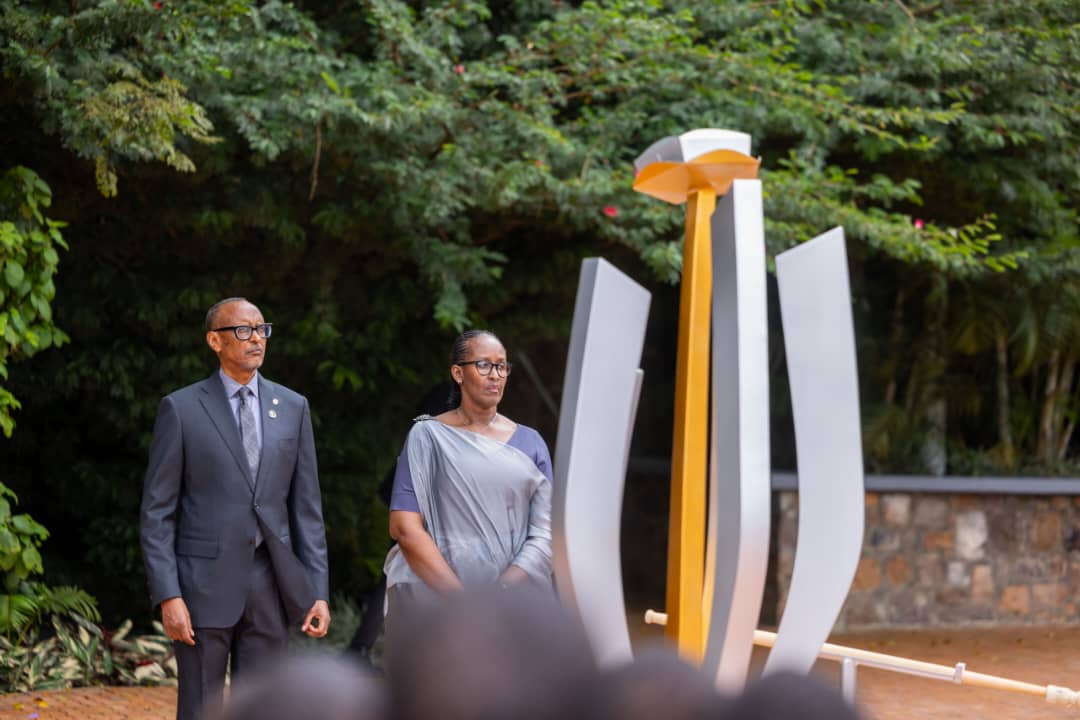
President Kagame and First Lady at the Kigali Genocice Memorial Center this Tuesday as the country begins 100 days on national mourning
KIGALI — President Paul Kagame used his Kwibuka32 address to deliver a forceful defense of historical truth, pointing to what he described as overwhelming and irrefutable evidence documenting the 1994 Genocide against the Tutsi—both within Rwanda and internationally.
Speaking this Tuesday at the Kigali Genocide Memorial, Kagame highlighted the role of the Gacaca courts in recording the genocide in unprecedented detail, calling them one of the most significant truth-telling processes in modern history.
“The Gacaca process documented the cause of the genocide in every single village and neighborhood in Rwanda,” he said, noting that over 50 million handwritten pages were produced over a decade.
Kagame presented Gacaca not just as a justice mechanism, but as a national archive—one built by communities themselves in the aftermath of devastation.
Unlike conventional courts, Gacaca operated at the grassroots level, where survivors, witnesses, and perpetrators testified about what had happened in their communities.
The result, Kagame said, is a body of evidence so vast and detailed that it leaves no room for ambiguity about the nature and scale of the genocide.
“This is the reality of the genocide—clear for all to see,” he said.
He added that the conviction of key perpetrators by international courts further reinforces this record, establishing accountability through rigorous legal processes.
Hard-Won
Beyond Rwanda’s borders, Kagame pointed to a major milestone in international recognition: the 2018 resolution by the United Nations General Assembly, which formally designated the events of 1994 as the “Genocide against the Tutsi.”
According to Kagame, the resolution was supported by every UN member state except one—a near-unanimous acknowledgment of historical truth.
“In 2018, the United Nations adopted a resolution that called the genocide by its proper name,” he said.
For Rwanda, this recognition marked a significant step in correcting decades of ambiguity and denial in how the genocide was described internationally.
Kagame stressed that naming matters—not only for historical accuracy, but for justice and prevention.
Denial
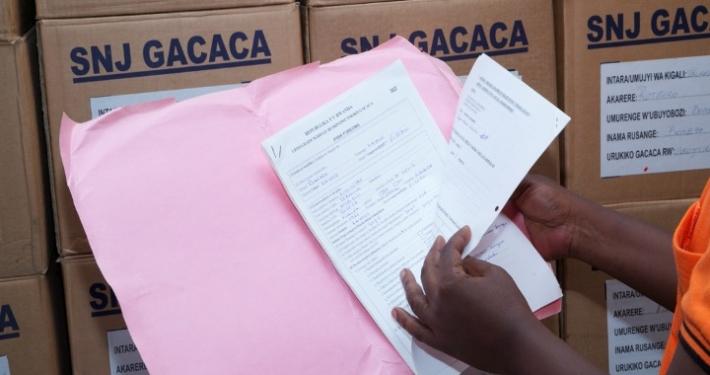
These include huge volumes of video recordings of genocide testimonies, written requests to the court, and written decisions among other material
Despite this extensive documentation and global recognition, Kagame warned that efforts to distort or deny the genocide continue.
“The truth is undeniable, and yet we still find people sowing doubt and twisting the facts,” he said.
He rejected the notion that such distortions are simply the result of ignorance, arguing instead that they often stem from political motives.
“This is not just a matter of ignorance, but something much deeper,” Kagame said, without elaborating on specific actors but clearly signaling concern about ongoing revisionism.
According to Kagame, genocide denial is not harmless—it is a dangerous precursor that can recreate the conditions for future violence.
Why Truth Matters
Kagame framed the defense of historical truth as central to Rwanda’s long-term stability and security.
He warned that minimizing or misrepresenting the genocide risks eroding the lessons learned from it, making societies more vulnerable to repeating past mistakes.
“It means that the risk of seeing history repeat itself is a constant danger,” he said, emphasizing that indifference to truth can be as dangerous as denial itself.
In this context, Gacaca’s 50 million pages are more than historical records—they are a safeguard against forgetting.
They represent, Kagame suggested, a collective commitment by Rwandans to confront their past honestly, however painful, and to ensure that future generations inherit an accurate account of what happened.
A Continuing Responsibility
Kagame’s remarks made clear that the work of defending truth is ongoing.
Even with extensive documentation and international recognition, he said, vigilance remains necessary to counter denial, distortion, and attempts to rewrite history.
As Rwanda enters the 100-day commemoration period, Kagame’s message was that Kwibuka is not only about remembrance—it is also about protecting the integrity of that memory.
In a world where narratives can be contested and manipulated, Rwanda’s response, he suggested, is rooted in evidence, testimony, and an unwavering commitment to truth.
And in those 50 million pages, he implied, lies a record that cannot be erased.
