



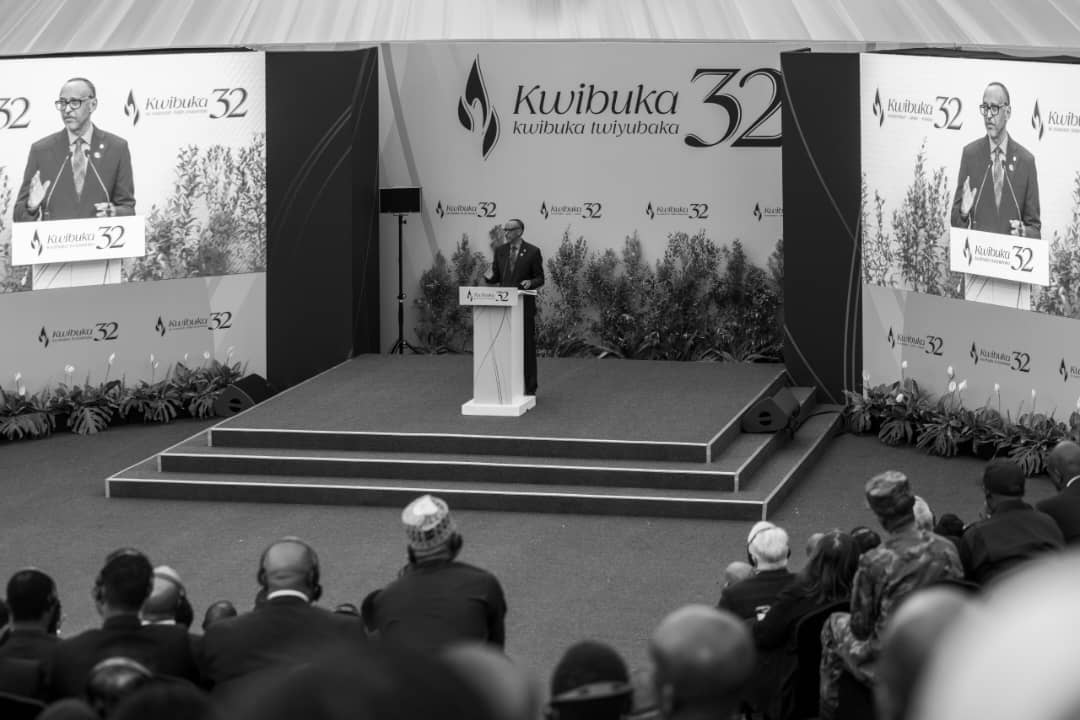
President Kagame speaking today
KIGALI — In a striking and philosophical segment of his Kwibuka32 address, President Paul Kagame turned his focus beyond Rwanda’s borders, issuing a broader warning to Africa and the international community: the greatest danger in the face of hatred and extremism is not always action—but inaction.
Speaking at the Kigali Genocide Memorial, Kagame used a vivid analogy to illustrate how violence spreads when early warning signs are ignored.
“Imagine a farmer whose field catches fire,” Kagame began.
“At first, the flames are small. A few neighbors think it does not concern them. Others say the wind will change and the fire will die out on its own. So they watch and wait.”
But the fire does not stop.
“Meanwhile, a pyromaniac is secretly adding fuel to the fire,” he continued. “So the fire spreads from one field to another and then into the forest and the towns and beyond.”
By the time people react, he said, it is too late—what began as a small, containable problem becomes a widespread catastrophe.
“Only then do people run with buckets of water,” Kagame said, underscoring the futility of delayed responses.
A Lesson
Kagame used the analogy to deliver a pointed critique of what he called “moral passivity,” particularly within Africa.
“Africans, more than most, should understand the danger of moral passivity in the face of hatred and violent extremism,” he said.
Drawing from the continent’s own history—including the 1994 genocide—he argued that the failure to act decisively against early signs of violence has repeatedly led to devastating consequences.
He noted that Africa today accounts for a significant share of the world’s active conflicts, suggesting that the lessons of the past have not always been fully internalized.
Sovereignty and Responsibility
Kagame also addressed the principle of sovereignty, which he described as both necessary and sometimes misused.
“The call for African sovereignty… must also mean that African institutions act decisively when Africans are at risk,” he said.
He warned that sovereignty should not become a shield for inaction or a tool for perpetrators to evade accountability.
“Bad actors must not be allowed to hide behind the principle of sovereignty to evade responsibility for abuses,” Kagame said.
The message was clear: independence must be matched by responsibility, and institutions must be willing to intervene when warning signs emerge.
A Regional Warning
While not naming specific countries, Kagame suggested that the risks Rwanda faced in the past are not confined to history—they are present in the region today.
“Genocide ideology is still spreading in our region,” he warned, adding that if left unchecked, it has the potential to reverse progress and destabilize entire societies.
His remarks reflected ongoing concerns about hate speech, armed groups, and political narratives that can inflame divisions.
Kagame stressed that these issues require collective action, rather than being left to individual countries to address alone.
Rejecting Cynicism and Denial
Kagame also pushed back against critics who question Rwanda’s concerns about security and extremism.
“There are those who claim that Rwanda exaggerates… or that we have ulterior motives,” he said.
He dismissed such claims as not only false, but dangerous—arguing that they reflect the same kind of cynicism that contributed to the failure to prevent the genocide in 1994.
“This is not only false, it exposes the deep cynicism that led to the tragedy we commemorate today,” Kagame said.
At its core, Kagame’s message was a call for early and decisive action against threats, before they escalate beyond control.
The farmer’s burning field, he suggested, is not just an analogy—it is a warning drawn directly from Rwanda’s own experience.
Small signs of hatred, if ignored, can grow into large-scale violence. And waiting for certainty, or for the problem to resolve itself, can be catastrophic.
Never Again Requires Action
As Rwanda begins the 100-day commemoration period, Kagame’s message extended beyond remembrance into responsibility.
Kwibuka, he implied, is not only about reflecting on the past—it is about recognizing patterns in the present and acting before it is too late.
For Africa and the wider world, the lesson is clear: preventing violence requires courage, vigilance, and a willingness to act—even when it is uncomfortable.
Because as Kagame’s analogy makes plain, by the time the fire is visible to everyone, it may already be too late to stop it.
