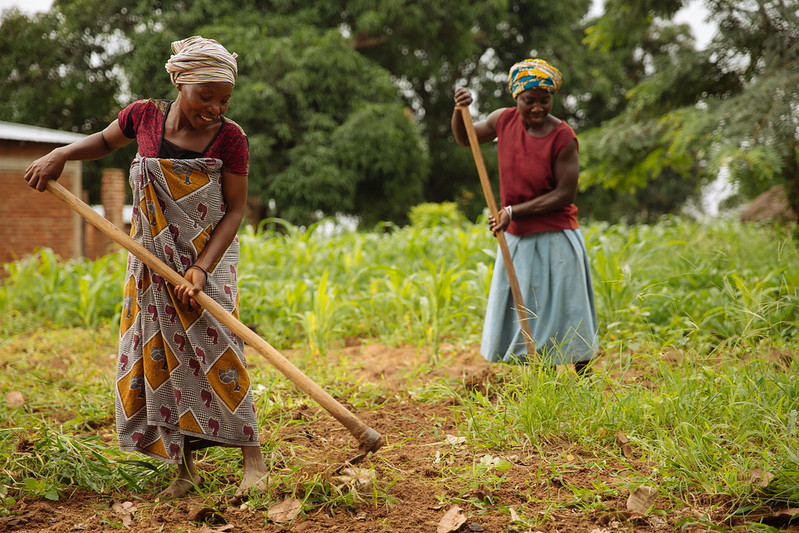
Farmers in Tanzania during routine fieldwork—many rely on voice-based mobile services for access to vital information, highlighting Africa’s digital usage gap. (Internet photo).
TANZANIA — Somewhere outside Kigoma, a farmer picks up a feature phone that cost her less than a sack of maize. She doesn’t tap an app. She doesn’t scroll a feed. She listens. In Kiswahili, a voice walks her through this season’s fertilizer subsidy, the nearest health post’s vaccination hours, and a reminder about a district town hall. When prompted, she presses “1” to register a question. Somewhere in a server in Dar es Salaam, her response joins a dataset that will be read, tomorrow morning, by an NGO analyst.
This is what digital inclusion actually looks like on a continent where, according to recent data, roughly 40% of Africa’s population is online—highlighting both significant progress and a large untapped digital market. It is not the version sold at innovation summits. It is slower, older, quieter, and, for the roughly 960 million Africans still unconnected to mobile internet despite living under network coverage—the “usage gap” documented in GSMA’s Mobile Economy Africa 2025—it is the only version that works.
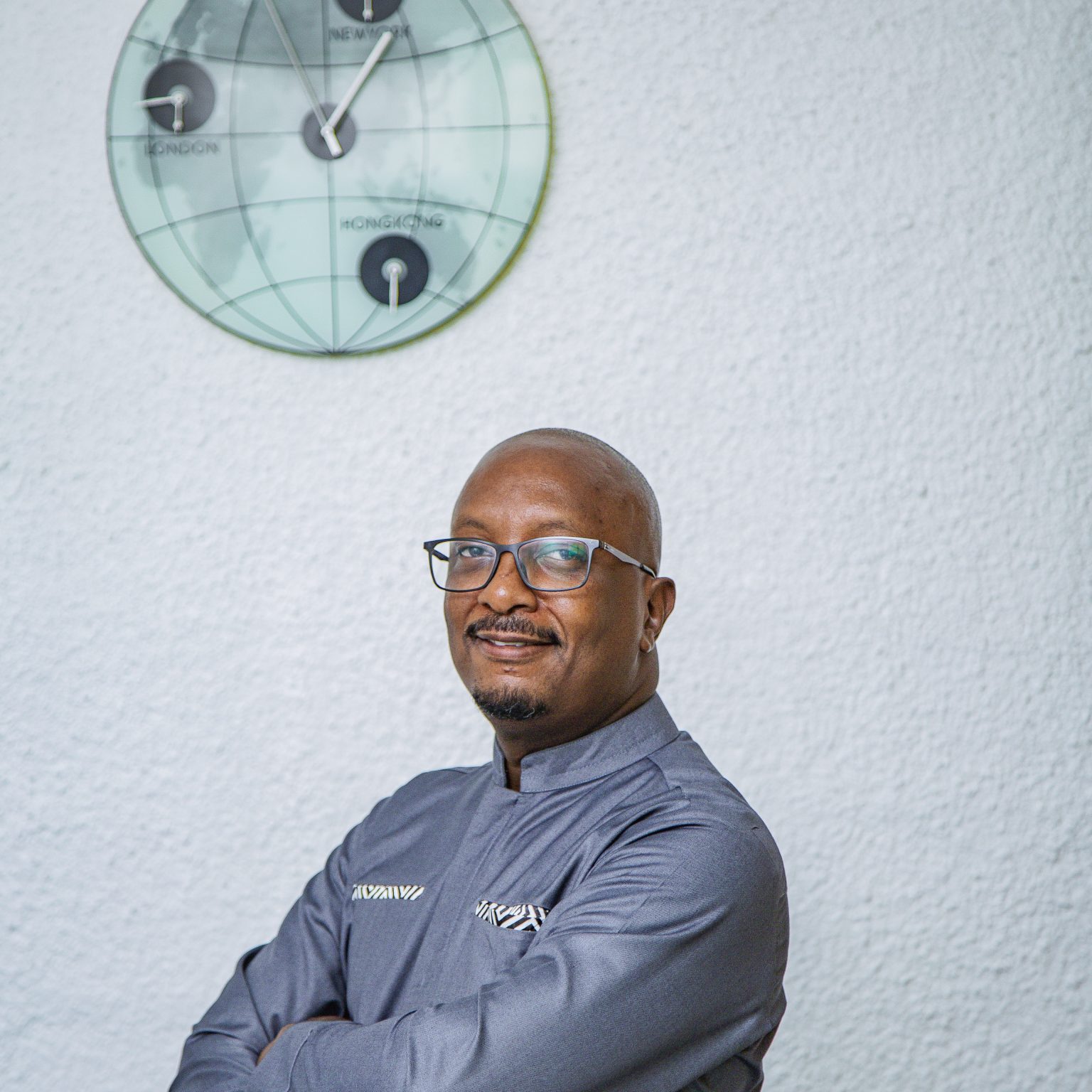
For Victor Nkindi, founder and CEO of Hooza Media, that gap is not a market failure to be lamented. It is the business.
The False Summit of Coverage
Africa’s connectivity story is usually told in two numbers: how many towers, how many subscribers. Both have climbed impressively. Sub-Saharan Africa now has roughly 489 million unique mobile subscribers, a figure GSMA projects will reach 751 million by 2030. Rwanda alone counted 13.3 million active SIM cards at the end of Q2 2025, according to the Rwanda Utilities Regulatory Authority (RURA)—a mobile-cellular penetration of roughly 95.12 percent of the population, among the highest in the East African Community.
But coverage is not connection, and connection is not use.
The ITU’s latest data is unforgiving on this point: in Africa, 14 percent of the population still has no mobile broadband signal at all, rising to 25 percent in rural areas—the largest coverage gap of any region in the world. Where the signal exists, affordability bites. An entry-level 2GB mobile broadband plan costs the median African household 4.2 percent of monthly GNI per capita, more than double the UN Broadband Commission’s affordability threshold of 2 percent. The gap between African and European mobile internet prices, the ITU notes, widened between 2023 and 2024—from a factor of 12 to a factor of 14.
Rwanda is instructive precisely because it is often held up as the exception. The Ministry of ICT and Innovation (MINICT) reports internet penetration at 38 percent as of mid-2025, matching the continental average for the first time. Coverage stands at roughly 96 percent of inhabited areas. And yet: smartphone ownership sits at 34 percent of households, mobile internet usage at roughly 20 percent, and the rural-urban divide is stark—57 percent of urban Rwandans use the internet, against just 19 percent in rural areas.
For the poorest households, a basic smartphone plus 1GB of data can consume up to 60 percent of monthly income.
“The digital revolution, if it is to be transformative, must be measured by who it reaches—not by who has the fastest connection,” Nkindi said.
The Smartphone Bet, and What It Still Leaves Out
Rwanda’s push to close the affordability gap has been bold. In October 2023, Airtel Rwanda, the Ministry of ICT and Innovation, and Reed Hastings unveiled a $16.50 4G smartphone, paired with a subsidized data plan under the ConnectRwanda 2.0 program.
It is a serious intervention. But even the most ambitious device strategy faces three stubborn barriers: literacy, language, and recurring data costs.
A cheap smartphone still assumes a user who can read comfortably, navigate apps, and sustain ongoing data expenses. For many—especially older, rural, and lower-literacy populations—this remains out of reach.
Voice, in this context, is not a fallback. It is the primary channel.
Building for the Phone That Is Actually There
Hooza Media was founded in 2013 on a simple but counterintuitive idea: the most important device in Africa is not the smartphone, but the basic mobile handset.
In Rwanda, basic phone ownership has reached 85–87 percent of households, while mobile internet usage lingers at around 20 percent. That gap is where Hooza operates.
Using interactive voice response (IVR), SMS, and local-language content, the platform delivers information on health, agriculture, elections, and public services—without requiring internet access.
Its reach now spans 17+ African countries and Haiti, positioning it as both a media platform and civic infrastructure.
Rwanda as Proof of Concept
Rwanda’s digital policy environment has made it an ideal testing ground. The ICT Sector Strategic Plan (2024–2029) targets universal internet access by 2030. Digital literacy has reached 75 percent, supported by over 2,000 digital ambassadors nationwide.
Within this ecosystem, voice-first platforms are not substitutes—they are bridges.
“Rwanda is a predictable, innovative environment,” Nkindi said. “What worked here is now scaling across more than 20 countries.”
The AI Question, Answered Sideways
Africa’s AI debate often focuses on infrastructure: more data centers, more compute. But a quieter constraint persists—lack of locally grounded data.
Voice platforms like Hooza generate structured, real-time data from populations often excluded from the digital economy: rural farmers, informal workers, and low-literacy communities.
This includes feedback on vaccination campaigns, agricultural sentiment data, civic participation metrics, and early warning responses in disaster-prone regions.
These datasets may ultimately form the foundation of Africa’s AI ecosystem.
The Entrepreneur’s Contract
Nkindi frames entrepreneurship less as disruption and more as responsibility:
“Success is rigor and resilience, not genius… You are here to build the continent.”
What Bridging Actually Means
The defining statistic remains stark: 64 percent of Africans—around 960 million people—live within network coverage but do not use mobile internet.
They are not a future market. They are a present reality.
Bridging the gap means designing for them now—through tools that match their realities, not assumptions.
Hooza’s model captures this directly: reaching people through the devices they already own, in the languages they already speak.
Because in the end, the measure of digital transformation is not speed.
It is reach.
And it is the voice at the end of the line.
Victor Nkindi is the founder of Hooza Media, a Kigali-based firm delivering “last-mile” voice and mobile content across Africa. Hooza specializes in reaching underserved communities without internet for NGOs, public institutions, and corporations.