



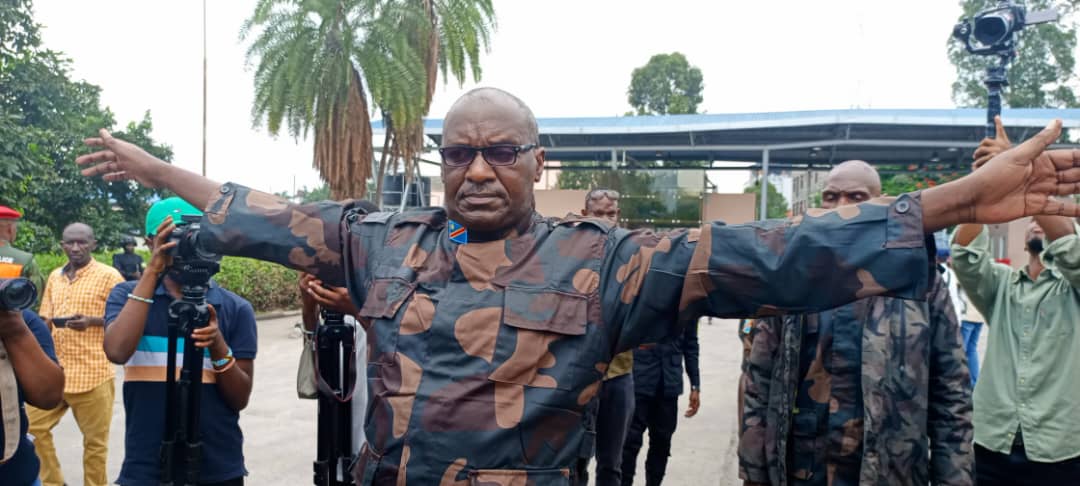
Brigadier General Ezéchiel Gakwerere, a high-ranking leader of the FDLR militia, was captured in Goma, DR Congo by M23 rebels. Many more have since been captured too. How come Tshisekedi’s backers don’t speak about such episodes
During a recent meeting of the RPF Political Bureau, President Paul Kagame made a statement that quickly became the subject of intense debate.
Referring to Kinshasa’s Western backers, he said: “They were saying they’ll make disappear M23; by extension, they were saying even you Rwanda, we will make you disappear.”
To understand the full weight of that statement, it is worth examining the facts that shape Rwanda’s perception of the security threat it faces. Kinshasa’s actions and rhetoric have repeatedly extended far beyond the M23.
In Kigali’s view, Kinshasa’s primary target was never the armed group itself, but Rwanda; and the evidence supports that view.
Consider this. M23 returned to the Congo in 2017, entering from Uganda. When the group established itself in Cyanzu, Rutshuru, Uganda was not subjected to the same level of condemnation that Rwanda has consistently faced. The double standards were evident from the very beginning.
For more than a year and a half into President Félix Tshisekedi’s presidency, M23 was not subjected to military operations.
In fact, before late November 2021, M23 representatives had been welcomed in Kinshasa and housed for months with the Congolese state footing the bill. If Kinshasa’s goal was truly to eliminate the rebellion, why the delay? Why the hospitality?
Even before M23 captured Bunagana, a town that borders Uganda, elements of the FDLR and FARDC were shelling Rwandan territory. When M23 later seized Bunagana, Tchengerero, Rutshuru Centre, and Kiwanja, the FDLR were regrouped along the Rwandan border under the command of the late General Peter Cirimwami, instead of being deployed to counter the rebels. If the objective was solely to confront M23, why was military actions simultaneously directed at Rwanda’s frontier?
To make matters worse, SADC forces deployed heavy weaponry in Goma reportedly oriented toward Rwanda, even though the battlefield was primarily located west and north of the city. And when AFC/M23 launched its offensive on Goma from the west and north through Sake and Nyiragongo, areas not adjacent to Rwanda, FARDC artillery shells still landed in Rubavu and surrounding areas inside Rwanda.
As if to confirm what Kigali had long suspected, regional political rhetoric accompanied these hostile actions all along.
Burundian President Évariste Ndayishimiye publicly told students at the University of Kinshasa (INIKIN) that he wanted to help Rwandans remove their government. Such statements made it clear that the conflict had broader political ambitions than simply defeating an armed movement.
Similarly, during the Congolese presidential campaign, President Tshisekedi repeatedly vowed to confront Rwanda directly, at one point declaring that President Kagame would “never sleep in his own home again.” These remarks shifted the political discourse from confronting M23 to openly targeting Rwanda.
Political alliances further reinforce Rwanda’s concerns. Kinshasa has continued engaging with individuals associated with Rwandan armed terror groups, including the son of former President Juvénal Habyarimana. For Rwanda, such relationships reinforce the belief that Kinshasa’s war of choice has always had one objective: regime change in Kigali.
Clearly, from Kigali’s perspective, these developments form part of a broader pattern. If certain political and military actors ultimately view Rwanda as the strategic target, then confronting M23 becomes, in their eyes, merely a means of advancing that larger objective.
This also explains the continued pressure on Rwanda to lift its defensive measures, despite ongoing security concerns along the border. It is a demand President Kagame has rejected, and for good reason.
When the rhetoric, the military deployments, the alliances, and the diplomatic double standards all point in the same direction, the conclusion becomes unavoidable: the primary target was never M23, rather, it was always Rwanda.
