



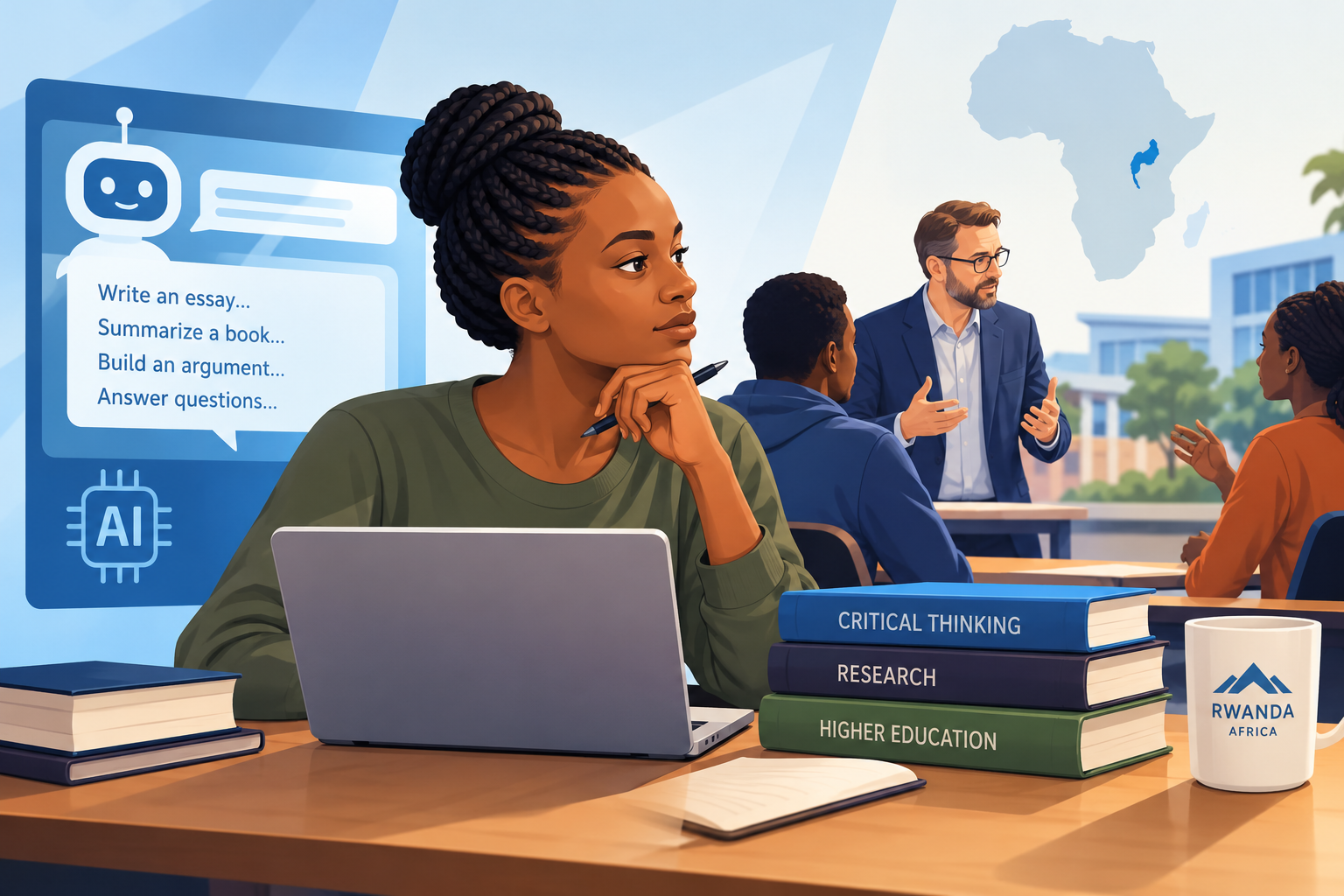
As artificial intelligence changes how knowledge is created and assignments are completed, a collaboration between Polish academic Wojciech Baluch and Rwanda-based Nexus Inc. is exploring a new way to approach university learning and assessment.
Artificial intelligence can write an essay, summarize a book, construct an argument and answer questions that once required hours of research. For university students, these tools offer extraordinary opportunities. For lecturers, however, they raise a difficult question: when a student submits excellent work, how do we know what the student has actually understood?
Simply banning AI is unlikely to resolve this challenge. Nor should universities assume that every student who uses it is cheating. The more important task is to understand how students use AI, whether it helps them learn, and how they can still demonstrate independent thinking.
This is the question Polish academic Wojciech Baluch of Jagiellonian University is exploring through an innovative approach to university examinations. Instead of relying entirely on take-home essays, students prepare with AI and then participate in a structured debate. They discover the position they must defend at the examination and must explain their reasoning, respond to opposing arguments and apply what they have learned in real time.
The idea is straightforward: a student should not only present an answer but also demonstrate an understanding of the ideas behind it.
Baluch has published preliminary research based on an experiment involving 20 humanities students across two university courses. The findings offer an early basis for further investigation into how students combine their own thinking with AI-generated material. The approach is not a final answer to every challenge in education; it is an invitation to study those challenges more carefully.
Why this matters to African universities
For universities across East Africa, the question is particularly timely. Students are already encountering AI in their research, assignments and professional preparation. Yet institutions need better evidence to guide decisions about assessment, academic integrity and responsible AI use.
Could AI help a law student test an argument before defending it? Could a philosophy student learn to challenge an idea rather than simply repeat it? Could lecturers better understand whether students are using AI to deepen their knowledge or merely to complete assignments? These are questions worth investigating, not answering through assumptions.
Through a developing collaboration with Baluch, Nexus Inc., a Rwandan deep technology company working in artificial intelligence, software engineering and digital infrastructure, will contribute the technical expertise needed to support the research. Its role is to help translate the academic approach into practical technology that can support assessment, organise research materials and enable further analysis.
The broader ambition is to explore participation by selected universities in Rwanda, Uganda and Kenya, creating opportunities for research across different educational and cultural settings.
For East Africa, this presents an opportunity not merely to adopt AI tools developed elsewhere, but to help produce evidence about how these technologies affect our own students, institutions and learning environments.
“We should not measure the future of education by how well machines can answer questions, but by how well human beings learn to question, reason and understand.”
“Africa must be part of the research that shapes the future of AI in education, not simply a destination for technologies developed elsewhere.”
The collaboration is still developing, and its value will ultimately depend on rigorous research, university participation and responsible implementation. But its central question deserves attention now: how can education evolve alongside AI without losing the independent thought, human dialogue and intellectual curiosity that make learning meaningful?
The goal should not be to return universities to a world without AI. It should be to prepare students for a world in which AI is everywhere, and ensure that their ability to think remains indispensable.
James Kaliisa is the Co-Founder and Chief Technology Officer of Nexus Inc., a Rwanda-based deep technology company advancing artificial intelligence, software engineering and digital infrastructure.
