



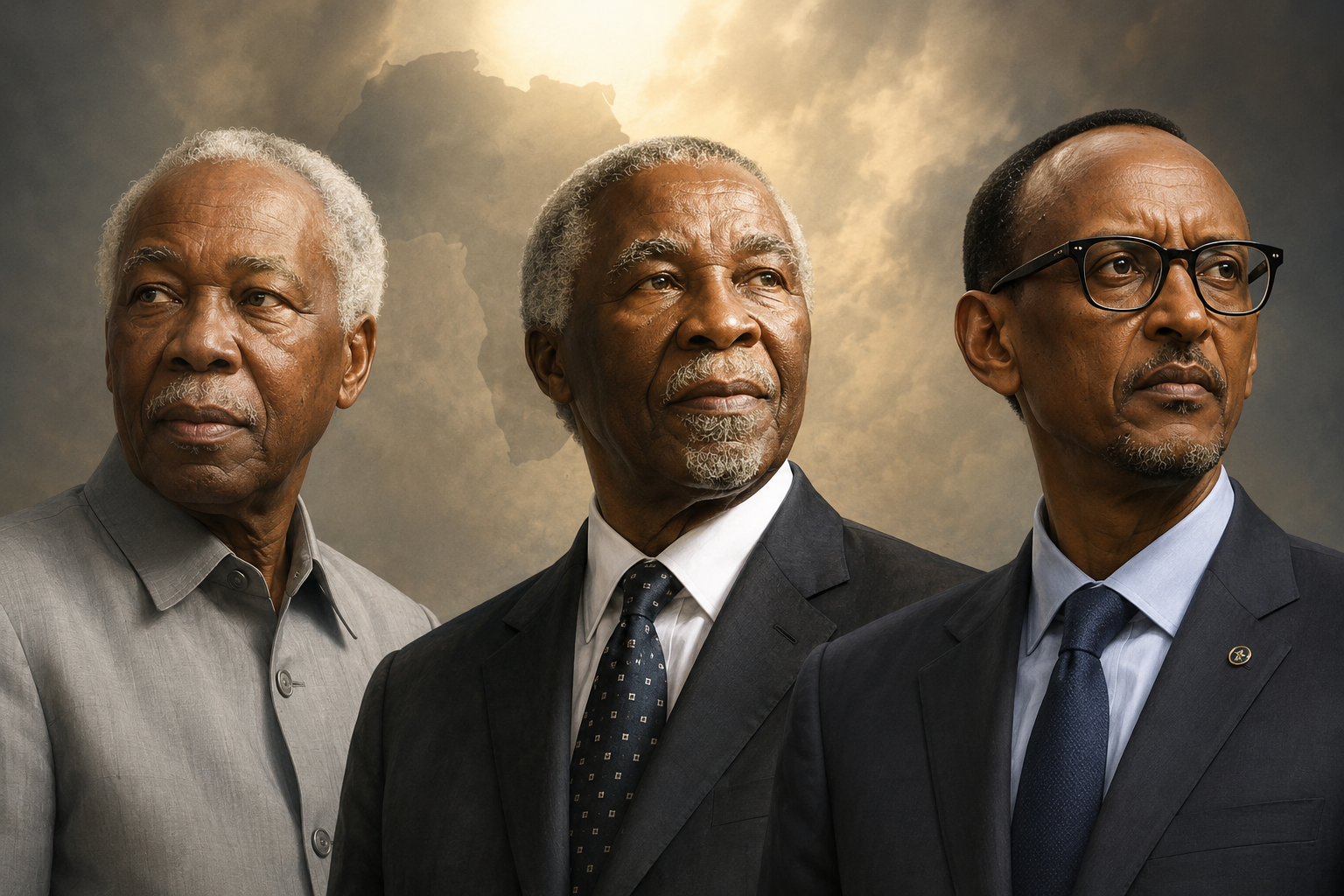
The debate over the identity and citizenship of Congolese Banyarwanda, including the Banyamulenge, is not new. In theory, it was settled decades ago by some of Africa’s most respected statesmen. What remains is the political will to translate that consensus into practice.
In 1996, at a roundtable organised by the International Peace Academy in New York, former Tanzanian President Julius Nyerere addressed the question of the Banyamulenge directly. He blamed the Zairean government for the crisis in the Great Lakes region and made clear that the Banyamulenge had been living in eastern Zaire for centuries, dating back to before the colonial partition of Africa.
“No government has a right to deny them their right of citizenship,” Nyerere said. He added that the Banyamulenge “can’t go back to Rwanda.”
Nyerere drew a powerful comparison with the Maasai, who are spread across Kenya and Tanzania and cannot simply be told to “go home” because of borders imposed during the colonial era.
Thabo Mbeki, the former South African president and principal mediator of the 2002 Pretoria Agreement that brought an end to the Second Congo War, also understood that peace requires addressing the grievances of Congolese Banyarwanda. As a mediator who helped broker peace between the DRC and Rwanda, his position carries particular weight.
“Part of the problem in Congo, from the days of Mobutu, is that they refused to recognize that the Banyamulenge are Congolese,” Mbeki said in March 2024 during a speech he gave at the Thabo Mbeki African School of Public and International Affairs.
The Pretoria Agreement itself recognised the need for inclusive political solutions that recognized Congolese Banyarwanda are citizens of that country. Mbeki’s experience reinforces a simple truth: lasting peace cannot be achieved in the Congo by ignoring the legitimate concerns of any community.
More recently, regional leaders have weighed in. President Yoweri Museveni of Uganda has stated on more than one occasion that M23 has “legitimate grievances” in need of a negotiated political solution. President William Ruto of Kenya has publicly recounted that, during a meeting of African heads of state, they asked President Félix Tshisekedi whether members of M23 were Congolese.
“DR Congo President said they are Congolese. End of question,” Ruto said. He added: “So, if these are Congolese, how does it become a Rwanda problem?”
Ruto’s position, combined with pressure from the East African Community for Kinshasa to negotiate with its own citizens, ultimately led President Tshisekedi to formally request the withdrawal of regional troops that had been deployed to help enforce a ceasefire.
President João Lourenço of Angola, who has mediated the Luanda Process, has likewise drawn on Angola’s own experience, advising Congolese leaders that, just as Angola had to negotiate with UNITA to achieve peace, Kinshasa must do the same with M23.
President Kagame has consistently maintained that the conflict is rooted in Kinshasa’s failure to resolve its own internal problems. He has stated: “Everybody has their own share of this problem, and they should be answerable. Be it DR Congo, be it Burundi, and ourselves. We are not going to be answerable for the doing of others.”
Kagame’s message is clear: his country will no longer tolerate a situation in which Congolese Banyarwanda are uprooted and driven into Rwanda, only for the conflict resulting from their persecution to be blamed on Kigali.
If all regional leaders, with the notable exception of Gitega, which is fighting alongside Kinshasa, are calling for the question of Congolese Banyarwanda to be resolved through negotiations, while Kinshasa continues to resist, is it not time to impose that solution?
The international community has the tools to do so. The East African Community has a standby force that should have no greater purpose than to help prevent the uprooting or attempted extermination of any people in the region on the basis of their ethnic identity.
The United Nations Security Council could adopt a binding resolution compelling Kinshasa to guarantee equal rights to all its citizens. Alternatively, the African Union, the EAC, or SADC could establish a unified framework that leaves no room for Kinshasa to delay or obstruct the return of hundreds of thousands of refugees, many of whom are Congolese Rwandophones.
The pretence that this is still a matter open to debate has long since expired. The principle was settled decades ago. What is needed now is the political will to act on it.
