



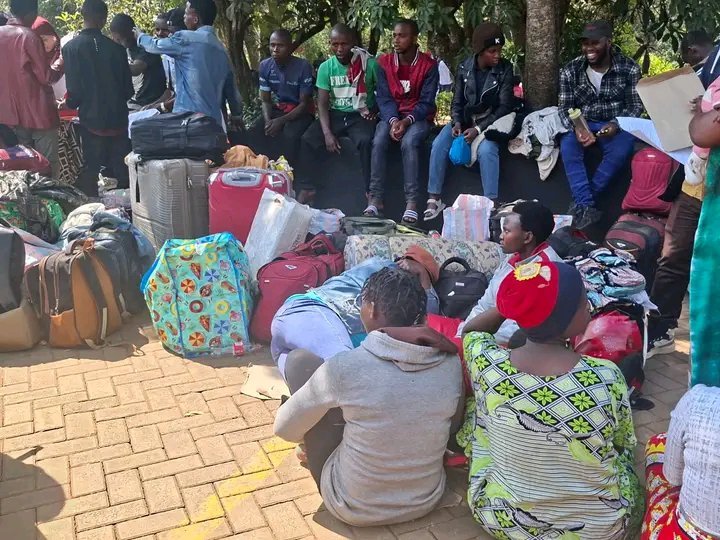
By Tuesday, at least 600 Burundians had left Kenya, according to the embassy in Nairobi
When President William Ruto addressed micro, small and medium-sized enterprise traders and investors at State House in Nairobi on September 2, he was speaking to a constituency with a legitimate grievance. Across East Africa, small entrepreneurs are struggling with expensive credit, taxation, weak purchasing power and an increasingly unforgiving business environment.
His answer, however, was directed elsewhere: at foreigners operating small businesses.
Ruto called for small businesses operated by foreigners to be closed, with enforcement beginning on September 7. The announcement immediately created uncertainty among foreign traders, particularly Burundians. By September 7, hundreds of Burundians had gathered outside their embassy in Nairobi, some seeking travel documents to return home and others seeking assistance to regularise their status.
It was at this point that the Kenyan government began moving rapidly to contain the damage.
Trade Cabinet Secretary Lee Kinyanjui said visa-free entry into Kenya does not automatically confer the right to work or operate a retail business without the requisite permits and licences. Kenya also announced a temporary window for undocumented EAC citizens to regularise their status and warned against harassment or discrimination.
That clarification is important. Kenya has every legitimate right to enforce its immigration and business laws.
But it also raises the central question of this debate:
If the problem is undocumented immigration, illegal employment and unlicensed businesses, why frame the political message so broadly that nationality itself appears to become the problem?
There is a fundamental difference between enforcing the law and making nationality the organising principle of economic exclusion.
Consider a simple example.
A Burundian woman living in Nairobi makes maandazi, the ubiquitous fried wheat-flour pastry found throughout East Africa. She buys her flour from a Kenyan shop, purchases cooking oil from a Kenyan wholesaler, pays rent to a Kenyan landlord and sells her finished product to Kenyan consumers.
What exactly is Burundi exporting to Kenya in this transaction?
Almost nothing.
Her passport is Burundian; her economic activity is overwhelmingly Kenyan.
Or consider a Ugandan mechanic operating a modest garage in Nairobi. He buys spare parts from Kenyan suppliers, pays rent in Kenya, perhaps employs Kenyan assistants and repairs vehicles belonging predominantly to Kenyan customers.
He is Ugandan by nationality, but his economic relationships are Kenyan.
If he is undocumented, Kenya should regularise his status or enforce the law. If he is operating without a licence, he should obtain one or face the appropriate sanction. If he is evading taxes or levies, the state should collect them.
But what economic problem is solved merely by establishing that his passport is Ugandan?
Illegal activity should be punished as illegal activity. Nationality should not become a substitute for evidence.
Kenya should identify who is undocumented, who is unlicensed, who is evading taxes and who is violating the conditions of a work permit. Those are questions that can be investigated and answered.
A passport cannot answer them.
And this brings the debate directly to the contradiction at the heart of East African integration.
For years, the region has struggled to remove the barriers that prevent goods from moving efficiently between Partner States. Article 13 of the EAC Customs Union Protocol requires Partner States to remove existing non-tariff barriers to goods originating in other Partner States and to refrain from imposing new ones, subject to permitted exceptions.
Yet those barriers remain stubborn. TradeMark Africa reports that the average time taken to resolve reported non-tariff barriers in the EAC rose from 76 days in 2021 to 274 days in 2024. The organisation notes that such barriers, including additional charges, licensing requirements and inconsistent procedures, create uncertainty, slow trade and increase the cost of doing business.
The significance is difficult to miss.
East Africa has struggled to remove barriers to goods, even though the region has a treaty obligation to do so. It is now increasingly debating restrictions on the people, labour and small businesses that make regional commerce possible.
The two are not legally identical. Article 13 concerns trade in goods; it would therefore be inaccurate to describe every restriction on foreign traders as an Article 13 non-tariff barrier.
But they reveal the same larger problem: East Africa has constructed an impressive architecture of integration while struggling to translate it into the everyday economic experience of its citizens.
The EAC Treaty is explicit about the direction of travel. Article 104 commits Partner States to adopt measures for the free movement of persons, labour and services and to ensure the rights of establishment and residence of their citizens within the Community.
The Common Market Protocol gives that ambition greater substance. It provides for free movement of persons and workers, non-discrimination based on nationality, and the movement of services and capital, alongside rights of establishment and residence. The EAC itself describes these as fundamental freedoms of the Common Market.
None of this means an EAC citizen can cross into Kenya and ignore Kenyan law.
The principle is more sophisticated: national regulation should govern conduct without turning nationality itself into an economic disability.
Tanzania has already demonstrated how easily that line can become blurred.
In 2025, Tanzania prohibited non-citizens from engaging in 15 categories of business, including retail and wholesale trade, mobile-money services, phone repairs, salons, parcel delivery, tour guiding and other small-scale activities.
The rationale is understandable. Governments have a responsibility to protect economic opportunities for their citizens.
But if Kenya protects Kenyan traders, Tanzania protects Tanzanian traders, and other Partner States gradually follow the same path, the Common Market risks becoming formally integrated but economically fragmented.
Several years ago, I had a conversation over coffee in Kigali with a Tanzanian friend who was then a Member of Parliament from one of Tanzania’s prominent opposition parties. Our discussion turned to regional politics, particularly the right of East Africans to move, work and own property in neighbouring countries.
He told me that Tanzanians were deeply concerned that citizens from neighbouring, more densely populated countries could eventually acquire too much of Tanzania’s land and strategic resources. His view was that Tanzania’s relatively abundant land made it uniquely vulnerable and that certain resources therefore had to remain national assets.
I do not present his remarks as an official statement of Tanzanian policy. They were a politician’s personal expression of a broader national anxiety.
But that is precisely what makes the conversation revealing.
The official language of integration says: our borders should matter less.
The underlying anxiety says: what if making our borders matter less allows our neighbours to acquire too much of what we consider ours?
Those ideas cannot comfortably coexist forever.
If such fears increasingly shape policy, the EAC may retain its treaties and institutions while losing the political confidence necessary to make them meaningful.
The issue becomes even more consequential when viewed through the movement of capital.
Capital is not always a multinational corporation arriving with hundreds of millions of dollars. Sometimes it is a Burundian’s savings invested in a Nairobi food stall. Sometimes it is a Ugandan’s money invested in a garage. Sometimes it is a Kenyan entrepreneur opening a modest shop in Arusha.
These are precisely the people a genuine regional market should encourage.
If East Africa welcomes foreign capital when it arrives in boardrooms and investment conferences but becomes suspicious when that capital is carried by an ordinary regional entrepreneur, the region risks creating an uncomfortable hierarchy:
foreign capital is welcome when it is large; foreign people become problematic when their capital is small.
That cannot be the meaning of a Common Market.
Kenya should therefore enforce its laws firmly, fairly and without apology. If a foreign trader is undocumented, regularise or require him to leave according to due process. If a business is unlicensed, enforce the licensing law. If taxes are being evaded, collect them.
But where a foreign national is legally resident, properly licensed and compliant with the law, the government should have to articulate a much stronger justification for excluding him from an economic activity solely because of his nationality.
Kenyan entrepreneurs deserve better protection than a politics of scapegoating can provide.
If local businesses are struggling, the harder questions must be confronted: Is credit too expensive? Are taxes too burdensome? Are licences unnecessarily complicated? Are cartels distorting markets? Is infrastructure inadequate? Are local entrepreneurs receiving sufficient access to finance and markets?
Removing a Burundian maandazi seller does not answer any of those questions.
Nor does expelling a Ugandan mechanic necessarily make Kenyan mechanics more competitive.
Sometimes the easiest political explanation for economic frustration is the foreigner. The harder explanation is structural.
East Africa cannot build prosperity by repeatedly shrinking the circle of people permitted to participate in its economy.
The purpose of the EAC was to enlarge that circle.
Its Treaty envisages the free movement of people, labour and services and rights of establishment and residence. Its Common Market envisages the movement of persons, labour, services and capital. Its Customs Union requires the removal of barriers that obstruct regional trade.
Yet the lived experience increasingly tells another story: goods encounter persistent administrative friction, small entrepreneurs encounter national protectionism, and citizens who cross borders sometimes discover that the political meaning of their nationality has not changed nearly as much as the treaties suggest.
That is the contradiction East Africa must confront.
The answer is not to abolish national sovereignty. Nor is it to pretend that every foreign trader is operating legally.
The answer is to make national enforcement compatible with regional ambition.
Kenya can protect Kenyans without declaring their neighbours unwelcome. Tanzania can empower Tanzanians without treating every East African entrepreneur as a threat.
Because the EAC was created not merely to make borders easier to cross, but to make those borders less economically consequential.
The Burundian woman making maandazi with Kenyan flour, the Ugandan mechanic repairing Kenyan vehicles, the Tanzanian entrepreneur investing across the border and the Kenyan trader opening a business in Arusha are not peripheral to the integration project.
They are the project.
If every government ultimately concludes that economic opportunity belongs only to its own citizens, East Africa will have built the institutions of a Common Market while steadily dismantling its spirit.
The greatest danger to the EAC, therefore, may not be the formal collapse of a treaty.
It may be something quieter and more consequential: the gradual disappearance of the belief among ordinary East Africans that the region truly belongs to them all.
Sylivanus M. Karemera is Station Manager, KT Radio 96.7FM, which is under Kigali Today Ltd
