



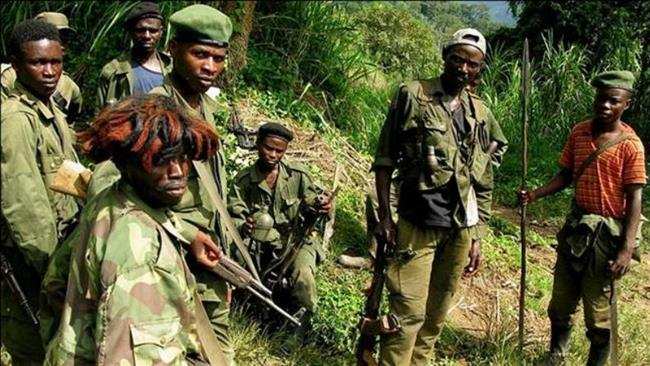
FDLR combatants in the forests of eastern DR Congo
Around 27 years ago, Richard Orth, a former defense attaché at the U.S. Embassy in Kigali, offered a sober warning that remains strikingly relevant today. In his 1999 unplublished policy paper on Rwanda’s post-genocide security environment “Rwanda’s Hutu Extremist Insurgency: An Eyewitness Perspective”, Orth explains what happened after the 1994 Genocide against the Tutsi was stopped in Rwanda, and the interim government that perpetrated fled across the border.
Orth’s core insight was simple but uncomfortable: the Forces démocratiques de libération du Rwanda (FDLR), then known as the ex-FAR and Interahamwe, were defeated militarily in Rwanda but their politics never changed. They reconstituted in eastern Congo, protected by weak state authority and regional complacency, and continued to pursue the same objective they had failed to achieve in 1994: the violent return to power through ethnic extermination.
This continuity matters today because the DRC-backed FDLR remains central to the crisis in eastern of that country that borders Rwanda. While the FDLR is often described in international discourse as just another militia in a crowded conflict zone, Orth understood it as something far more dangerous: an ideologically committed genocidal insurgency whose survival depends on sanctuary, external support, and political ambiguity.
The Washington Accords, signed on 4 December 2025, were designed precisely to break this cycle. They rest on a clear trade-off: Rwanda commits to de-escalation and normalization of relations, while the DRC undertakes to finally neutralize the FDLR and dismantle the infrastructure and state support that allows it to operate. This is not a concession to Rwanda; it is a prerequisite for any durable peace in the Great Lakes.
Yet implementation is still pending. Kinshasa continues to rely on FDLR elements as battlefield auxiliaries against other Congolese armed groups. This mirrors the pattern Orth described in the late 1990s, when Congolese authorities viewed genocidal militias as tactically useful and strategically expendable. History suggests the opposite is true. The FDLR does not dissolve when ignored; it digs in and grows.
Orth also warned against misreading Rwanda’s security posture. He noted that Rwanda’s post-genocide interventions were driven not by expansionism but by the basic logic of counterinsurgency: denying a genocidal force the external rear bases without which it cannot survive. Three decades later, Rwanda’s argument has not changed. What has changed is the world’s impatience with hearing it.
Critics of Rwanda often treat the FDLR as a marginal issue, a rhetorical device used to justify hard power. Orth’s work demolishes that assumption. He shows that as long as genocidal forces remain intact, peace processes become procedural exercises rather than security solutions. Agreements fail not because they are badly drafted, but because they evade the central threat.
The Washington Accords will succeed if the in-built security core is taken seriously. Neutralizing the FDLR is not an optional confidence-building measure. It is the test of whether the international community is finally prepared to close the chapter that began in 1994.
Reconciliation without security is a shaky place-holder, not a strategy. The choice before Washington, Kinshasa, Kigali, as well as the newly invigorated African Union mediation led by Lomé, is stark. Either the region confronts the genocidal insurgency that has haunted it for three decades, or it condemns itself to negotiating the same failed peace, again and again.
