



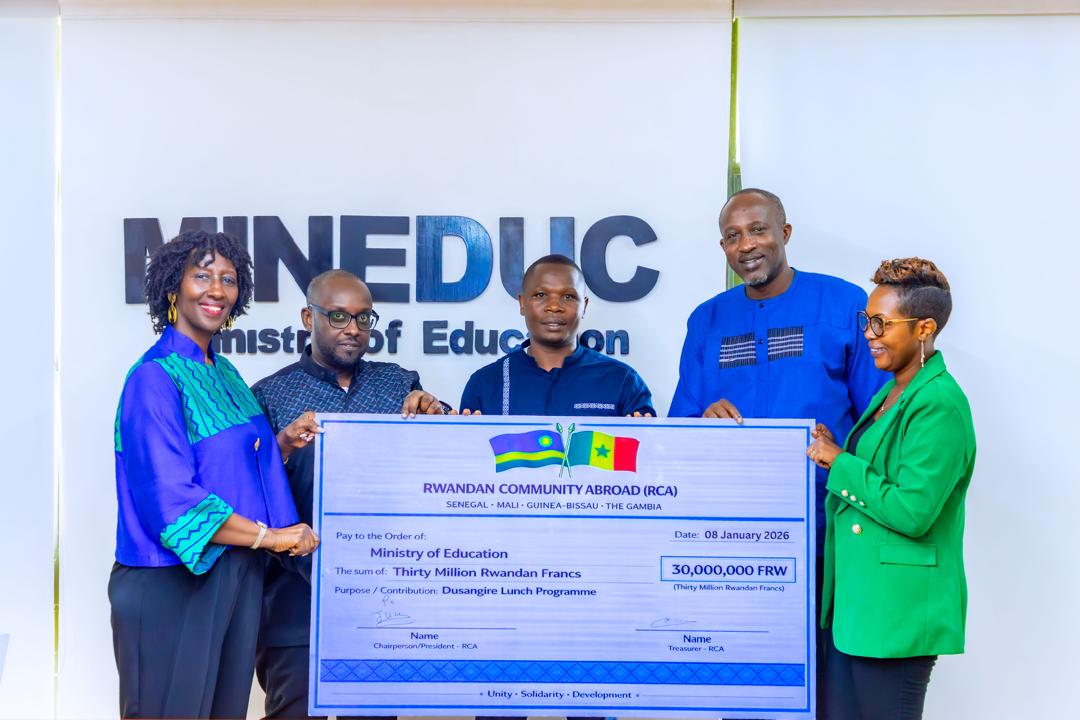
Rwandans living in Senegal, Gambia, Mali and Guinea-Bissau have contributed Rwf 30 million to Rwanda’s national school feeding initiative, Dusangire Lunch (Lunch for All), in a show of solidarity aimed at supporting children’s education back home.
The contribution is expected to provide lunch for at least 10,000 pupils.
The donation was officially handed over on Tuesday to the Ministry of Education by Mrs Jacqueline Uwamwiza, the Vice President of the association of Rwandans living in Senegal.
She was accompanied by a representative from the Directorate in charge of Rwandans living abroad at the Ministry of Foreign Affairs, as well as an official from the Rwandan Embassy in Senegal.
The funds were received by officials from the Ministry of Education, including Ms Divine Uwineza, Head of the School Feeding Unit at the ministry.

Appreciation from the Ministry of Education
Speaking during the handover ceremony, Ms Divine Uwineza commended Rwandans living in Senegal, Gambia, Mali and Guinea-Bissau for their continued commitment to national development initiatives.
She thanked them for their contribution to sustaining the Dusangire Lunch programme and took the opportunity to explain the origins of the initiative, as well as its current progress and impact in providing meals to schoolchildren across the country.
She noted that the programme plays a critical role in improving school attendance and helping learners remain focused throughout the school day, particularly during afternoon classes.
Continued Diaspora Engagement
The Rwandan Embassy in Dakar, which represents Rwanda in Senegal, Gambia, Mali, Cape Verde and Guinea-Bissau, reaffirmed its commitment to working closely with Rwandans living in those countries.
The embassy continues to mobilise the diaspora to actively participate in government programmes and to contribute meaningfully to Rwanda’s socio-economic development.
The Dusangire Lunch programme was launched in 2019 with the objective of encouraging various stakeholders—including public servants, the private sector, civil society organisations, Rwandans living abroad, and the wider Rwandan community—to support school feeding initiatives.
The programme aims to ensure that children are able to stay in school, learn effectively, and study in a safe and supportive environment.

According to the Ministry of Education, the programme currently reaches more than four million children nationwide.
Authorities say it has delivered tangible results, particularly in reducing school absenteeism and improving learners’ concentration and performance, especially during afternoon lessons.
