




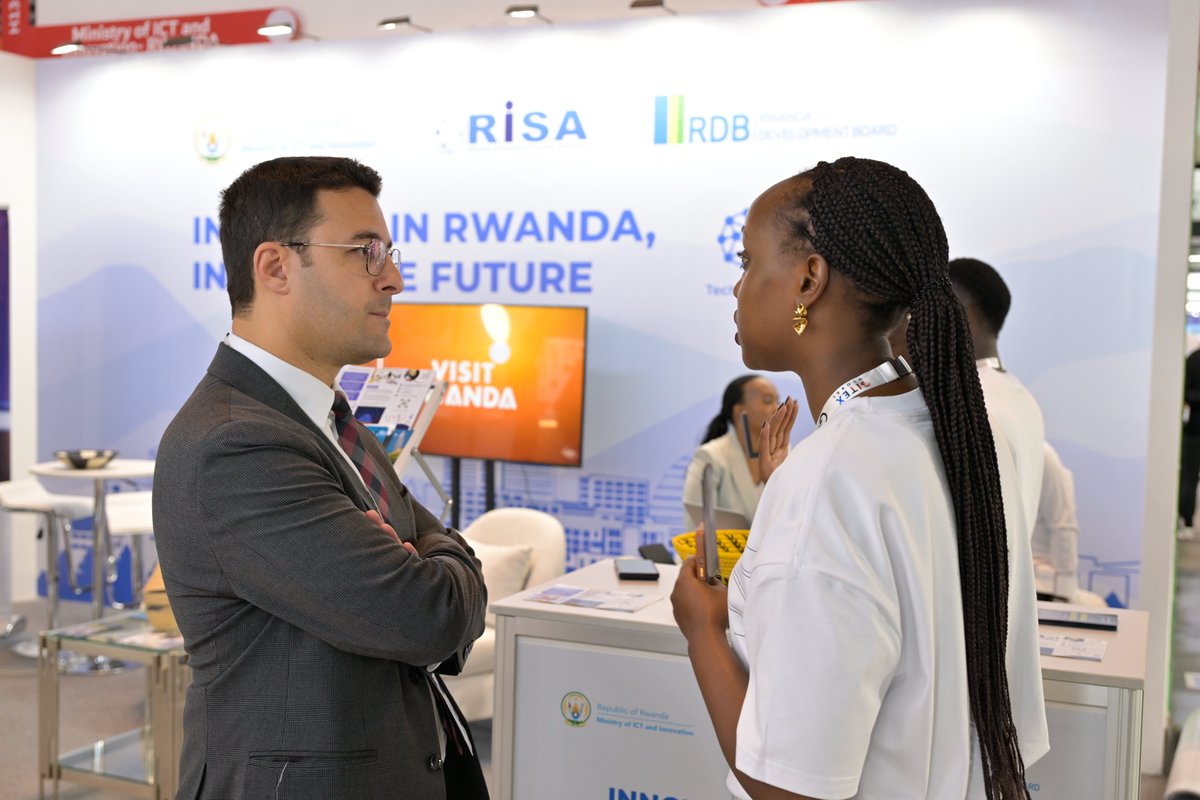
In October last year, Rwanda showcased its thriving digital economy, tech innovations, and investment opportunities at GITEX GLOBAL 2025 in Dubai.
Kigali — Foreign investors poured more than $1.1 billion into Rwanda last year, a sharp increase that underscores growing confidence in one of East Africa’s active economies, even as much of the continent struggles to attract new capital.
According to the 2025 Foreign Private Capital survey released today, total foreign inflows jumped 23.9 percent in 2024, rising to $1.098 billion from $886.9 million the year before.
The increase was driven largely by long-term investments in factories, banks and property developments — the kinds of commitments that signal faith in a country’s future, not just quick profits.
At the heart of the surge was foreign direct investment, or FDI — money used to build businesses, expand plants or acquire stakes in local companies. That category rose nearly 22 percent to $872.9 million, making it by far the largest source of foreign capital.
Put simply, foreign private capital is money that overseas companies and investors bring into Rwanda to build businesses, lend to firms or buy stakes in local enterprises.
It includes everything from a bank opening new branches to a manufacturer setting up a factory.
More companies are choosing to build in Rwanda rather than merely trade with it.
Other forms of investment also grew. Portfolio investment — typically shares and short-term financial assets — increased 12.8 percent.
Even more striking was a 33.7 percent jump in what economists call “other investment,” a broad category that includes loans and intercompany financing.
Borrowing by private companies from abroad climbed sharply as well. Private sector external debt inflows rose 28.5 percent to $543.6 million.
Most of that money came from parent companies and affiliated firms overseas, suggesting multinational groups are increasingly funding their Rwandan operations internally rather than relying on commercial lenders.
The results point to a deepening relationship between Rwanda and global corporate networks.
The strongest inflows went into finance, manufacturing and construction. Banks and financial services attracted $299 million, about 27 percent of total foreign capital, reflecting the rapid expansion of digital banking and fintech.
Manufacturing followed closely with $267 million, boosted by government incentives aimed at reducing imports and building local industry. Construction and real estate drew $150 million, mirroring Kigali’s fast-changing skyline.
Agriculture, education and health combined accounted for nearly 10 percent of inflows — a smaller share, but notable for signaling growing interest in social-sector investments.
Enterprise revenues tell a similar story. Turnover among surveyed foreign-backed companies rose 10.5 percent to nearly $4 billion, suggesting that many existing investors are not only staying but expanding.
The geography of Rwanda’s investment surge also shifted. It was led by Mauritius at $251 million.
Inflows from Kenya more than doubled to $140 million, while investment from China jumped 261 percent to $109 million and the United Arab Emirates surged 311 percent to $41 million.
Those gains helped offset declining capital from France, underscoring Rwanda’s widening ties with African, Asian and Gulf investors — and a gradual rebalancing away from traditional European sources.
Multilateral lenders such as the International Finance Corporation also played a major role.
Still, the overall trajectory stands out.
Globally, foreign investment has slowed amid geopolitical tensions, higher interest rates and weak growth in many developing economies. Rwanda’s near-24 percent rise is unusual, especially for a small, landlocked country with limited natural resources.
Officials credit the performance to regulatory reforms, predictable governance and a business environment designed to minimize bureaucracy.
The government has set an ambitious target of doubling private investment to $4.6 billion by 2029 under its Second National Strategy for Transformation.
The data behind the report comes from 424 foreign-linked enterprises, with nearly 90 percent responding — an unusually high participation rate that gives the findings added credibility.
Economists caution that borrowing from related companies, while helpful for growth, also increases exposure to external shocks.
And they note that heavy concentration in finance and manufacturing could leave Rwanda vulnerable if those sectors slow.
But for now, the message from investors appears clear: Rwanda is being treated less as a frontier market and more as a long-term bet.
In a region often defined by political uncertainty, the country is quietly positioning itself as a place where capital can plan ahead — building factories instead of extracting resources, funding startups instead of waiting on aid.
For Kigali, the challenge now is turning that confidence into jobs, exports and inclusive growth — and proving that stability can deliver prosperity.
