



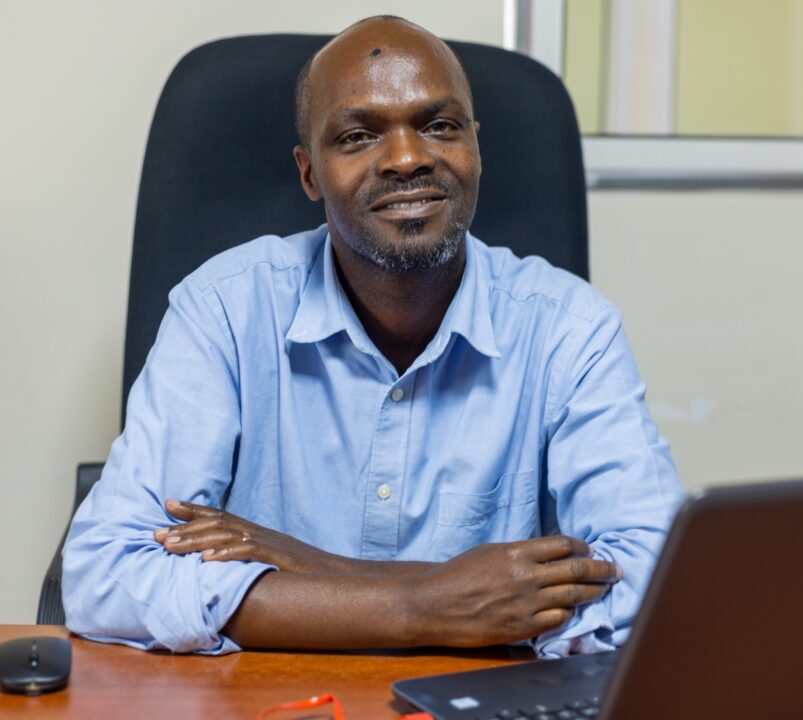
Jean de la Croix Tabaro, Editor at KigaliToday.com, pictured at his workstation. His story reflects a journey through exile in eastern DR Congo and return to Rwanda after the 1994 Genocide against the Tutsi.
Thirty-five years ago, in Musange village, Nyamagabe district, life unfolded in quiet rhythms shaped by farming seasons, school routines, and community gatherings. Our village, like many across Rwanda, was preparing for two remarkable events that seemed to promise hope.
The first was the visit of Pope John Paul II. He was warmly received nationwide and celebrated as a spiritual guest of honor. In our schools, special prayers were written and recited every morning. His presence gave us a sense of unity and anticipation, and for a brief moment, the country felt peaceful and connected.
At the same time, we were preparing for national primary leaving examinations. It was a new academic arrangement, requiring pupils to sit for exams in Primary Six and Seven since the later was phasing out.
Education felt like a bridge to a better future. We studied with determination, believing that hard work would shape our lives. Yet beneath this optimism, tensions were growing.
News began circulating about attacks by the “Inyenzi,” the name used at the time for the Rwandan Patriotic Front. For us in rural areas, information came mainly through Radio Rwanda, operated by ORINFOR (Rwanda Information Office). We had no access to alternative broadcasts. What we heard shaped our understanding of events.
As conflict intensified, families with members in the military began receiving difficult messages. In April 1994, my family entered into mourning when my elder brother, Jean de Dieu Mutuyiyera was killed in combat.
His death marked a personal turning point, occurring during the beginning of the Genocide against the Tutsi, which devastated the country and claimed over a million lives within three months. The grief was not only private; it was shared by the entire nation.
We had heard many stories about the Inkotanyi, but rumors alone did not make us leave. When gunfire reached the hills near Buhanda and Rwankuba in Ruhango, fear became real. The sounds echoed across the valleys, removing any remaining doubt.
We crossed through Nyungwe forest and entered eastern DRC, eventually reaching Bukavu. Our first settlement was Nguba, later moving to the Inera camp near Kashusha. Exile had begun, quietly and abruptly.
Fire in the Camp and the Forest of Survival
Camp life was structured yet fragile. Families registered for meal cards to receive food and basic necessities. Some traded supplies, others stored them carefully. Former soldiers regrouped within the camps, and weapons gradually appeared.
Political instability in the then Zaire under Mobutu Sese Seko intensified uncertainty. The camps slowly changed character, becoming spaces of tension rather than temporary refuge.
Then one day, fire broke out. Panic spread instantly. Smoke filled the air, and voices rose in confusion. I remember running downhill while holding my Holy Bible tightly. My family asked why I carried only that, but in that moment it was the only object that felt steady.
We fled across hills until the vast landscape of Kahuzi-Biega National Park swallowed us. More than a hundred thousand people scattered from the camps. We entered months of life in the forest. Survival became our daily focus.
I gathered wild cassava, bananas, and yams. Palm trees provided oil, and the land offered unexpected resources. The soil was fertile, yet salt was scarce, but in my culture, people believe that in some circumstances, food is a luxury, and salt, just a bonus. Food sustained the body, but uncertainty weighed heavily on the heart.
During this period, my mother left us to go find Saiba, the last born in our family and we never reconnected with her. Her absence in the forest remains one of the most painful memories of my life.
We moved constantly through Kahuzi-Biega for about three months. We rarely slept in the same place twice. One morning, armed men surrounded us, searching for belongings. We stood silently as they took what little we had. In our hearts, we accepted it, choosing survival over confrontation.
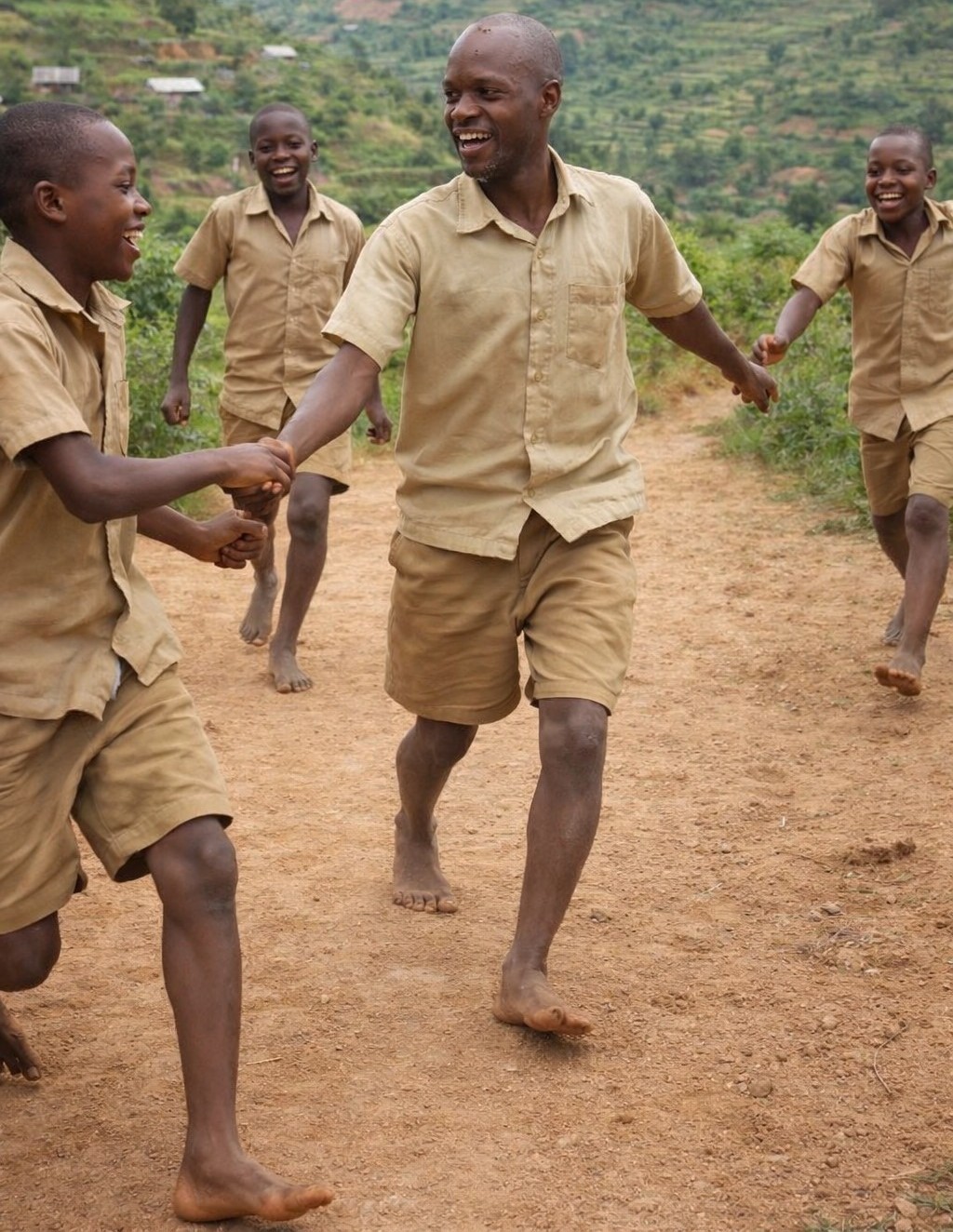
An AI generated image attempting to place the writer (center) back to his 1990s school days — those who studied barefoot will understand.
Eventually, we reached a bridge near Hombo. On the other side, soldiers lined us up. They spoke Kinyarwanda. For the first time in years, we heard familiar voices in uniform. Instead of violence, they organized registration and distributed food.
The relief was unexpected. The fear that had followed us for years began to loosen its grip. Soon after, trucks transported us back toward Rwanda during the Christmas period of 1996. We crossed through transit camps before returning home to Musange.
When we first saw Rwandan soldiers in uniform, we instinctively avoided them. Over time, conversations replaced suspicion. The name “Inkotanyi” had once symbolized fear to us, shaped by years of uncertainty. Now we understood them differently.
For a young returnee, the transformation was profound. These were the forces that had ended the Genocide and restored stability. Under disciplined leadership, they became the national army, contributing to national rebuilding and renewed confidence.
Looking back, the journey from Musange to exile and back was not only physical. It was emotional and historical. It carried grief, displacement, endurance, and eventually reconciliation with reality.
The forests of DRC hold memories of loss, while Rwanda holds the experience of return. Today, that path stands as a reflection of resilience. It reminds me that history can uproot communities, yet it can also bring them home.
The writer is the editor for kigalitoday.com, our sister platform.