




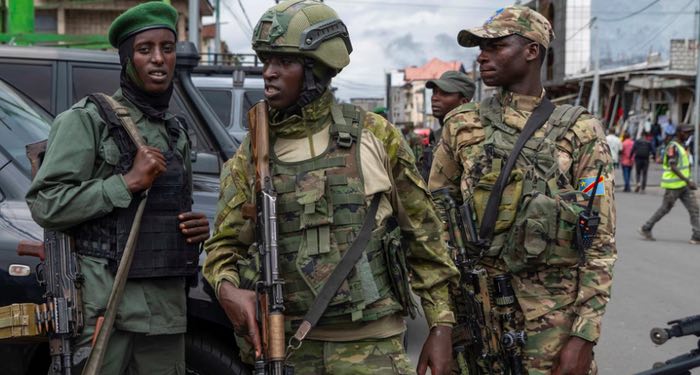
When President Félix Tshisekedi agreed to a new ceasefire in eastern Democratic Republic of Congo (DRC), the announcement was hailed as a breakthrough. Kinshasa said the commitment reflected “a spirit of responsibility, calm, and the search for a peaceful solution to the conflict.”
Days later, Vivian van de Perre, acting head of MONUSCO, arrived in Goma to advance monitoring arrangements, declaring: “I have arrived in Goma as part of MONUSCO’s mandate and ongoing efforts to support the operationalization of the ceasefire monitoring and verification mechanism.”
Yet in a conflict where agreements often collapse before the ink dries, the deeper question remains: why has peace eluded eastern Congo for nearly three decades?
The current ceasefire is anchored in a monitoring framework signed in Doha on October 14, 2025, between Kinshasa and the AFC/M23. It freezes military positions, bans reinforcements, and obliges all parties to protect civilians under international humanitarian law. MONUSCO, supported by UN Security Council Resolution 2808 (2025), is expected to deploy teams to Uvira, a flashpoint town that has repeatedly changed hands.
Rwanda’s Foreign Minister Olivier Nduhungirehe has warned that ceasefires “will be in vain” if Kinshasa lacks the political will to halt airstrikes and artillery attacks. His caution reflects a long history of broken agreements: a 2024 humanitarian truce brokered by Washington, the July 31 Luanda ceasefire, the April 23 declaration, the Washington Peace Agreement of June 27, the Doha Declaration of July 19, and several others through late 2025. Each promised de-escalation, only to be followed by renewed clashes.
The roots of eastern Congo’s conflict run far deeper than any single accord. The crisis is fueled by unresolved legacies of the 1994 Genocide against the Tutsi, the presence of the FDLR militia, competition over vast mineral wealth, ethnic tensions, weak state institutions, and regional rivalries. Kigali argues its security doctrine requires neutralizing hostile armed groups across the border and protecting Tutsi communities. Kinshasa insists on sovereignty and territorial integrity. Between them stand militias, foreign interests, and millions of civilians negotiating survival.
Two broad scenarios illustrate the deadlock. One is sovereignty: AFC/M23 withdraws, and the Congolese state reasserts control, potentially with MONUSCO support. Another is autonomy or federalism, granting de facto self-rule to rebel-held zones—a solution widely rejected as rewarding rebellion. A third, de facto partition, would shatter regional norms and inflame rivalries. None offers a mutually acceptable outcome; each implies existential loss for at least one actor.
The Congolese army lacks the capacity to decisively defeat AFC/M23. The rebels hold military momentum but lack legitimacy and face accusations of abuses. International mediation has also revealed limits. African Union facilitation, SADC deployments, U.S. brokerage, and Qatari talks have managed escalation rather than changed incentives. As one analyst noted, the tragedy is not merely failed agreements but “the normalization of the Congolese sacrifice as a variable in regional interests.”
This week’s images of UN helicopters landing in Goma—the first since January 2025—and ceasefire documents signed under global scrutiny symbolize cautious progress. Yet reports of continued bombing in South Kivu and lingering fears among Banyamulenge communities underscore how fragile that progress remains.
Peace in eastern Congo has not failed for lack of paperwork. It has faltered because the political economy of war remains intact and the balance of power unchanged. Until armed actors conclude that war costs more than compromise—and until civilians are protected not by promises but by enforceable guarantees—the grass will continue to suffer beneath the elephants’ struggle.
