



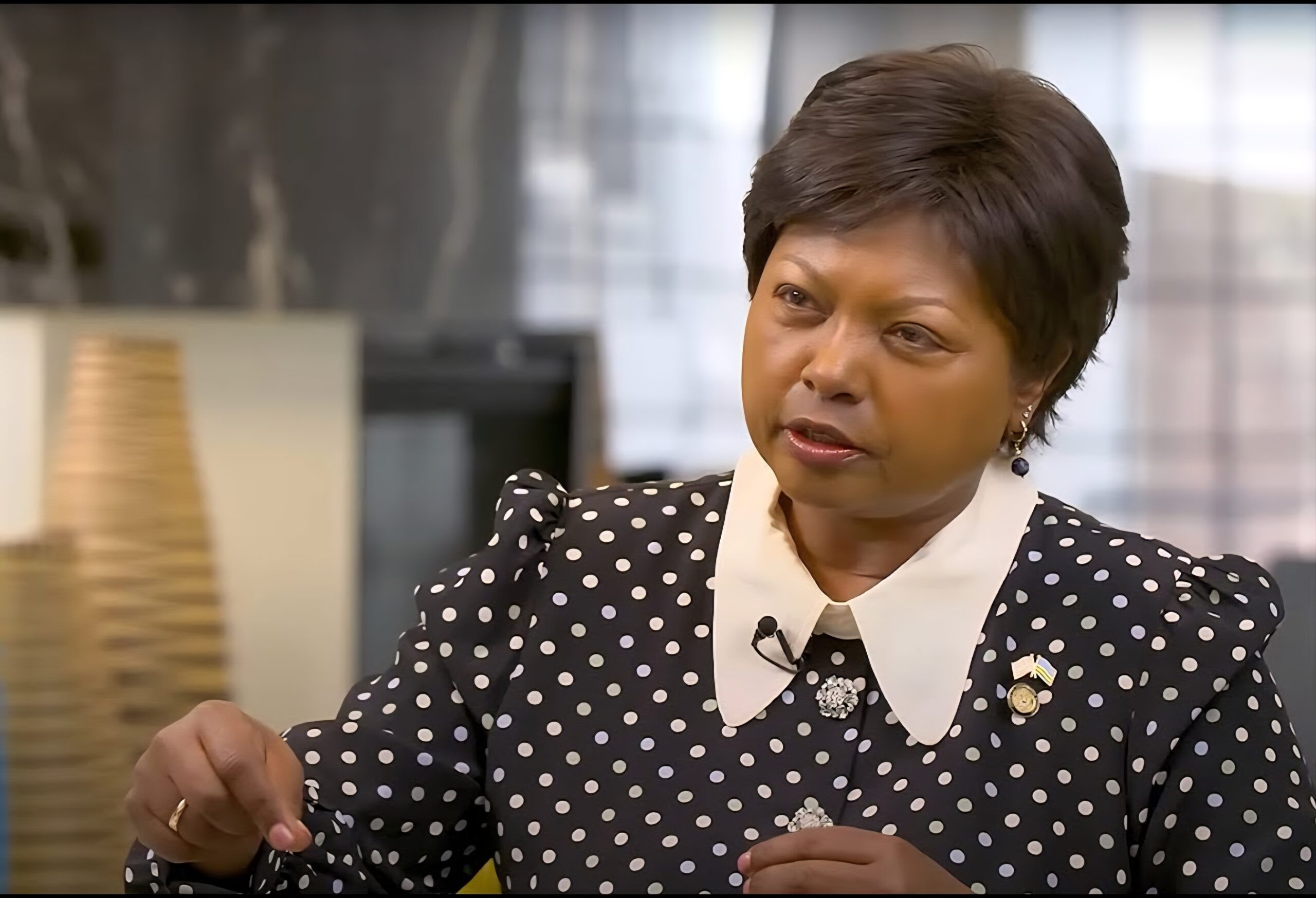
Rwanda ambassador in Washington, Mathilde Mukantabana
WASHINGTON — A brief, non-violent encounter in a hotel corridor has opened a new front in the conflict dispute between Rwanda and the Democratic Republic of Congo, with Kigali forcefully rejecting what it calls a fabricated narrative by Congolese officials and insisting the episode has been distorted to serve political ends.
In a sharply worded statement released Wednesday morning, Rwanda’s embassy in Washington sought to set the record straight about what it described as a routine and “inadvertent” encounter between security personnel from the two countries, both of whose delegations were staying at the same hotel during high-level diplomatic talks.
“An unarmed member of the security detail of a Rwandan VIP staying in a Washington DC hotel inadvertently encountered security agents of a DRC delegation in a hotel hallway accessible to all guests,” the statement said, emphasizing that the space was public and that there had been no attempt to breach restricted areas.
According to Kigali’s account, the situation escalated briefly when “the Rwandan detail member was… restrained from accessing the elevator by the DRC security agents,” an action the embassy described as “inappropriate and wrong behavior in a common area.”
The encounter, it added, “was eventually resolved without further escalation.”
Yet what might otherwise have remained a minor misunderstanding quickly spiraled into a diplomatic dispute.
Rwandan officials say the decision to de-escalate was immediate.
Following the incident, “the Rwandan party made a decision to change hotels,” the statement noted — a move intended to avoid further friction at a moment of sensitive negotiations.
But as the delegation checked out, embassy officials said, they were “harassed and filmed by unknown persons,” an episode Kigali framed as a deliberate provocation.
“Despite this provocation, the Rwandan team was restrained and professional at all times, and carefully avoided any confrontation,” the statement said.
The embassy reserved its strongest language for the Congolese government’s subsequent public characterization of the incident.
It accused officials in Kinshasa of engaging in “gross misrepresentation” and singled out remarks made by Patrick Muyaya, the Congolese Minister of Information, during a press conference the previous night.
“These contemptible lies should be disregarded and condemned,” the statement concluded.
Congolese officials had presented a far more alarming version of events. In Kinshasa’s telling, the encounter was framed as an attempted security breach involving the residence of Denise Nyakeru Tshisekedi, the country’s First Lady, who was also in Washington.
Kinshasa officials and their social media brigade have been reporting that unidentified individuals had tried to access areas near her accommodations, prompting heightened security measures.
Videos have been widely circulating of three men being tormented by camera-holding individuals. The victims can be seen and heard asking why they’re being filmed.
In what appears as their way to descalate the situation, the men walked away. And another video shows them leaving the hotel all together with their luggage.
Rwanda has categorically rejected that account by Congolese official, stressing that its personnel were unarmed, operating in a shared hotel space, and posed “no threat whatsoever.”
The latest development comes at a delicate moment in relations between the two neighbors.
The delegations were in Washington recently for talks aimed at advancing the Washington Accords for Peace and Prosperity, a U.S.-mediated agreement signed in December 2025 intended to calm one of Africa’s most volatile conflicts.
Under the accord, both sides committed to respecting each other’s sovereignty, while Rwanda agreed to lift what it describes as “defensive measures” in parts of eastern Congo, contingent on action by Kinshasa against the FDLR — a militia group linked to perpetrators of the 1994 Genocide against the Tutsi and long cited by Kigali as a central security threat.
Talks held on March 17–18 produced what U.S. officials described as “concrete steps” toward de-escalation, including commitments on civilian protection and coordinated actions on the ground.
But the underlying mistrust remains profound, with each side accusing the other of bad faith.
For Rwanda, the hotel episode — though minor in substance — has become emblematic of a broader pattern. Officials in Kigali view the Congolese response as part of an effort to shift attention away from unresolved security concerns, particularly the continued presence of the FDLR in eastern Congo.
More broadly, the dispute underscores how fragile the diplomatic process remains. Even far from the front lines of North Kivu, tensions can surface abruptly, shaped as much by perception and narrative as by events themselves.
Rwandan officials, for their part, insist they will not be drawn into escalation over what they describe as a contained and misrepresented incident.
The embassy reiterated that its delegation “conducted itself with the highest level of professionalism throughout” and urged a return to the larger objective at hand.
That objective — stabilizing eastern Congo after decades of conflict — remains elusive. And as the episode in a Washington hotel corridor suggests, even the smallest encounters can carry the weight of a much larger and unresolved war.
