



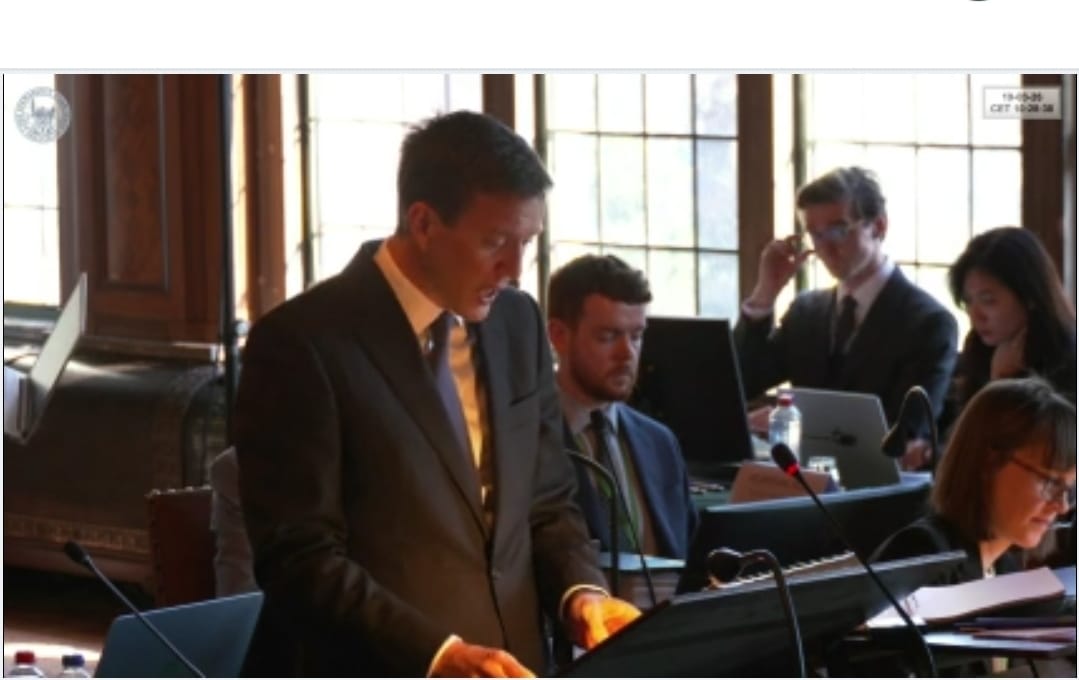
Screenshot: UK counsel addresses the tribunal at the PCA, March 19, 2026, defending the deal’s termination as a “common sense” policy shift—an argument Rwanda rejects.
The legal battle between Rwanda and the UK over their failed migration deal moved to the Permanent Court of Arbitration this week, with both sides fighting over who owes what.
What started as a major treaty is now a messy dispute. After the new UK government scrapped the deal last July, Kigali is pushing for London to honor the financial promises made before the exit.
In a sharp opening statement yesterday, Rwanda’s counsel used a striking analogy to describe the UK’s approach to the deal. They compared the UK’s behavior to “the strategy of a salesman who, having realized he’s not going to get the deal he wanted, just starts saying ‘please, please sign on the dotted line.”
The analogy highlights how UK officials allegedly shifted to applying pressure rather than negotiating on substance in late 2024. Kigali argues this was a tactical attempt to force an agreement through informal channels without actually resolving the core financial and legal issues already on the table.
Rwanda’s argument is simple: you can’t just walk away from a signed international contract without paying the bill.
Rwanda’s £100 Million Claim
Rwanda’s legal team, led by Justice Minister Emmanuel Ugirashebuja, is demanding over £100 million. This covers two payments of £50 million each that were originally set for 2025 and 2026.
Kigali says these installments were guaranteed once the treaty was signed. They argue the money wasn’t “pay-as-you-go” based on how many people arrived, but a committed investment in Rwanda’s capacity to host refugees.
To show how they calculated the costs, Rwanda’s lawyers used a conservative baseline of 300 people at £20,000 each. They pointed out that 300 people is less than 1% of the 130,000 refugees Rwanda already supports.
A Broken Promise
A major part of the friction is “Article 19.” This was the part of the deal where the UK was supposed to take in a “portion” of Rwanda’s most vulnerable refugees in exchange.
Kigali says they did their part by building the courtrooms and hostels. But while the UK sent only four people to Rwanda, it didn’t take a single person back in return.
Rwanda’s team noted that while the UK claims the deal wasn’t “workable,” other countries are still active. In 2024, the U.S. resettled over 3,300 refugees from Rwanda, and Canada took over 600.
The UK’s “Common Sense” Defense
The UK is standing its ground. Their legal team argued that the decision to end the deal was “simple common sense” because the plan wasn’t working.
London is also leaning on past diplomatic talks. They mentioned an “apology” and informal signals from Kigali that suggested both sides knew the deal was under pressure.
Basically, the UK is saying there was a “mutual understanding” that the deal was over. Rwanda’s response was quick: informal chats and apologies don’t override a signed treaty.
The Cost of a Split
This case is now a test for international law. It asks if a new government can just tear up a treaty because they changed their mind on policy.
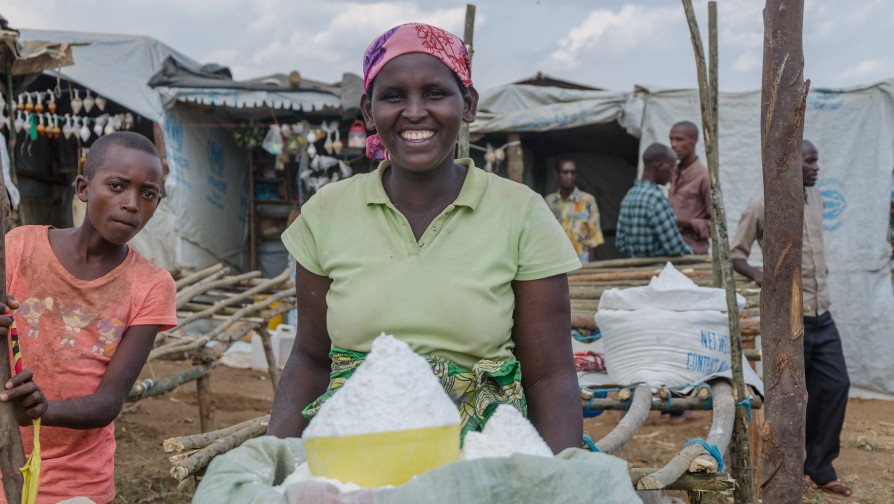
A refugee smiles at Mahama Refugee Camp in eastern Rwanda.
Rwanda says they didn’t want to take their partner to court but felt they had no choice. On top of the £100 million, they want another £6 million for costs and a formal apology from London.
The court’s decision, expected in a few months, will finally set the price for this sovereign divorce.
Rwanda maintains that its position in the case does not alter its longstanding commitment to hosting refugees and supporting their integration. Officials say the country will continue to provide safety, access to essential services and opportunities for refugees to rebuild their lives with dignity.
The government points to its broader refugee policy, which emphasises inclusion in national systems such as education, healthcare and employment, as well as partnerships with international agencies. This approach, it says, reflects Rwanda’s continued willingness to offer protection and viable prospects to displaced people, independent of the outcome of the UK agreement.