



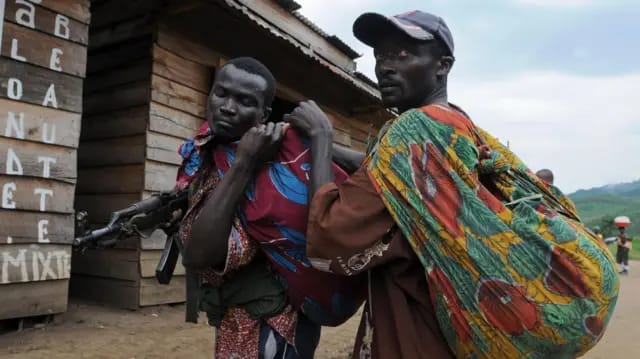
This photo was captured in Lushebele, what was for many years, a stronghold of the Rwandan FDLR militia. They wear civilian clothing, and become ‘humanitarian catastrophe’ when chased to forests, but celebrate as ‘Wazalendo’ when the M23 withdraw
In the hills and forests of eastern Democratic Republic of the Congo, the war is being fought not only with rifles, mortars and drones. It is also fought with language.
Over the past three years, as the rebel coalition led by the March 23 Movement — now operating politically under the banner of the Alliance Fleuve Congo (AFC-M23) — expanded across large parts of North Kivu, a striking narrative pattern has emerged in how the conflict is described.
When the movement advances, the story often becomes one of attacks against civilians. When its positions are assaulted, the attackers are typically described as “Wazalendo,” the militias fighting for the Congolese state.
Yet beneath this simple framing lies a far more complex battlefield — one that increasingly involves the long-standing presence of the Democratic Forces for the Liberation of Rwanda (FDLR), a militia whose leadership traces its origins to perpetrators of the 1994 Genocide against the Tutsi.
The question shaping the conflict today is not only who controls territory, but how the war itself is interpreted.
A Hidden Coalition
Reports compiled since 2023 by the United Nations Group of Experts on the Democratic Republic of the Congo describe a consistent operational pattern in North Kivu: collaboration between the Congolese national army, the Armed Forces of the Democratic Republic of the Congo (FARDC), local militias grouped under the name Wazalendo, and fighters from the FDLR.
The alliances are rarely acknowledged publicly. Official Congolese directives have even ordered soldiers to sever contact with the FDLR. But investigators and field reports indicate that cooperation on the ground persisted well into 2025.
In villages scattered across the territories of Rutshuru, Masisi and Nyiragongo — particularly around the strategic city of Goma — FDLR fighters were documented operating alongside Wazalendo groups in attacks against M23 positions.
On December 26, 2024, for example, FDLR units launched assaults against M23 positions inside Virunga National Park, striking locations known as Ka Lac, Nditi and Kamatembe. The attacks originated from long-standing FDLR camps hidden within the park’s forested interior.
More than a year later, on August 29, 2025, fighters linked to the group attacked M23 positions again in Kishishe village, in Rutshuru territory. And in February 2026, Wazalendo militias accompanied by FDLR elements launched fresh incursions around Kishishe, Bambo and Kibirizi.
These events rarely appeared in headlines as FDLR offensives. Instead, they were generally attributed to “local militias” or loosely grouped under the label Wazalendo.
The Narrative
When M23 responds to attacks from these same regions, the description of events often changes.
Operations that the rebels describe as counterinsurgency campaigns against FDLR networks are frequently reported primarily through the humanitarian consequences that follow — civilian deaths, burned villages, and displaced communities.
The shift in framing is particularly visible in the July 2025 violence across the Binza area of Rutshuru territory. During that month, M23 forces conducted sweeping operations across at least fourteen villages, including Kiseguru, Katwiguru, Nyamilima and Nyabanira.
The operations were widely described internationally as massacres of unarmed civilians.
Yet the same region had long been identified by United Nations investigators as a relocation hub for FDLR commanders and fighters.
The result was a collision of narratives. In one version, civilians were targeted in their fields and homes. In another, the violence occurred during attempts to dismantle militia networks embedded within rural communities.
Both accounts contain elements of truth, but they highlight different realities of the same battlefield.
Kishishe: A Village at the Center
Few places illustrate the competing interpretations of the war more vividly than Kishishe, a village in Rutshuru that has repeatedly appeared in both military reports and human rights investigations.
For years, the area served as a logistical node for armed groups — a recruitment site, a charcoal-trading hub and a staging ground for attacks across Bwito chiefdom.
In August 2021, fighters linked to the FDLR attacked M23 positions from nearby Kahumiro. Six months later, Wazalendo and FDLR units again launched incursions in the area.
When M23 forces returned on February 21, 2022, they carried out what they described as a clearance operation, arresting roughly 270 individuals suspected of collaborating with militia networks.
Outside reporting focused largely on the civilian impact: arrests, displacement and injuries among local residents, many of whom were described simply as “Hutu villagers”.
The sequence — militia attack, M23 response, civilian narrative — has become a recurring pattern across North Kivu.
The Quiet Collapse of FDLR Territory
While narratives remain contested, the territorial map of the conflict has shifted dramatically since 2023.
For decades, vast areas of northern North Kivu — especially Rutshuru and Masisi — functioned as de facto strongholds of the FDLR. From these areas, the group maintained recruitment networks, controlled charcoal production and launched cross-border attacks into Rwanda.
But beginning in 2024, M23 offensives began dismantling that infrastructure.
In March of that year, the rebels captured Nyanzale, once considered one of the FDLR’s most important operational bases. Soon afterward, they seized Rwindi and Vitshumbi along the shores of Lake Edward.
Other traditional FDLR bastions followed: Kazaroho, Marangara, and large parts of the Binza groupement, which had long served as a relocation zone for commanders fleeing earlier offensives.
In Masisi territory, the same pattern unfolded. Areas such as Lushebele, Karenga and Kibarizo — previously documented as coalition bases linking Wazalendo militias with FDLR fighters — gradually fell under M23 administration.
By late 2025, United Nations assessments suggested that most historic FDLR strongholds in the so-called “Petit Nord” had been dismantled, leaving only scattered pockets of fighters in remote forest areas.
The Turning Point: Goma
The decisive moment in this transformation came in January 2025, when M23 captured the city of Goma.
The fall of the provincial capital gave the rebels control over major supply routes and border crossings while severing several FDLR frontlines near the Rwanda border.
Bases in areas such as Kanyamahoro and camps along the fringes of Virunga National Park — long used to stage attacks — were overrun during the offensive.
With control over Rutshuru, large sections of Masisi and the territory of Nyiragongo, the movement effectively dismantled what had been the FDLR’s most durable operational landscape for nearly three decades.
The War Beyond the Battlefield
Yet even as the military geography of the conflict changes, the narrative battle continues.
For the government in Kinshasa, the conflict remains primarily a story of foreign aggression. Officials portray AFC-M23 as a proxy force backed by neighboring Rwanda.
The “Wazalendo” release images of celebration, displaying ammunition reportedly taken from M23. They dance, drink alcohol and show cash payments from Kinshasa Government. The narrative is that of victory.
For those that frame themselves as human rights organizations, meanwhile, focus on documenting the supposed suffering of civilians trapped between armed actors.
Yet, when M23 attack and displodge the same Wazalendo who were in celebration yesterday, the information coming from the battlefield is that M23 rebels are causing ‘humanitarian catastrophe’.
These competing interpretations rarely intersect, leaving the outside world with sharply different pictures of the same events.
In the end, the eastern Congo conflict has become something more than a territorial struggle.
It is also a battle over meaning.
On the ground, entire networks of militia bases have disappeared from areas that once served as the heartland of the FDLR. Yet in the global conversation about the war, those shifts often receive less attention than the humanitarian toll of each new offensive.
And so the paradox endures.
When AFC-M23 advances, the narrative often centers on civilian victims. When it is attacked, the attackers are described as patriotic militias.
Between those two descriptions lies the complicated, contested reality of one of Africa’s longest and most misunderstood wars.
