



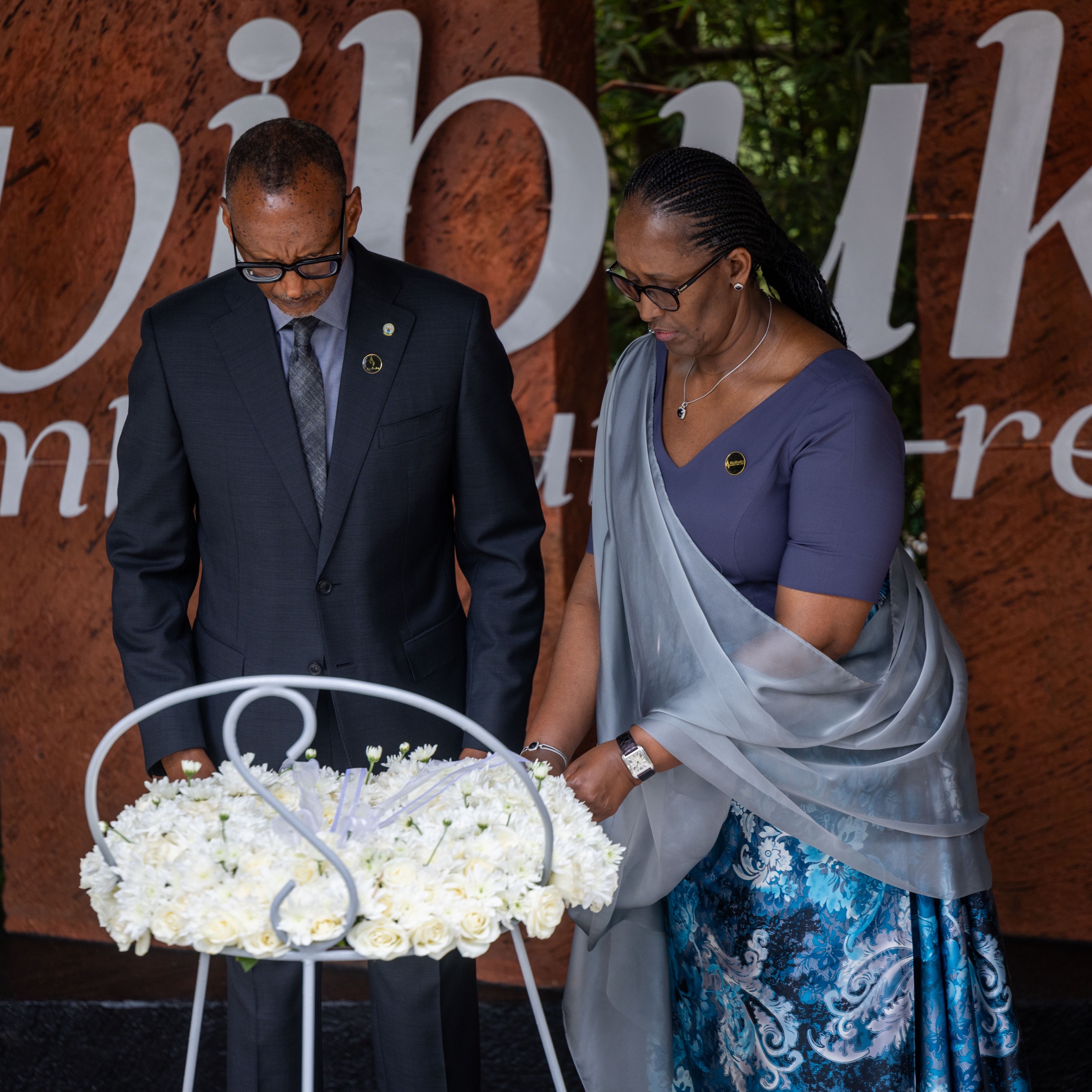
President Paul Kagame and First Lady Jeannette Kagame lay wreaths in solemn tribute during the commemoration of the 1994 Genocide against the Tutsi.
At the 32nd commemoration of the Genocide against the Tutsi, President Paul Kagame delivered a searing, uncompromising verdict on one of the many lessons Rwanda has learned. His message cuts to a brutal truth: when the lives of victims do not serve the interests of powerful actors, those lives are deemed expendable.
Rwandans learned this in the most savage way imaginable. And they have not forgotten.
Kagame rightly excoriated the international community’s catastrophic failure in 1994 as definitive proof. The United Nations peacekeeping mission in Rwanda was not reinforced as the slaughter accelerated; it was deliberately weakened at the very moment it was needed most. As the Genocide intensified, the world responded with withdrawal and cowardice. For Kagame, this was no miscalculation. It was a deliberate indifference to African life.
He then exposed how the crime itself was systematically obscured. By refusing to acknowledge that a genocide was underway, key international actors manufactured the justification for inaction. The refusal to name the atrocities for what they were- the Genocide against the Tutsi became a shield against responsibility. This, he says, was akin to aiding and abetting perpetrators.
Meanwhile, even minimal interventions, such as jamming the hate broadcasts of Radio Télévision Libre des Mille Collines (RTLM), which actively incited the killing, were dismissed as too costly or impractical. These choices revealed a hierarchy of human worth. Rwandan lives ranked disturbingly at the bottom.
With no meaningful external intervention coming, the responsibility to stop the Genocide against the Tutsi fell entirely to the Rwandan Patriotic Army- RPA. This was a herculean mission carried out under unbearable pressure and moral anguish. RPA-Inkotanyi fighters advanced knowing that no matter how fast they moved, they would always arrive too late to save everyone. That burden, the knowledge of lives lost while the world dithered, remains an open wound on the nation’s conscience.
But here is the undeniable fact that Kagame insists the world remember: the genocide was stopped. The RPA saved Rwanda. They did what no foreign power would do. From that salvation emerged an iron principle that now defines Rwanda’s posture: Rwanda will never outsource its security.
The Rwanda Defence Force (RDF) today operates with the same spirit, protecting lives without waiting for foreign validation or permission, a fact that makes Rwandans proud.
“No sanctions or insults from outside can ever tarnish the honor and integrity of Rwanda’s defense and security forces who are among the finest that be found anywhere,” Kagame said earlier today.
In fact, the principle around which the RDF operates does not stop at Rwanda’s borders. Kagame warned that the lesson of 1994 applies wherever, especially in Africa, human life is still treated as secondary to political calculation. This obvioulsy includes neighboring eastern Congo. Rwanda will not stand idle in the face of threats. It will not depend on those who have already proven, with Rwandan blood, that their delay or indifference is a death sentence.
Kagame’s speech was a declaration of iron resolve. The lessons of the Genocide against the Tutsi were brutal beyond measure, but they forged an unbreakable national commitment to self-reliance, relentless vigilance, and the absolute defense of human life, whether or not the powerful ever deem it worthy of action.
