On October 2, 1961, addressing Members of Parliament, Grégoire Kayibanda—who would soon become Rwanda’s first president after independence—framed the country’s new political order as one rooted in majority rule, urging Tutsis to “comply” with a Hutu-led government, even as he had already made clear that legislative power would be exclusively reserved for Hutus.
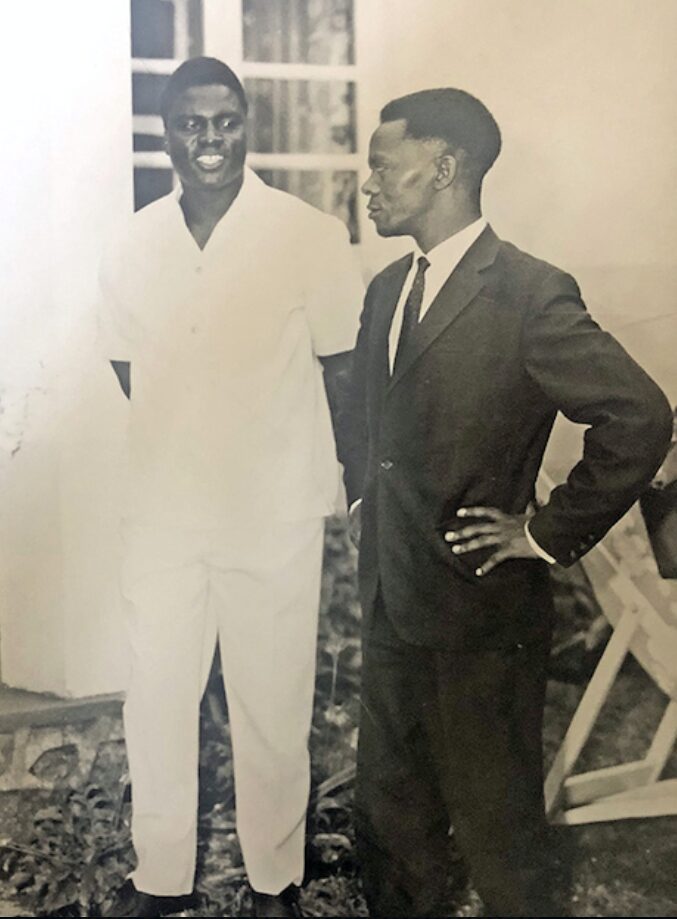
Juvenal Habyarimana and Gregoire Kayibanda. This was a few months before they went to be the country’s top political and military leaders
For a country emerging from colonial rule, the language sounded democratic. In practice, it signaled the start of a system where power and belonging were increasingly defined along ethnic lines. Over time, such positions evolved from rhetoric into doctrine.
That doctrine was not confined to speeches—it was formalized, repeated, and enforced across institutions.
On June 7, 1969, PARMEHUTU’s fourth manifesto called on Hutus everywhere to take pride in their identity, as long as they “liberate” themselves from Tutsi influence.
Years earlier, on January 26, 1963, a meeting in Butare chaired by Françoise Sezirahiga warned:
“This meeting is to caution all public servants, especially the Tutsis and some ‘stupid’ Hutus who are being influenced to create misunderstandings between each other, that this might be a concealed attempt to bring down the government.”
The same meeting added:
“What is particularly troubling is that certain individuals remain in influential positions they would not hold if authorities had acted earlier… Their growing complacency stems from the fact that they are no longer held accountable or punished as they were during Jean-Baptiste Habyarimana’s time as Prefect.”
Public rhetoric echoed and amplified these ideas. On January 28, 1964, during independence anniversary celebrations, Kayibanda declared:
“You all know how PARMEHUTU is dedicated to the liberation of Hutus, in line with the colonizers’ decision to hand over power to us, not them (Tutsi).”
Political Engineering
The education system became a central instrument in implementing this vision.
In August 1962, the PARMEHUTU newspaper Voice of Democracy published directives instructing teachers and parents:
“We hereby order you not to continue ‘favoring’ Tutsi students as it was with the colonial regime and before. These days, we find that so many Hutu students are discontinued, yet we know they do not lack the ‘knowledge’ to continue with school.”
On June 21, 1964, a party congress reaffirmed: “We gladly recognize that since 1959, PARMEHUTU has never desisted from its core mission of entrenching Hutu students into institutions of higher learning. We will continue, as a party, to play that role, especially for party members.”
Kayibanda reinforced this approach on May 1, 1967, stating: “I am deeply saddened by any uneducated Hutu, wherever you are, and am willing to do anything to help you.”
Parliamentary consultations reflected similar thinking. A report from Kibuye Prefecture noted:
“We have learnt with dismay that the people of Kibuye Prefecture are disappointed that Hutu children have not yet embraced the culture of education. Only Tutsi children go to school. This is alarming; the government and other agencies should take heed and provide facilitation to encourage Hutu children as well.”
Dispossession
Beyond education, the state moved decisively to restructure property and citizenship.
On June 8, 1961, the Ministry of Justice instructed local authorities to redistribute property left behind by Tutsis who had fled in 1959.
This position was reinforced on February 26, 1966, when Kayibanda declared: “Whoever fled and comes back cannot reclaim their land and other property if it was given to someone else or the government designated it for another purpose. Your departure is entirely your responsibility.”
Local officials implemented these directives with precision.
On July 22, 1963, Kibungo Prefect Eliya Kamonyo wrote: “Referring to my earlier letter No. 599 dated June 20, 1963, you are hereby granted full authority to redistribute the property belonging to refugees… Should any refugees return to claim their property, they should be directed to me without hesitation.”
On July 3, 1964, Prefect Karodian Gatwabuyenje ordered the sale of refugees’ cattle.
Institutional Continuity
The July 1, 1973 coup that brought Juvénal Habyarimana to power was presented as a corrective moment. In a national address on August 1, 1973, he promised unity and an end to divisionism. But the underlying system endured.
With the establishment of the MRND on July 5, 1975, Rwanda became a one-party state, and earlier patterns of exclusion were maintained and formalized.
Habyarimana quickly entrenched these policies.
On August 1, 1973, he declared: “Admission into higher institutions of learning will henceforth depend on tribe and region.”
He reiterated this approach on August 1, 1982: “The government acknowledges the challenges within the education system… It emphasizes a strong commitment to prioritizing access to education for the majority of Rwandans, specifically the Hutu population.”
Policies adopted during MRND congresses in 1980 and 1983 were later codified into Law No. 14 of 1985.
The disparities were evident. In 1989, Gisenyi Prefecture received 1,045 admission slots instead of the allocated 649, while Butare received only 696 out of 866.
Expanding Exclusion
Policies targeting refugees were further tightened.
On October 25, 1973, Habyarimana declared: “Property left behind by Tutsis is considered to have no rightful owner and is therefore taken over by the state. The responsibility for this loss is placed entirely on those who fled because their departure was voluntary.”
In 1968, as Minister of Defence, he denied a passport to priest Prudence Kayiranga, stating:
“That priest does not deserve a passport because his parents are refugees… more educated Tutsis would intensify their fight against the state.”
On August 16, 1985, an immigration official in Gitarama ordered returnee Bisamaza to leave within five days.
By July 26, 1986, the MRND Central Executive Committee declared:
“We cannot sit back and allow further population growth due to the return of refugees… their existence and survival would constitute an additional source of insecurity.”
Media and the Normalization of Violence
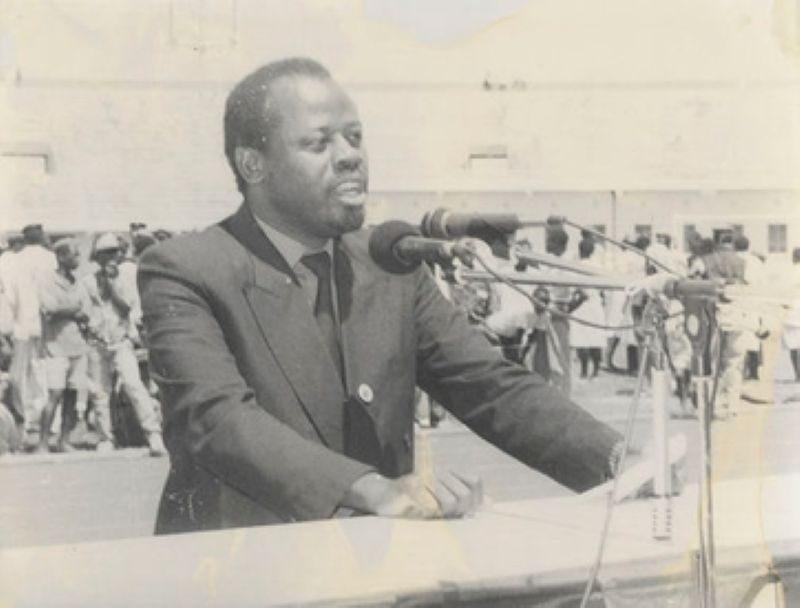
On April 12, 1994, Froduald Karamira publically urged the Hutu population to work alongside the police and military to exterminate the Tutsi
Media messaging reinforced and normalized these positions.
The PARMEHUTU-linked newspaper Jya mbere warned on November 27, 1959: “If Tutsis continue to live with Hutus, they will be eliminated.”
On April 7, 1960: “PARMEHUTU was born to liberate the Hutus.”
By January 28, 1963, Kayibanda announced on national radio: “Tutsis would face a ‘quick and terminal end.’”
In December 1963, more than 15,000 Tutsis were killed in Gikongoro over two weeks.
Radicalization in the 1990s
Extremist ideology intensified in the 1990s.
Kangura printed the “Ten Commandments of the Hutu” in December 1990.
On March 8, 1992, Members of Parliament Bernadette Mukarurangwa and Laurent Baravuga led a meeting in Butare where one resolution stated: “Get machetes and spears to hunt down all those who are not members of the party.”
At the same time, internal dissent emerged.
On August 15, 1992, Christopher Mfizi wrote in his resignation: “Your Excellency, I wish to formally announce my resignation from MRND… I have witnessed party leaders urging the public to engage in violence and looting, yet no action was taken.”
Final Descent into Genocide
By early 1994, the system was fully operational.
On February 17, 1994, at Hotel Rebero, Habyarimana said: “In case RPF starts war, we have a project of taking care of its accomplices.”
On April 4, 1994, Col. Théoneste Bagosora declared: “The only single available solution in Rwanda is to eliminate the Tutsi.”
During the Genocide:
On April 12, 1994, Froduald Karamira stated: “This struggle concerns everyone… unity is required, working alongside the police and military to bring the mission to completion.”
Radio broadcasts added: “There is no division within the army or the Hutu community…”
On April 23, 1994, MRND leadership declared: “The leadership of MRND appreciates our youth and the Interahamwe for their support to the national army… our mission is to continue consolidating power and unity.”
A System Built Over Time
What unfolded in 1994 was not an accident. It was the execution of a system built step by step through political decisions, public messaging, and institutional practice.
From Parliament to classrooms, from local administration to national media, each level of the state contributed to a structure that normalized exclusion and made mass violence possible.
Even within this system, some resisted.
Figures such as Agathe Uwilingiyimana, Félicité Niyitegeka, and Michel Rwagasana stood against the politics of division.
Their legacy stands in stark contrast to the system that made genocide possible—and remains central to Rwanda’s enduring commitment to “Never Again.”