


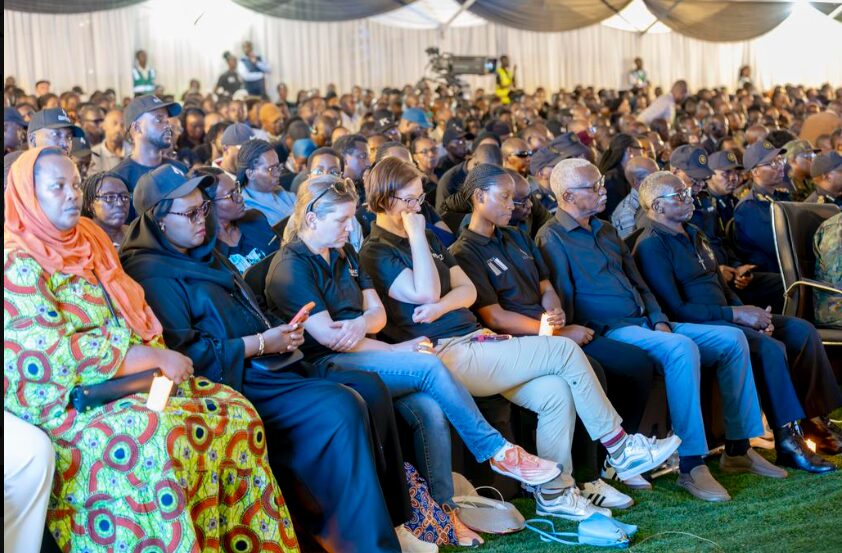
Mourners during the 32nd commemoration held at the Nyanza-Kicukiro Genocide Memorial.
KIGALI -The President of IBUKA—the umbrella organization representing survivors of the 1994 Genocide against the Tutsi—Dr. Philibert Gakwenzire, has said the historical conduct of Belgian troops in Rwanda reflects a legacy that did not favor peace. He pointed to their role in fostering divisions that later fueled violence during the genocide.
He made the remarks this weekend during the 32nd commemoration held at the Nyanza-Kicukiro Genocide Memorial, a site that bears witness to some of the most brutal killings in Kigali. The location is particularly significant, as it marks the spot where thousands were murdered after Belgian UN peacekeepers abandoned them at the height of the slaughter.
“They are the ones who sowed division among Rwandans, not to mention the killings that targeted Tutsi during the struggle for independence,” Dr. Gakwenzire said.
Colonial Roots of Division
He noted that in the years leading to and immediately following independence between 1959 and 1962, Tutsi communities were systematically targeted, leading to widespread killings and forced displacement into exile.
According to him, Belgium’s influence extended into the political and military structures of the time, including the installation of President Grégoire Kayibanda and the creation of an army that served sectarian interests.
“They established leadership and institutions that protected a divisive system, the consequences of which later turned against them,” he said.
Dr. Gakwenzire emphasized that Rwanda’s painful history should serve as a lesson on the importance of leadership grounded in values and unity.
“When you do good, you benefit from it, but when you do wrong, it comes back to you,” he said, adding that Rwanda has since chosen a path of rebuilding a nation founded on unity and shared identity.
The Mayor of the City of Kigali, Samuel Dusengiyumva, described Nyanza-Kicukiro as a deeply significant memorial site, where many victims of the genocide were killed after being taken from ETO Kicukiro.
“This hill is the final resting place of many of our people who were killed here and across Kigali. Today, they are honored with dignity,” he said.
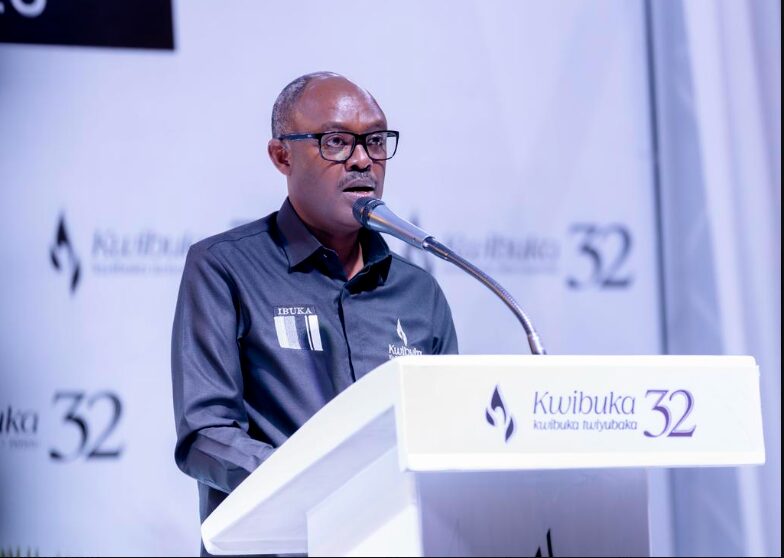
The President of IBUKA, Dr. Philibert Gakwenzire, has said the historical conduct of Belgian troops in Rwanda reflects a legacy that did not favor peace.
He also pointed to the site as a reminder of the failure of the United Nations peacekeeping mission (MINUAR), whose forces withdrew and left thousands of Tutsi civilians unprotected.
“Rwanda will continue to highlight this as a symbol of abandonment, where those meant to protect instead withdrew, leaving civilians at the mercy of Interahamwe militias and former government forces,” he said.
Survivors recount that Tutsis who had sought refuge at ETO Kicukiro were rounded up by Interahamwe and Ex-FAR, killed some along the way, and later massacred thousands at Nyanza-Kicukiro using guns, grenades, and machetes, often after being robbed of their belongings.
A Site That Reflects Failure and Betrayal
The conduct of Belgian troops is seen to have played a critical role in the 1994 Genocide against the Tutsi, characterized by an initial attempt to support a peacekeeping mission followed by a rapid, controversial withdrawal that abandoned Rwandans to their deaths.
In October 1990, Belgium sent a contingent of 500 soldiers in support of the Rwandan regime, alongside France and Zaire. In 1993, after the signing of the Arusha Peace Accords, Belgium contributed 450 troops to the United Nations Assistance Mission for Rwanda (UNAMIR).
From January to April 1994, Belgium, through its intelligence service within UNAMIR and its embassy in Kigali, possessed key information on the preparations for the genocide. Belgian political parties continued to display their support for the MRND between 1990 and 1994.
On April 7, 1994, Belgium decided not only to withdraw its troops, thus paralyzing UNAMIR, but also conducted a very active diplomatic campaign aiming for the total withdrawal of the Mission.
On April 11, Belgian troops abandoned more than 2,000 refugees at ETO Kicukiro, who were slaughtered by government soldiers and Interahamwe militiamen. Under Belgian pressure, on April 21, the Security Council decided to withdraw UNAMIR, leaving a symbolic military presence of 270 men in Rwanda
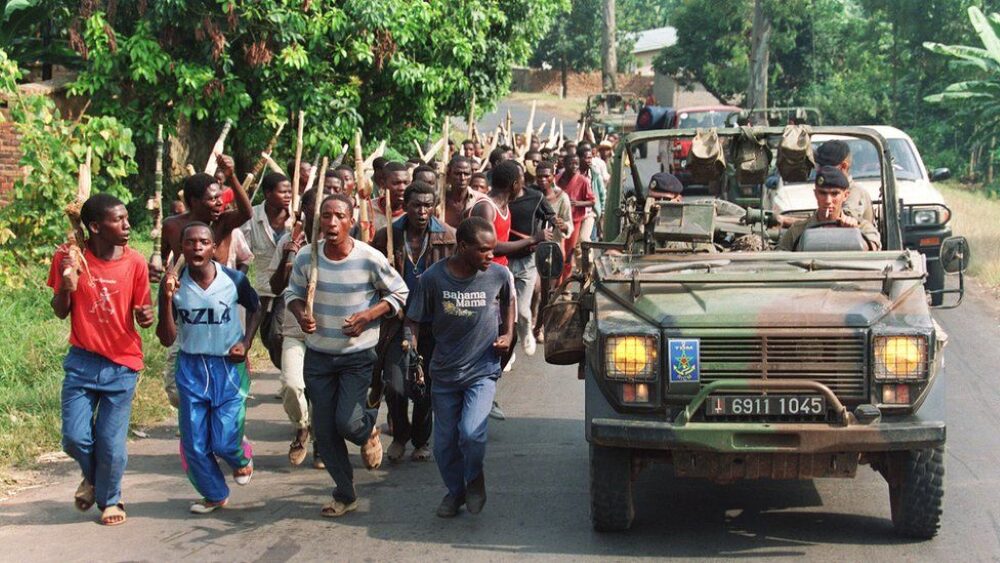
The conduct of Belgian troops is seen to have played a critical role in the 1994 Genocide against the Tutsi.
Despite the scale of the tragedy, IBUKA paid tribute to the former FPR-Inkotanyi forces, whose intervention ultimately stopped the killings and rescued many who would otherwise have perished.
As Rwanda continues to commemorate the genocide for the 32nd time, everyone should embrace the importance of remembrance, not only to honor the victims but also to reinforce the country’s commitment to unity and to ensuring that such atrocities never happen again.