



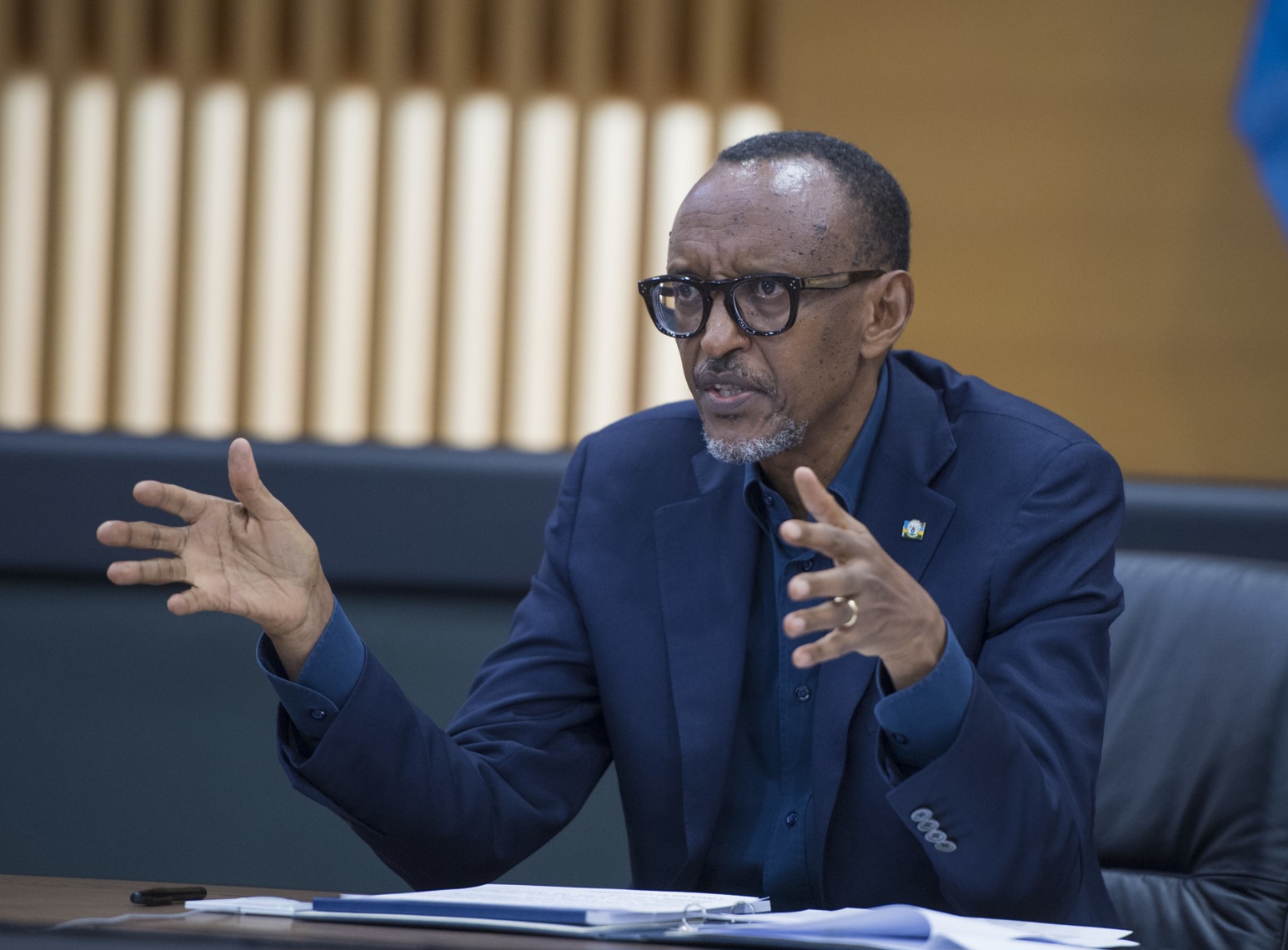
President Paul Kagame speaking during a virtual summit of the EAC
KIGALI — President Paul Kagame has delivered one of his most forceful defenses yet of Rwanda’s security posture in relation to eastern Democratic Republic of Congo
The President questioed what he described as the international community’s “illogical” and imbalanced demands on Rwanda.
In interview with French Jeune Afrique, Kagame rejected calls for Rwanda to scale back its defensive measures, arguing that such pressure ignores both the root causes of the conflict and escalating rhetoric from Kinshasa.
“Don’t expect me to lift our defensive measures while you allow Félix Tshisekedi to do whatever he wants,” Kagame said.
Security First
Kagame framed Rwanda’s actions as a direct response to longstanding threats, insisting that responsibility for the crisis lies primarily with the Democratic Republic of Congo.
“The problem is that of the DRC, not Rwanda,” said. “This problem has lasted for nearly thirty years.”
He pointed to repeated failures in implementing past agreements between Kigali and Kinshasa, suggesting that Rwanda cannot rely on commitments that have historically gone unfulfilled.
“We have signed several agreements with the DRC since 2007; none have been respected,” he said.
For Kagame, these failures justify maintaining a firm military posture along Rwanda’s borders, regardless of external pressure.
FDLR
A central pillar of Rwanda’s stance is the continued presence of the FDLR, a group linked to perpetrators of the 1994 Genocide against the Tutsi.
Kagame described the group in unequivocal terms: “The FDLR is a genocidal force.”
Kagame stressed that Rwanda’s concerns are not abstract or historical, but rooted in ongoing security risks.
“If they were not directed against Rwanda, it would not be our problem,” he said.
This positions the FDLR not simply as an armed group among many in eastern Congo, but as a direct and existential threat to Rwanda’s national security.
International Pressure?
In the interview, Kagame pushed back strongly against what he views as selective pressure from Western governments and international actors.
“Rwanda is presented as the problem, when that is not the case,” noted.
He criticized the tendency to focus on Rwanda’s actions while overlooking inflammatory rhetoric and policies from Congolese leadership.
In Kagame view, calls for Rwanda to withdraw or de-escalate without corresponding obligations on Kinshasa amount to an unfair and unrealistic expectation.
The Head of State also addressed the growing threat of sanctions, making clear that such measures would not alter Kigali’s security priorities.
“If I must choose between an existential threat and sanctions, I will choose to confront the threat,” he pointed out.
The statement underscores a broader doctrine: Rwanda will prioritize its perceived security needs over international approval.
A Region on Edge
Kagame warned that the current trajectory risks further destabilizing the region, pointing to rhetoric and actions that could fuel escalation.
“You cannot fear a fire while adding fuel to it,” he said.
While he stopped short of predicting open conflict, his remarks suggest that Kigali sees itself as reacting to, rather than driving, rising tensions.
