



Four months after the signing of a peace agreement presented as historic, war continues in eastern DRC. In a interview with French magazine JeuneAfrique, the President Paul Kagame defends an uncompromising line and places responsibility back on Kinshasa, Washington, and the international community.
The scene alone summed up the state of relations between President Kagame and Félix Tshisekedi.
It was December 4, 2025, in a lounge at the White House in Washington. Monica Crowley, the chief of protocol, was welcoming the Rwandan and Congolese presidents before ushering them into the Oval Office, where they were to sign what was described as a “peace and regional integration agreement” meant to be historic. There was a couch where the two heads of state were expected to sit and exchange a few words, along with half a dozen chairs for members of their respective delegations.
Félix Tshisekedi arrived first and sat squarely in the middle of the couch. Paul Kagame entered the room and addressed him in English:
“Hello, Mr. President, how are you?”
His Congolese counterpart did not move. He remained seated in the center of the couch and extended his hand while lowering his head, as though refusing to look him in the eye. Seeing that his president had nowhere to sit, Rwanda’s Minister of Foreign Affairs, Olivier Nduhungirehe, offered him his chair. Kagame declined. He remained standing.
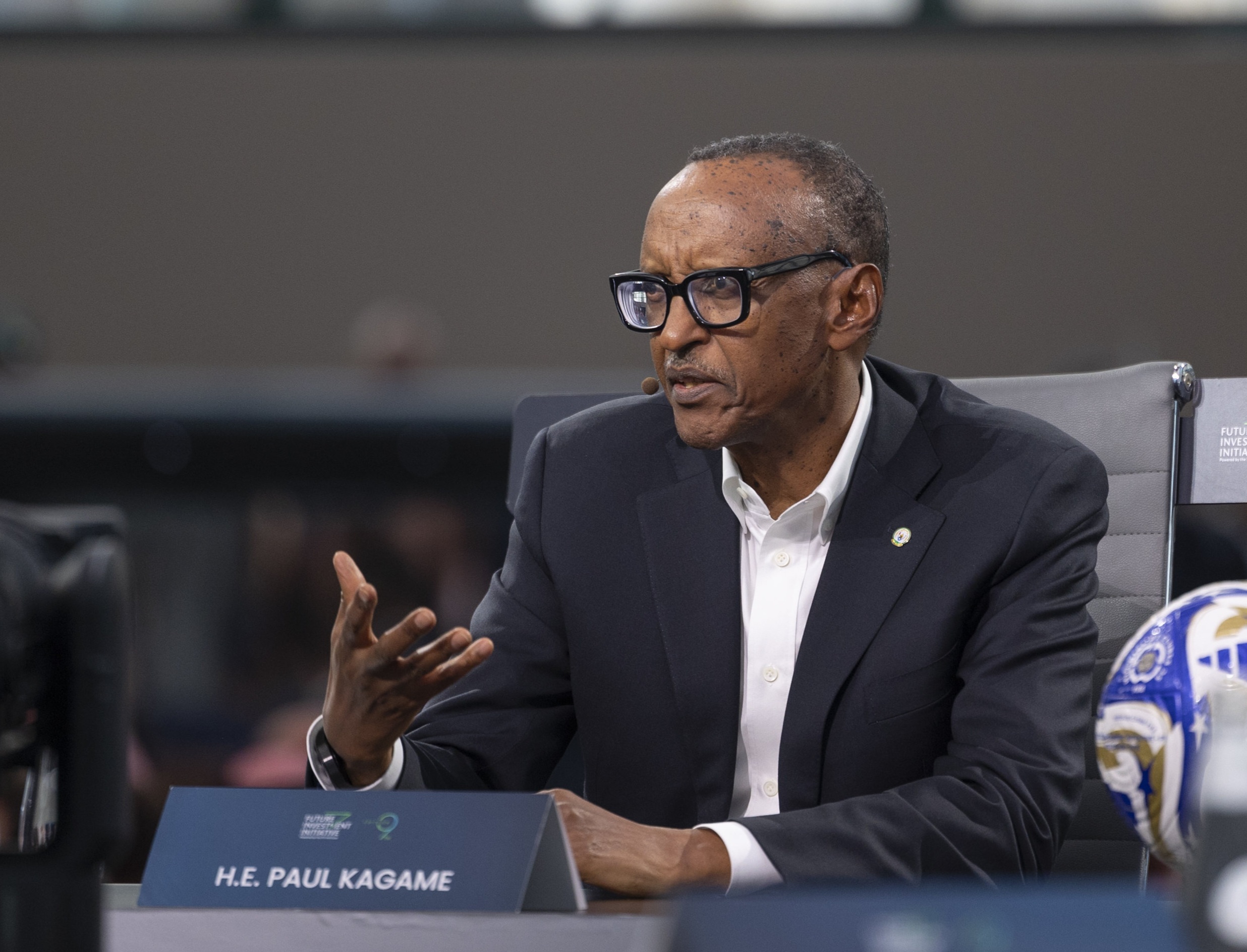
Four months later, the icy chill between the two neighbors — perfectly illustrated by their body language during the signing of the Washington agreements — has not eased by a single degree. Nor has the situation in eastern DRC, where fighting continues between the Congolese army and the AFC/M23 rebels, backed by Rwandan troops.
To the infantry war has now been added a drone war, and since the United States imposed sanctions on the Rwandan army on March 2, Kigali has not hesitated to denounce what it sees as the bias of a Trump administration openly suspected of being driven by commercial interests.
It was in this tense context that Paul Kagame received Jeune Afrique at Urugwiro Village, the presidential office, on March 26. This is the full interview;
Jeune Afrique:
For some time now, Rwanda has been the target of increasingly strong sanctions, pressure, and criticism over its regional policy. Do you not feel that a process of diplomatic isolation of your country is underway?
Paul Kagame:
Before getting to your question — and correcting your impression — I would like to restate what I keep saying to those willing to hear it: the conflict in eastern DRC is not Rwanda’s doing.
Rwanda is a concerned party because of several aspects of this crisis, particularly the unresolved problem posed by the genocidaires of the FDLR (Democratic Forces for the Liberation of Rwanda). This is a problem that everyone has known about for thirty years, without ever seriously seeking a solution.
The failure of the United Nations mission, the most expensive in UN history, which mobilized tens of thousands of troops over decades, is in this respect obvious.
The FDLR are a danger to Rwanda because they operate from a neighboring country — DRC — with the support of that country’s government. They are not only a problem for Rwanda, but also for some of its other neighbors.
We are only defending ourselves, and the sanctions or threats you mention amount to blaming the victims while congratulating the perpetrators. Sanctions and threats of that kind are nothing more than insults thrown in my country’s face.
Imposing the full burden of penalties on Rwanda is certainly easier than finally trying to solve this conflict.
Jeune Afrique:
On March 2, the Trump administration imposed sanctions on the Rwanda Defence Force and four of its generals for supporting M23, while demanding the immediate withdrawal of your troops from eastern DRC. Do you intend to comply?
Paul Kagame:
Once again, we must first understand who and what we are talking about.
M23 is not a Rwandan movement, but a Congolese movement, now called AFC/M23, and associated with former president Joseph Kabila. The problem posed by this movement is a Congolese political problem, which must find a Congolese political solution.
Now, to answer your question: you cannot expect one side — in this case Rwanda — to fulfill all of its obligations under the Washington agreements of December 4, while the other side — DRC — fulfills them only partially, if at all.
The American side, which brought us together, must ensure that both Congo and Rwanda move in the right direction. It must not give the impression of applying heavy pressure to one side while treating the other gently, for reasons I do not wish to comment on.
Jeune Afrique:
The capture of Uvira by M23 on December 10, just six days after the signing of the Washington agreements, was perceived by the Trump administration as an affront and opened the way to sanctions. Do you understand that American sentiment?
Paul Kagame:
No. It is a selective sentiment.
People want to suggest that there is a link between the fall of Uvira and the Washington agreements, and that the capture of Uvira was a form of defiance toward those agreements. That is completely inaccurate.
For weeks, even months, fighting had been taking place both toward and from Uvira. The American side was kept informed almost daily about how that situation was evolving.
With or without the signing of the Washington agreements, the fall of Uvira was going to happen. It was inevitable. All parties involved in the Washington agreements knew that.
Jeune Afrique:
On January 22, your ambassador in Washington said Rwanda was “engaged in security coordination with AFC/M23,” which many interpreted as acknowledgment that your “defensive measures” in fact meant that Rwandan troops were indeed present on the ground in eastern DRC. Do you agree with that interpretation?
Paul Kagame:
Yes, that makes sense.
What do we mean by defensive measures? It means defending our territory and our borders against what threatens us, which may involve several possibilities, such as the use of our military equipment, the deployment of troops on the ground, or other things.
In fact, I do not see where the contradiction is.
If I am defending my border and, to do so, I must deal with the threat 5, 10, or 20 kilometers beyond it, that still remains a defensive measure.
And besides, let us stop looking at only one side. Why do people only talk about Rwanda, when it is facing a government that works with the FDLR, and from whom nothing is being demanded?
Do not expect me to lift our defensive measures while you do nothing to put an end to what threatens my country.
Jeune Afrique:
Is a compromise possible if each side — DRC and Rwanda — does its part?
Paul Kagame:
That compromise is at the heart of the Washington agreements, and of many others before them, which DRC has never respected.
Jeune Afrique:
You keep saying that the Congolese armed forces are collaborating with the FDLR. What exactly do you know about this, and how many troops do you estimate the ex-genocidaires still have?
Paul Kagame:
That collaboration is still just as intense.
As for the number of those terrorists, it does not matter. They may be a few hundred or a few thousand. What matters is what they represent, their ideology, and the fact that they benefit from the support of the government of DRC.
That alone makes them a major problem for us.
If you focus on their exact number, you miss the point.
There is no numerical difference between the FDLR and the ADF (Allied Democratic Forces, affiliated with the Islamic State group), which the Ugandan army has been fighting for years on Congolese territory, with the agreement of Félix Tshisekedi.
Jeune Afrique:
Yet the Congolese government has repeatedly stated its willingness to put an end to FDLR activities and insisted on its good faith in that regard…
Paul Kagame:
And with what results?
In the areas controlled by M23, the latter is doing good work against the genocidal groups and obtaining results.
But in the areas of Masisi, Walikale, and everywhere the FARDC (Armed Forces of the Democratic Republic of the Congo) operate, the region is full of FDLR elements working in complicity with the government.
What interests me is not declarations made for public relations purposes, but the reality on the ground.
Jeune Afrique:
The recent visit to Kinshasa by Jean-Luc Habyarimana, one of the sons of former president Juvénal Habyarimana and a critic of your regime, prompted a reaction from your government. Yet he is a relatively isolated figure. Why react?
Paul Kagame:
If Habyarimana’s son begins to benefit from the support of Tshisekedi, the Congolese state apparatus, and its enormous resources, in what way is he isolated?
Tshisekedi is trying to use him to rally opinion in favor of the FDLR and to build them a support network in France, where this individual resides, and elsewhere.
How could we minimize that?
Jeune Afrique:
Since the capture of Goma in January 2025, M23 has repeatedly been accused of violating human rights and carrying out forced recruitment. Do you think this movement is better able to manage the areas it controls than the Congolese government?
Paul Kagame:
I would understand such accusations if the situation in Goma had been good and stable before the arrival of M23.
I also note that, curiously enough, people hardly spoke about human rights at that time.
The reality is that the situation is better than before.
Everyone can form their own opinion: it is better in Goma and better in Bukavu.
Jeune Afrique:
Do you consider your border now safer with the presence of AFC/M23?
Paul Kagame:
Without question.
Whether people like it or not, from a security point of view, it is obvious.
In fact, our entire border with DRC is now secured.
Jeune Afrique:
Until recently, the war in the East was an infantry war. It is now changing in nature with the use of combat drones by both sides, the FARDC and M23. Does this evolution worry you?
Paul Kagame:
What worries me first and foremost is that the conflict continues.
And what concerns me — and should concern all of us — is how to put an end to it.
Otherwise, other weapons, perhaps even worse than drones, may appear.
Jeune Afrique:
If peace returned, who, in your view, should administer the areas currently controlled by M23?
Paul Kagame:
I do not know, and I do not pay much attention to that. That is not my business.
What I want is that whoever administers that region, whoever it may be, should not be a danger to us, and that we coexist in peace. Period.
Certainly, the zone controlled by M23 no longer represents an immediate threat and, to some extent, that suits us.
But I know that this is not the end of the story.
There is still a lot of work to be done, both for the East and for Congo as a whole, so that neither one nor the other poses a danger to its neighbors, particularly to Rwanda.
That is why we will be uncompromising when it comes to the security of our border. By any means necessary.
Jeune Afrique:
Does Joseph Kabila’s presence in Goma mean he has obtained a green light from you and that you support him?
Paul Kagame:
Anyone who wishes to take part in the struggle for a stable Congo is welcome.
Kabila has made his choices. You know his problems.
The Congolese government is prosecuting him, he has been sentenced to death, some of his property has been seized, and he wants to confront that situation in his own country.
I do not see why I would deny him passage.
That would make no sense.
Jeune Afrique:
Rwanda’s development model relies in part on the strong reputation of its economic governance. Do the American and European sanctions not risk undermining that?
Paul Kagame:
A reputation is not based on biased notions, but on reality.
What should I do to preserve my reputation? Should I remain with my arms folded in the face of what threatens the very foundations of that reputation?
And in that case, do you think I would still keep that reputation?
Should I choose to preserve my reputation by refusing to fight what has brought us these sanctions and by tolerating those threats?
No.
The choice is difficult, but it is clear.
Jeune Afrique:
Do you not fear that these sanctions could be expanded, as the Congolese government is calling for, to Rwandan state-linked companies such as Crystal Ventures, or even to the ruling party?
Paul Kagame:
I do not know.
DRC is the cause of all the problems we are talking about, but those who decide to apply sanctions do so according to their own criteria and their own interests.
Imposing sanctions does not mean they are justified.
They are imposed on you because you do not align with the interests of those imposing them.
One thing is certain: no one should expect me to apologize and accept unjustified sanctions whose basis I do not understand.
Jeune Afrique:
Could Rwanda withstand a suspension of international aid?
Paul Kagame:
We have faced so many challenges.
Rwanda was a failed state — a non-state. And yet it exists today.
We survived what no other state could have survived.
Jeune Afrique:
African mediation efforts have followed one another for decades, and none has managed to resolve the crisis in eastern Congo. Why has the continent been unable to deal with this problem?
Paul Kagame:
I do not know.
There are a hundred things Africa is confronted with that it is unable to solve. This is one of them.
Most of our problems are self-inflicted, and even when we are capable of ending them, we do not know how.
Or else, we do exactly what should not be done.
Jeune Afrique:
Is your goal to become a regional hub for processing minerals from eastern DRC, as is often said in an accusatory tone?
Paul Kagame:
Rwanda is already a hub for different things, notably a financial hub.
Why would wanting to be a regional hub for minerals be a problem? In what way is that an accusation?
People tell us: you are in DRC because you want their minerals.
But on the one hand, Rwanda has its own mineral deposits.
On the other hand, yes, we gladly receive minerals coming from outside.
Minerals come from Congo and pass through Rwanda before heading to Dubai, France, Belgium, Hong Kong, or elsewhere.
Why is only Rwanda targeted?
We fully participate in the process of identifying the origin of these minerals.
We can account for everything that passes through here or remains here.
We can present the documents proving it.
But apparently people prefer to keep spreading these accusations…
Jeune Afrique:
Évariste Ndayishimiye, the president of Burundi, was elected chairperson of the African Union in February for a one-year term. Given your difficult relations with that neighbor, is that a problem for you, and what do you expect from him?
Paul Kagame:
It is good news for him.
What I expect from him is that he accomplishes positive things for Africa, for his country, and for all of us.
If he has the will and the capacity to do so, all the better.
If not, we will deal with that when the time comes.
Jeune Afrique:
How are your relations with Burundi?
Paul Kagame:
Calm. Nothing to report.
Jeune Afrique:
Rwanda has threatened to withdraw its troops from Cabo Delgado, in Mozambique, where they are helping fight an insurgency by jihadists affiliated with the Islamic State, if the European Union does not renew its financial support for the deployment. Do you intend to carry out that threat?
Paul Kagame:
We intervened in Mozambique nearly five years ago at the request of the Mozambican leadership, in order to help stabilize the situation in Cabo Delgado.
We did our best, and the situation has improved greatly.
But is it logical that we should have to pay for the service we are providing?
Is it normal that we make sacrifices and also have to pay for those sacrifices?
Those 20 million euros of European support are not a favor done to Rwanda, but a favor done to Mozambique.
We spend four or five times that amount to maintain a contingent of more than 5,000 men, in addition to police forces, even though our limited resources are those of the economy of a small country whose size is only one-third that of Cabo Delgado province.
The major energy companies operating in that region — Total, Exxon Mobil, and ENI — must find a way to finance the security they need.
Security has a cost, one that is in fact insignificant compared to the investments involved.
Either those companies and the government of Mozambique assume that cost, or they consider they do not need security, and I do not see why we should remain there one day longer.
Those 20 million euros a year are considered too much by the Europeans, and they even ask whether Rwanda deserves them.
My answer is simple: in that case, there is no need to give them to us.
But if no one covers the expenses related to the sustainability of that mission, we are ready to bring our troops back to Rwanda, where they will have more than enough to do, at any moment and whatever the consequences may be.
Jeune Afrique:
Your army is also present under UN uniform in Central African Republic and South Sudan. Are you facing the same difficulties there as in Mozambique?
Paul Kagame:
No.
But there too, if we realize that our presence is no longer desired, whether by the country where we are serving or by the United Nations, we will come home the very next day.
It is as simple as that.
Jeune Afrique:
In November, the election for the post of Secretary General of the Organisation internationale de la Francophonie (OIF) will take place. You have your candidate, Louise Mushikiwabo, and Félix Tshisekedi has his, Juliana Lumumba. Do you fear that this election will be disrupted by the animosity between your two countries?
Paul Kagame:
I suppose that will be the case, yes.
But in the end, someone will have to be elected.
I saw that Tshisekedi was backing his candidate, which is his right.
He can even put forward two candidates, if he wants.
That does not bother me.
Jeune Afrique:
Is it still possible that Félix Tshisekedi and you may one day finally understand one another?
Paul Kagame:
Maybe yes, maybe no.
In any case, I have no problem waiting for that to happen…
