



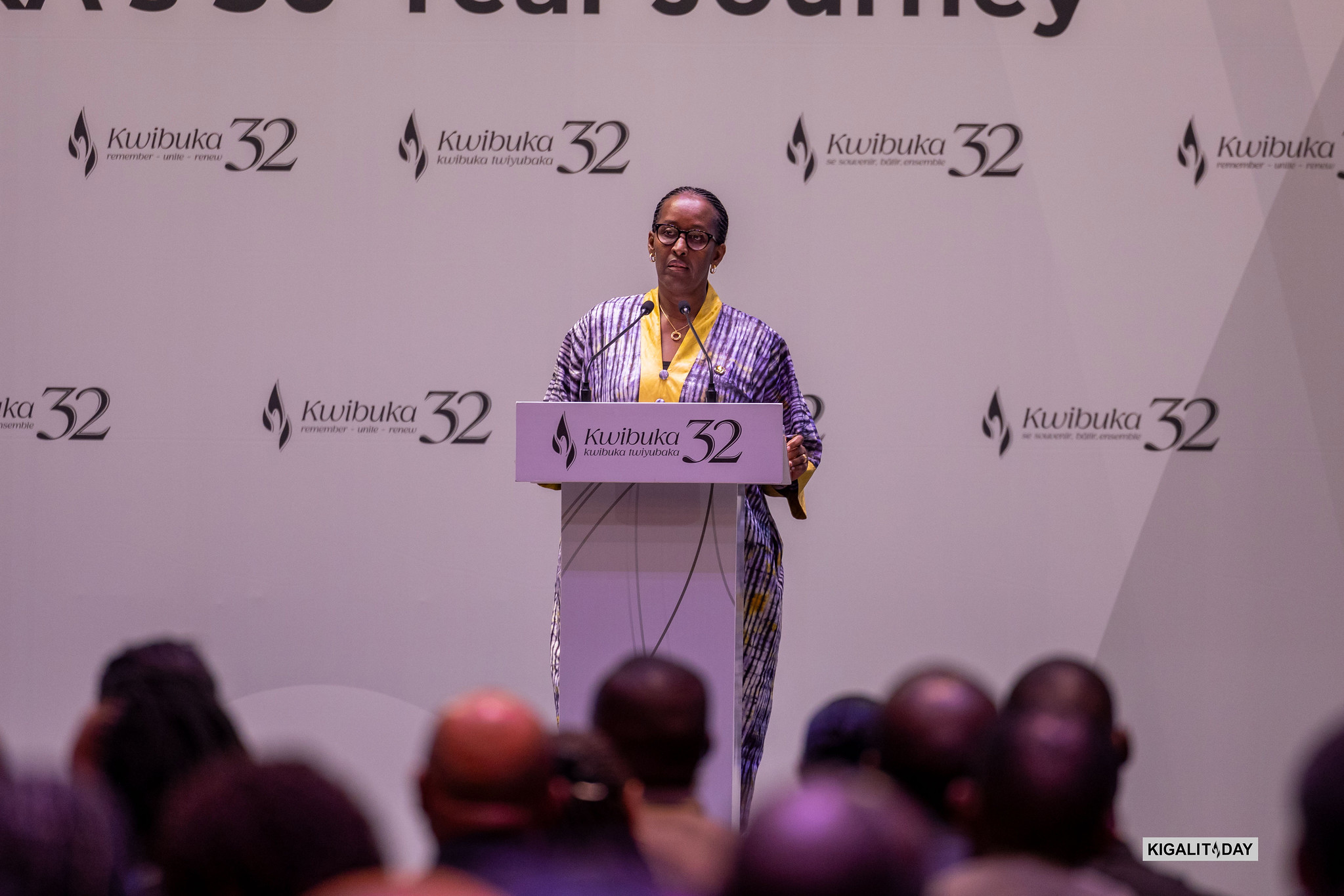
First Lady Mrs Jeannette Kagame addressing the Conference on Wednesday
Watching dignitaries and scholars from across the world gather in Kigali for the International Conference on Genocide Prevention, one could sense something struggling to be born: an African conscience.
A grassroots movement with “never again” not as a mere mantra, but as a way of life.
Rwanda’s First Lady, Jeannette Kagame, opened with remarks laser-focused on survivors. Indeed, their forgiveness is a pillar of Rwanda’s rebirth; their presence, an eternal light that chased out the darkness which once engulfed Rwanda.
Their resolve to live and their forgiveness form an eternal debt to a society that betrayed them. Their testimonies are our memories, a history that cannot be distorted, rewritten or lost, lest we lose ourselves.
As the First Lady said, Ibuka (Remember) is a mission we owe those whose lives were shattered too soon. A duty to live by and pass on the values they held dear, so that they may live eternally through our own finite lives, again and again. She warned: should we not remain vigilant, darkness will visit us again.
And here is where Africa comes in.
For Rwanda cannot stand alone as an island of resistance against hate ideologies. It would eventually be overwhelmed, as these ideologies spread across our region, revived again by inconsequential leaders whose only claim to fame is how long they cling to power, not what they do with it.
As sure as the sun rises each morning, these politicians will always revert to identity politics and hate scapegoating whenever the time for accountability rings.
So, as the UN Secretary-General’s Special Adviser on the Prevention of Genocide, Prof. Chaloka Beyani, pointed out, the warning signs are always there, if only we choose to act on them.
Africa must join Rwanda, not just in solidarity with a brotherly nation once abandoned by all to die, but in selfish interest. Because once these ideologies are normalized, no one is safe.
As President Kagame once remarked: “Why should we expect others to value African lives if we don’t value them ourselves.” One could add: “ if we don’t exact a painful cost from anyone who dares trample on them?”
Africans are also best placed to understand the danger of hate ideologies, with racism constantly directed at them. It was racism that allowed Belgian King Leopold to get away with the murder of 20 million Congolese.
It is still racism that allows Germany to evade accountability for the genocides it committed in Namibia. It was racism that justified slavery, the occupation and plunder of our continent.
It is also racism that allows some to speak openly of Africa’s recolonization. And perhaps the words of Martin Luther King Jr. will help some draw the logical link between racism and the conference held in Kigali:
“The ultimate logic of racism is genocide,” he said.
Africa can take concrete actions to prevent all these atrocities, inflicted on Rwandans in particular and Africans at large, from ever occurring again.
The first step is to remember. Rwanda’s First Lady insisted that Ibuka ni inshingano (remembrance is a responsibility) to give meaning to the lives lost, to restore their humanity. This is where Africa must begin.
And a good place to start is by prosecuting the mass killers hiding among our communities.
It is indeed an indictment of the continent to realize that not a single genocide fugitive has been prosecuted in Africa, 32 years after the genocide against the Tutsi, as Dr. Jean Damascene Bizimana, Rwanda’s Minister of National Unity and Civic Engagement, remarked.
And as Ambassador Dani Dayan, Chairman of Yad Vashem, the World Holocaust Remembrance Center, emphasized during the conference: remembrance must lead to responsibility to defend life, to confront hatred, to act before it is too late.
Rwanda’s First Lady said: “Umuryango utibuka urazima” literally meaning, “a family that doesn’t remember disappears.”
So, Africa must learn to conceive of itself as a family confronting the same dangers, honoring its duty to remember, and preventing darkness from ever visiting our continent again.
