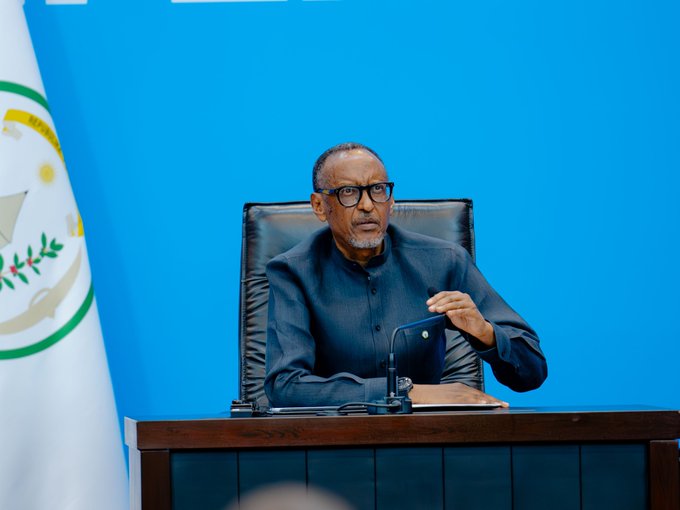
 KIGALI – President Paul Kagame says Africa’s biggest trade challenge is no longer creating a continental framework, but getting countries to follow through on the commitments that are supposed to make trade across the continent easier.
Kagame was responding to concerns over the slow implementation of the African Continental Free Trade Area (AfCFTA), an agreement designed to expand trade among African countries by reducing barriers to the movement of goods and services.
He said the agreement itself was an important achievement because it brought countries around a common vision for continental trade.
“I’m happy that that step was made for Africa to come together and not only think about, but to put a framework in which we are going to realize broader trade within the continent. Doing it is the most important thing. And that’s where we have fallen short as a continent,” Kagame said.
‘The Africans Must Be Frustrated’
The slow pace is particularly significant because AfCFTA was created to address one of Africa’s longstanding economic weaknesses: African countries often trade less with one another than their economic potential would suggest.
For businesses, the obstacles are not limited to tariffs. Different regulations, customs requirements, standards and other non-tariff barriers can still complicate trade between neighboring countries.
Kagame said the frustration surrounding the pace of implementation is understandable.
“We are not moving at the right pace,” he said. “It can cause frustration. And for good reasons, I think. The Africans must be frustrated,” he noted.
But frustration cannot substitute the work required to make the agreement effective. “We can’t just keep complaining. We have to find a way of getting together and doing what we have to do,” he warned.
He suggested that the problem partly lies in the difficulty of getting countries to move together after agreeing on the broader objective. According to him, countries keep nudging each other and trying to find the excuses some people have or reasons for not contributing to it full.
A Promise Still Worth Pursuing
Despite his criticism of the pace, Kagame did not portray AfCFTA as a failed project. Instead, he distinguished between the value of what African countries have already created and their failure to move quickly enough to realize its potential.
That distinction is important for Rwanda, which has consistently pushed for stronger regional and continental economic integration.
A more functional African market could give Rwandan producers and businesses access to markets beyond the country’s relatively small domestic economy.
AfCFTA trading began in 2021, with the agreement seeking to progressively remove tariffs and address other barriers to intra-African commerce. The implementation challenge now lies in turning those commitments into conditions that businesses can actually use.
That requires countries to keep confronting the reasons behind the slow progress rather than treating the agreement itself as the achievement.
The continental framework, Kagame suggested, has already been established. The unfinished work is making countries act on it.