



There is also a broader question of the double standards Wrong wants to maintain. When citizens in Western countries mobilise online to defend their national interests or challenge foreign reporting, they are often described as politically engaged or civically active.
A few days ago, Michela Wrong, a British self-styled investigative journalist, co-authored an article in The Continent magazine accusing the Office of the Government Spokesperson of Rwanda of coordinating a social media campaign involving “groups of people or accounts working together to promote the government’s message and challenge its enemies”.
Rather than making a compelling case, the article laid bare a telling assumption: that Wrong, as a Westerner, holds a monopoly on the truth, and that any dissenting voice is inherently suspect.
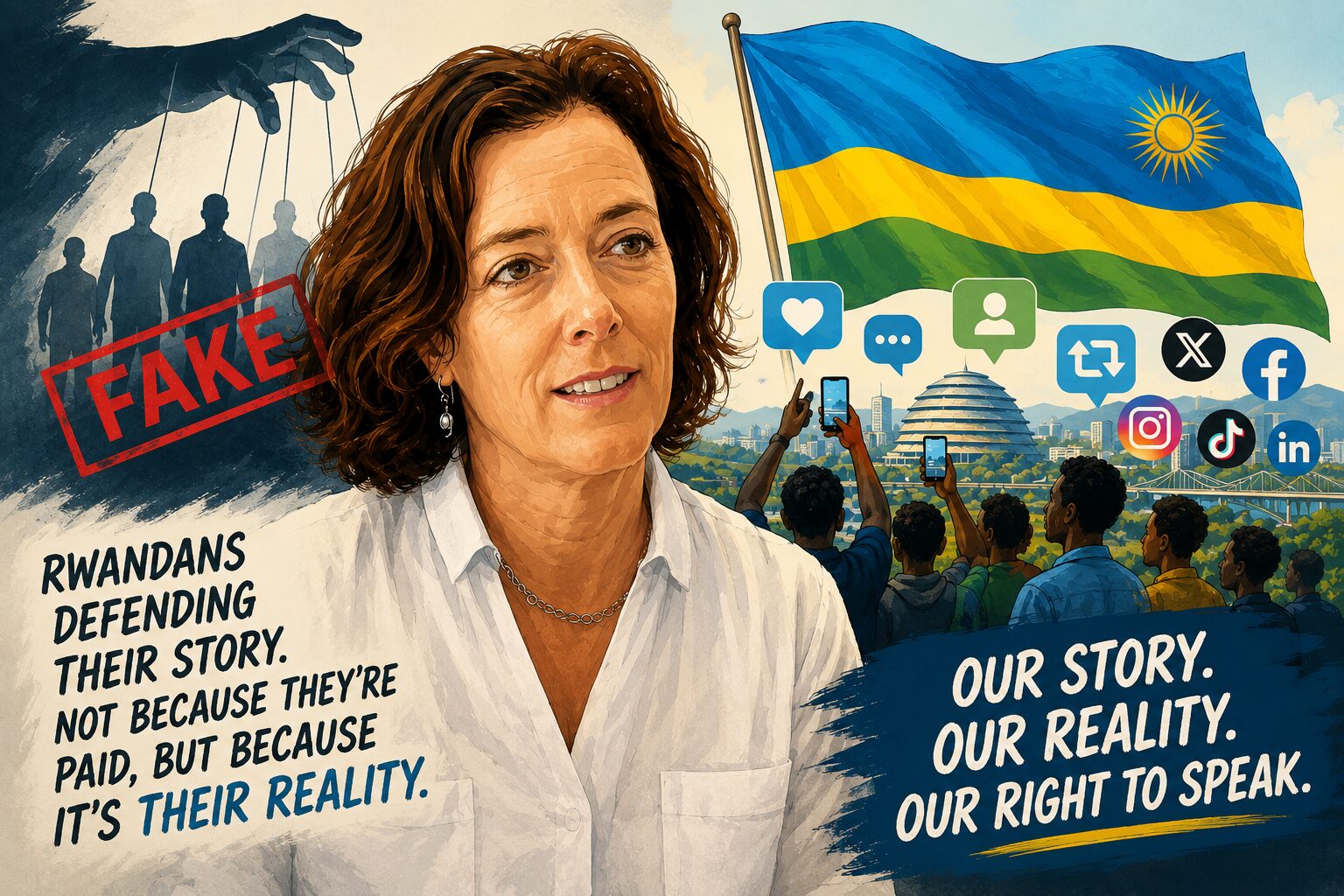
In that condescending Western worldview, Rwandans who actively defend their country online are dismissed as part of a coordinated, state-sponsored campaign.
To support her claims, Wrong published a list of a few Rwandan social media accounts alongside what appeared to be a doctored fake payment list.
To add a layer of irony, her story was endorsed by none other than Patrick Muyaya, the Congolese Minister of Communication, inadvertently inviting scrutiny about who exactly sponsored Wrong’s so-called investigation.
But what exactly is wrong with citizens defending their country’s reputation, challenging misinformation and propaganda, or presenting their own perspectives? Around the world, people use social media to advocate for their countries, challenge media narratives, and engage in political discussions.
Yet in Wrong’s view, Rwandans should apparently be treated differently.
This is absurd, considering that information contests involving Rwanda are rarely one-sided. Multiple actors actively compete to shape international perceptions, making it unsurprising that Rwandans also choose to participate in defending narratives they believe reflect their country’s reality.
It should be noted that since she began her anti-Rwanda crusade, Michela Wrong has received an overwhelming number of responses from ordinary Rwandans who challenged her claims. Annoyed by the pushback, she decided to block them all from following her X account. The joke in Kigali is that the number of her followers is now smaller than the number of people she has blocked.
The so-called investigative article is undermined by a central contradiction. Wrong implicitly accepts that journalists have the right to investigate Rwanda, criticise its policies, and publish controversial conclusions. Yet when Rwandans vigorously challenge those conclusions, their responses are portrayed as suspicious rather than legitimate civic participation. Wrong clearly believes she holds a monopoly on truth about Rwanda, and that anyone who disagrees with her uninformed take, or speaks of a different lived reality, must be paid to do so.
Maybe Wrong’s main issue is that the world is changing, and those who used to shape world opinion, such as the media outlets she once wrote for at the peak of her now fading career, will have to adjust.
Young Rwandans, and Africans at large, have become highly active on digital platforms. Across X, Facebook, Instagram, TikTok, and LinkedIn, they regularly share stories about innovation, entrepreneurship, healthcare, conservation, tourism, sports, education, and investment. They are telling the story of their respective countries as they know them, not because someone instructed them to, but because they believe their experiences deserve to be part of the global conversation.
There is also a broader question of the double standards Wrong wants to maintain. When citizens in Western countries mobilise online to defend their national interests or challenge foreign reporting, they are often described as politically engaged or civically active.
When Rwandans do the same, there is a tendency among some commentators to presume orchestration or hidden sponsorship. Such assumptions risk denying Rwandans the same agency routinely afforded to citizens elsewhere. It would be naïve to think that this treatment is not extended to other Africans who question narratives that have become gospel truth in a post-truth Western civilisation.
To be sure, no country should be immune from scrutiny, and journalists should be free to investigate public affairs. Equally, citizens should be free to question journalists, dispute their findings, demand stronger evidence, and offer competing interpretations.
Freedom of expression is not a one-way privilege reserved for those criticising Rwanda; it equally protects the right of Rwandans, who support their government and happen to be an overwhelming majority, to respond.
In the end, Michela Wrong’s article reveals a deeper question: Is freedom of expression universal, or does it become questionable only when Africans use it to challenge narratives about their own countries?
Young Rwandans increasingly view themselves as custodians of their country’s story. Having grown up during a period of significant social and economic transformation, many feel a responsibility to present Rwanda as they experience it rather than allowing others to define it on their behalf. This should become the new normal.
Anything less would suggest that some voices are considered inherently credible while others are expected simply to listen and acquiesce in silence. That will not fly, at least not where Rwandans are concerned.
