



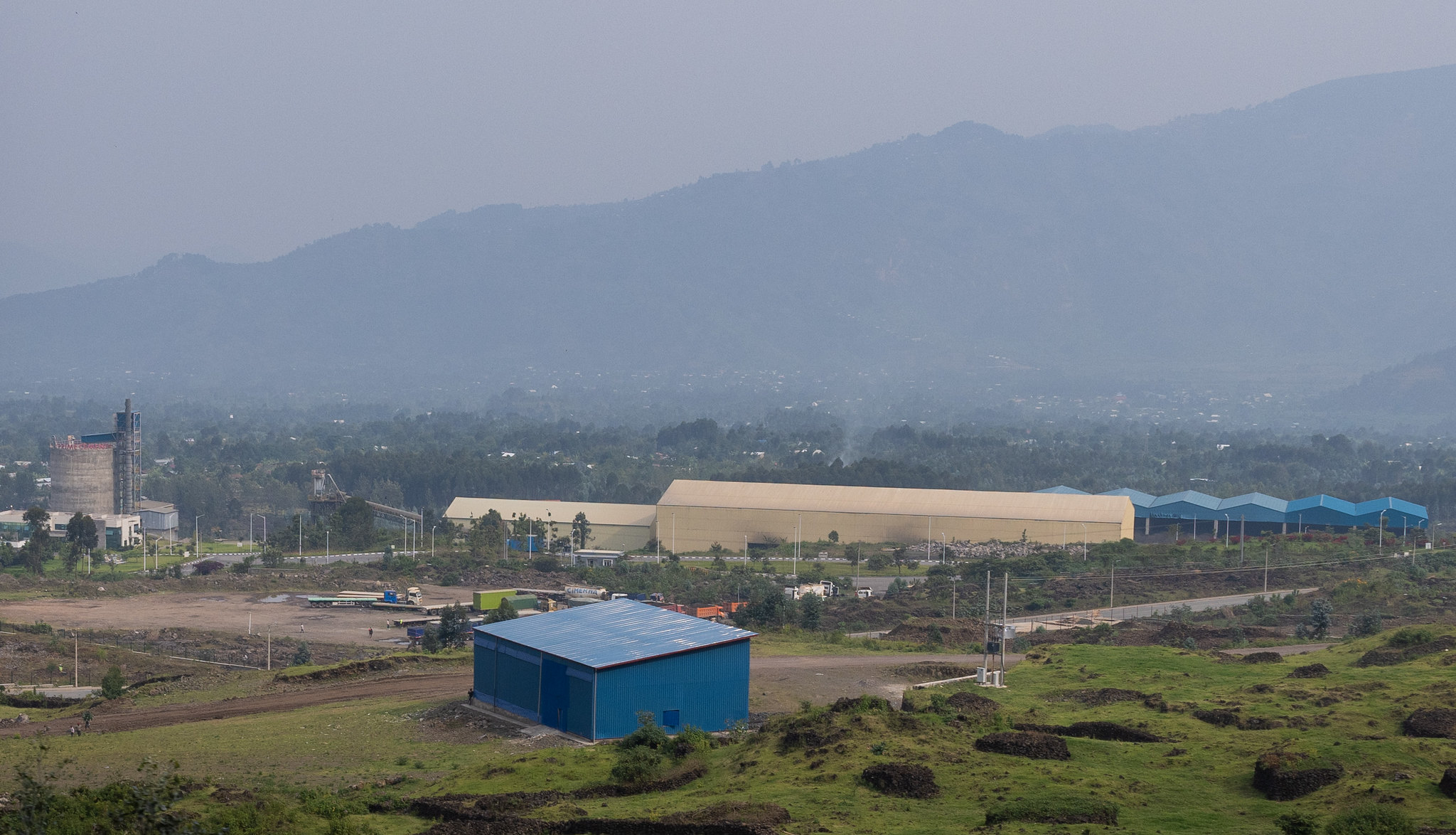
Part of the Musanze Industrial Park, under development in northern Rwanda
Kigali — Government has issued a new directive requiring all factories and industrial operations to operate exclusively in designated industrial zones or areas officially approved for industrial activity.
Through a Ministerial Instruction by the Trade Minister Prudence SEBAHIZI, released on February 13, 2026, the new requirement affects small, medium, and large industries across the country, signaling a push for stricter enforcement of zoning regulations.
Under the Ministerial Instruction, industries are now formally classified by investment size: small industries are those with capital between Frw 50 million and below Frw 500 million; medium industries have capital between Frw 500 million and below Frw 1 billion; and large industries are those with Frw 1 billion and above.
There are hundreds of such business entities across the country. Government has been setting up industrial parks with industrial zones, with over 300 large production facilities currently set up there.
It appears government wants all production to be in designated areas for better oversight, and also environmental purposes.
While the new cclassification provides regulatory clarity, authorities emphasize that the requirement to operate in approved zones applies to all industries, regardless of their size or capital.
The National Land Use Master Plan unveiled in 2020, divides Rwanda territorial land into clear categories: agriculture (largest share for farming and livestock), forestry (protecting forests and parks), residential (low-to-high density housing), commercial (shops and offices), industrial (factories in organized zones), mining, wetlands (protected), and water bodies.
This organized zoning, said government at the time, would prevent random building, save farmland, reduce pollution, attract investors, and support sustainable growth for all sectors.
The new Trade Ministry directive notes that existing factories operating outside approved industrial zones have been granted a ten years period to comply.
During this time, businesses are expected to either relocate to an industrial park or other officially approved area, or regularize their current location if possible.
After this period, non-compliant factories may face administrative sanctions, including suspension of operations, refusal to renew industrial licenses, or eventual closure.
Officials have previously indicated that the move is part of a broader effort to streamline Rwanda’s industrial sector, improve urban planning, enforce environmental compliance, and enhance safety standards.
By linking industrial licensing directly to approved locations, the government hopes to prevent industrial operations from encroaching on residential or mixed-use areas, a problem that has occasionally caused conflicts and regulatory challenges in Kigali and other cities.
The instruction also strengthens the regulatory framework for licensing and compliance. Industries must obtain an industrial license from MINICOM, submit detailed project descriptions, provide proof of land for industrial activity, and demonstrate environmental compliance.
Inspectors from the Ministry have the authority to conduct regular monitoring and, if necessary, suspend or revoke licenses in cases of non-compliance.
It is however important to note that the relocation requirement is location-based, not capital-based.
The key factor is whether a factory is situated in an officially approved industrial area.
Factories already operating in approved zones are not affected, regardless of their size or investment.
This instruction represents one of the most structured approaches yet to industrial regulation in Rwanda, combining capital-based classification, standardized licensing requirements, and clear enforcement mechanisms.
Factory owners must now start preparations immediately to ensure compliance within the two-year period, warning that failure to do so could result in significant administrative consequences.
