



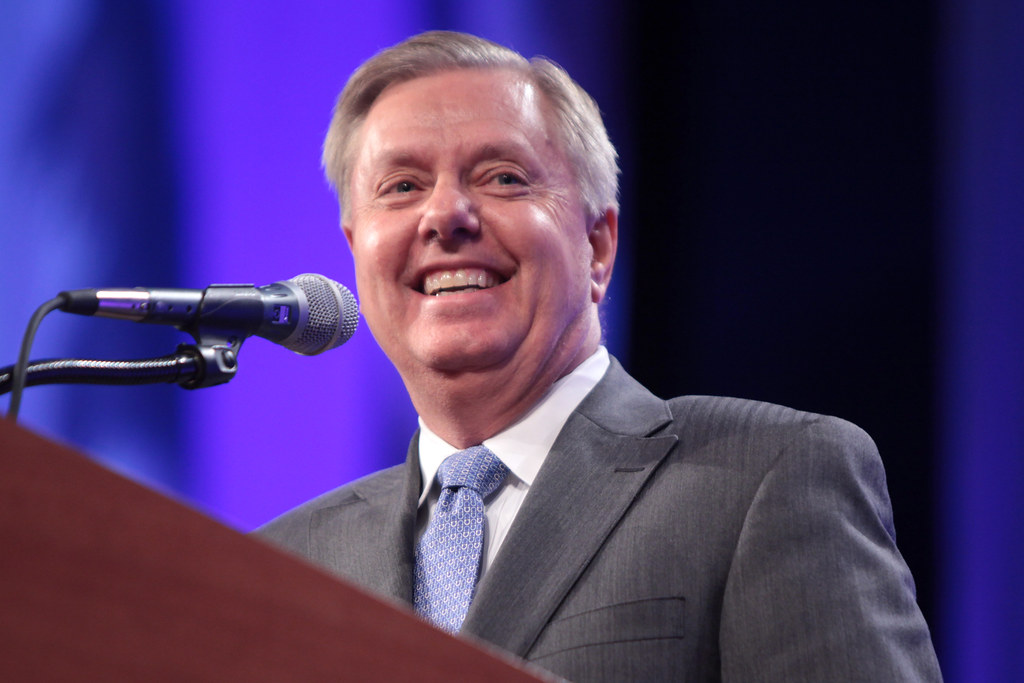
Republican South Carolina Senator Lindsey Graham
Apiece in the Wall Street Journal about a reported telephone conversation between Rwanda’s President Paul Kagame, and Republican South Carolina Senator Lindsey Graham, on the crisis in the Democratic Republic of Congo (DRC), claims to reveal “divisions within the US [United States of America] government about Rwanda.” What it does, however, is further highlight a confusion and a dismissiveness about the conflict.
We are told the telephone call was initiated by Rwanda, and was intended to forestall U.S sanctions against the country, because, as the Wall Street Journal (WSJ) puts it, “the White House says Rwanda has violated a U.S. brokered agreement on Congo…”
According to the WSJ, the South Caroline Senator, who is now close to President Donal Trump, argued that Rwanda was a reliable partner that should not be alienated. Sanctions, Graham is reported to have added, would also undermine Rwanda’s participation in the U.S. brokered peace deal.
The administration it seems agreed with the Senator, and the planned sanctions put “on ice” indefinitely, “overriding the objections of some Treasury and State Department officials.”
Perpetuating DRC crisis by perverting the truth
If, as reported, it is indeed true that officials were gang ho about imposing sanctions on Rwanda, a number of difficult questions should be aked.
How well are these “officials” or indeed the entire U.S. administration informed about the DRC crisis, how much do they care to be well informed? Or are they as well informed as they need to be and simply choose to pervert the truth, because they believe such perversion best serves their interests in the DRC?
We know that Rwanda has been at pains to lay out the underlying causes of the conflict in the DRC, consistently, constantly. Whether it is the U.S. or the European Union (EU), any Western government that does not fully understand the causes of the DRC crisis, is because they choose to turn a deaf ear to the information, indeed many seem to expend considerable effort to maintain ignorance or drown out the truth.
The touch paper that ignited the proposed sanctions is a case in point. The agreements signed by Presidents Paul Kagame of Rwanda, and the DRC’s Felix Tshisekedi, were to normalise relations between the two countries.
The so called Washington Accords, were to complement the peace process now known as the Doha Process, that is mediated by the state of Qatar. That process focuses on the inter-Congolese conflict, between the DRC state, and the AFC/M23 movement (Congo River Alliance/March 23rd Movement.)
Prior to the two heads of state travelling to Washington to sign the agreement, AFC/M23, had been raising the alarm about the latest government attack against the Kinyarwanda-Speaking Banyamulenge Congolese communities, in and around the city of Uvira.
As has now become common practice for the rebel movement, they call upon the “international community” to prevail upon the DRC to cease the attacks. The alarm is commonly ignored, the rebel movement launches a military response, it says to protect civilians, capturing the territory under attack, and the condemnations begin, but almost always against Rwanda.
The rebel movement fights to end the generations old persecution of Kinyarwanda-Speaking Congolese, grievances that not even the Congolese state disputes. Of recent, it has become normal, for members of this community to be set upon by government supporting mobs, beaten into semi consciousness, burnt alive and cannibalised.
It is scarcely believable, and yet this and similar unspeakable crimes against humanity, are laid before the world community, in the United Nations Security Council (UNSC), and other supposedly human rights agencies, which turn a blind eye and deaf ears, shrug, and instead point fingers at Rwanda, accusing it of “supporting” AFC/M23.
This is precisely what happened in the lead up to the threat of sanctions against Rwanda, only the latest, as Rwanda has become accustomed to threats of sanctions.
Uvira taken and resturned to government forces
As well as government forces FARDC (Armed Forces for the Republic of the Democratic Republic of Congo), the attack on the villages of Minembwe and surrounding areas, were launched by a coalition of Burundi forces, tens of thousands of whom are in the DRC, hundreds of armed groups now given the name “Wazalendo” and further armed by the state, to fight against Kinyarwanda-Speaking communities and AFC/M23, foreign mercenaries hired by the state, including former members of American Black Water military company, infamous for its abuses in Iraq, founded by Eric Prince.
In the lead of the attacks are always the so called Democratic Forces for the Liberation of Rwanda (FDLR), an armed group formed by the planners and perpetrators of the 1994 Genocide Against Tutsi in Rwanda, who found safe haven in the DRC, where they continued to be supported and armed. The fact that they are a designated terrorist organisation by the USA and the UN, seems to be of little relevance to the U.S. or indeed the UN.
These forces besieged a civilian population, raining bombs from Aerial Unmanned Vehicles, or drones, and aircraft upon them. The Wazalendo gave the community a ten day ultimatum to leave their homes or they would start killing them, a threat they had already begun to carry out.
The threat of what would have been yet another massacre in the DRC, was thwarted when AFC/M23 took the city of Uvira, and its surrounding areas.
Money determines what is right and what is wrong
Accustomed to being shielded by the so called international community, a shocked and panicked DRC’s Felix Tshisekedi, deployed his lavishly paid lobbyists, to ask the powerful nations of the West to issue condemnations against Rwanda, based on the claim that Rwanda had “violated” the Washington Accords.
In the confidence that they could manipulate the U.S. President against Rwanda, Tshisekedi’s paid supporters and lobbyists, flooded the internet, airwaves, bent the ears of American senators and congressional representatives, with a simple line: Rwanda has defied President Trump, they must be sanctioned. The simplistic, almost puerile strategy seems to have worked. The most powerful nation on earth, based its response on the often incoherent howling of lobbyists and perpetrators playing the victims.
As if on cue, U.S. Ambassador to the UN, Michael Waltz, descended on the UNSC, where he launched a blistering attack against Rwanda, in which he repeated, almost verbatim, Tshisekedi’s claims, tickling the Congolese head of state’s well fed tummy, who purred contentedly, protected by a powerful champion from the consequences of his psychopthic incompetence.
The onslaught pushed AFC/M23, to voluntarilly evacuate from Uvira, they said, as a sign of goodwill to advance peace efforts. No sooner had they left the city, than hordes of Wazalendo and their colleagues set about looting the city, and attacking people they perceived to be supporters of AFC/M23.
Never mind the saying might is right, Tshisekedi’s money, his dangling of Congo’s vast mineral resources, had triumphed over the truth, over any consideration of human rights, over the facts on the ground. Alongside might, money too is always right after all.
What the Americans had ignored, as does the WSJ, was that even if AFC/M23’s taking of Uvira had not been to rescue a besieged population from what a genocidal attack, led by the FDLR, that conflict could not be accurately described as a violation of the Washington Accords.
Disingenuous Conflation of Washington Accords and Doha Process
The taking of the city of Uvira – in truth a liberation of besieged civilians – was covered not under the Washington Accords, but rather, under the Doha process. Furthermore, the violation of a ceasefire, was by the government’s armed coalition in attacking civilians and AFC/M23 position, not AFC/M23.
The conflation of the Washington Accords with the Doha process, was and is, a dingenuous intent to link AFC/M23 to Rwanda, in a deliberate intent to ignore the rebel group’s grievances, which even the DRC government accepts as valid. The recent adoption of the term, “Rwanda-Backed M23,” by every media organisation, a signal of that disingenuousness.
It is a narrative that without questioning its verification, the WSJ amplifies. “The events,” [the telephone conversation], which haven’t been reported before,” the WSJ informs us, “points to the divisions within the U.S. government over how to handle Rwanda, whose actions via armed proxies have reignited the war in the Democratic Republic of Congo…”
The notion of Rwanda, having “armed proxies” in the DRC is to put it charitably, somewhat eccentric. A more blunt assessment would be that the WSJ cares so little about the crisis, it cannot even be bothered to observe the basic journalistic requirement to verify assertions it makes, and holds as authoritative.
Like many in Western media, the WSJ not only takes whatever claim the DRC makes at face value, but goes much furthter, by consciously ignoring the facts on the ground, facts which are now so much in the public domain.
“The U.S. and U.N. have long accused Rwanda of funding, arming and fighting alongside M23” says the WSJ, “Rwanda officials have denied sending forces to assist M23 but have acknowledged employing ‘defensive measures’” in Eastern Congo. The WSJ puts the words, defensive measures in quotes. A cursory glance at current affairs in the Great Lakes region, showes that Rwanda has had to repel several attacks from Eastern DRC. Some of these attacks leaving scores of civilians dead.
In response, Rwanda has indeed deployed defensive measures against the declared intention of not only the FDLR, but their fellow travellers, the FLN (National Liberation Front), financed by Paul Rusesabagina, a U.S. resident. Indeed, the Congo head of state has on several occasions declared his intention to invade Rwanda and unseat its government.
A year ago, he did try to make good his threats. The DRC’s coalition forces launched what was intended to be a major invasion of Rwanda, launching attacks against the Rwandan border city of Rubavu, claiming around twenty lives. The aborted attack would have been more deadly, if the defensive measures, scorned by the WSJ, had not been in place.
Perennial threat of sanctions
In the meantime, Rwanda seems to have little choice than accept that as long as the DRC crisis remains, thanks in large measure to the West’s dismissiveness about its underlying causes, threats of sanctions against the country will remain a fact of life.
Fuelling the threats will be Tshisekedi’s money, which he pours by the bucketloads, in every Western entity he believes will ignore that the causes of the crisis in his country lies at his own doorstep.
Tshisekedi himself all but lives in his flying palace, as he shuttles around Western capitals, to call for sanctions against Rwanda.
“Eearlier this month, Congo’s Tshisekedi visited Washington again, where he urged U.S. lawmakers to pass sanctions legislation on Rwanda to pressure it to adhere to the peace agreement…” The WSJ tells us, and “Senators Jim Risch (Republican), and Jeanne Shaheen (Democrat) who met with Tshisekedi during his visit, said in a joint statement afterwards that there was an ‘urgent need for Rwandan forces to fully withdraw its forces from the region if there is to be any chance at real, lasting peace.”
A more fatuous statement is difficult to imagine. Ignoring the utterly ridiculous demand that Rwanda withdraw “its forces from the region,” as though Rwanda were in a different hemisphere, the Senators might have asked the simple question, on what basis is the assertion that Rwanda has its forces in the DRC, and why?
Two three days ago, AFC/M23 military spokesperson, Lieutenant-Colonel Willy Ngoma was killed in a government drone attack, in violation of a ceasefire under the Doha process. There has been no condemnation from the Western nations, who will almost certainly declare fresh threats against Rwanda, if or when, the rebel group retaliates. It is that double standard that largely contributes to perpetuating the the crisis in the DRC.
