



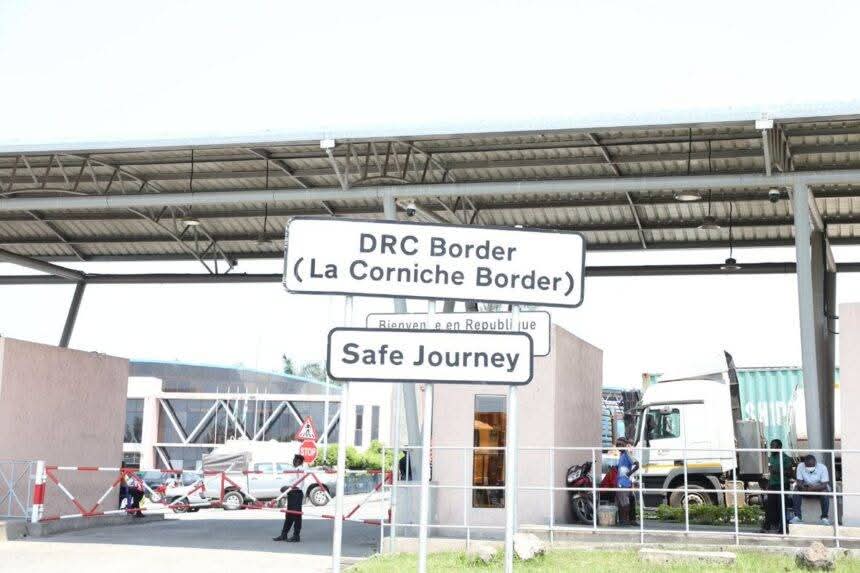
At one of the Rubavu-Goma border, a major crossing between the two countries
Rwanda’s exports to the Democratic Republic of the Congo have surged more than 140 percent year-on-year, according to official trade data for February 2026.
The shift coincides with a period of unusual stability in eastern Democratic Republic of the Congo following the consolidation of control by the AFC-M23 rebel movement which now controls North and SouthKivu in February last year.
Goma and Bukavu, both capitals of the two provinces, have up to a combined five million population – a significant market for Rwanda, since the only available trade route for imports is via Rwanda.
The latest figures point to a sharp acceleration in cross-border trade after years of disruption in eastern DRC, where multiple armed groups and shifting authorities had previously complicated movement of goods.
Key exports from Rwanda to the DRC reached $39.49 million in February 2026, up from $16.37 million a year earlier, marking a 141.17 percent increase year-on-year. On a monthly basis, exports rose nearly 48 percent.
The exports include packaged goods like milk, bottled water, and other food items.
In addition to trade, every single day, human traffick has also jumped back to peace-time era when up 40,000 people crossed daily.
Re-export trade—goods imported into Rwanda and then routed onward to the DRC—also expanded significantly, reaching $54.56 million, underscoring Rwanda’s growing role as a regional transit hub for commerce into eastern Congo.
Imports from the DRC into Rwanda surged even more sharply, increasing 345.85 percent year-on-year, though from a relatively low base.
The trade expansion comes as business conditions along the Rwanda-DRC border appear to have stabilized following the M23’s territorial consolidation.
Traders familiar with the corridor say the reduction of multiple checkpoints and competing local authorities has eased movement of goods, though the situation remains politically sensitive and uneven.
Economists caution that the surge may reflect not only improved conditions but also a normalization of previously suppressed trade flows.
Beyond the DRC, Rwanda’s trade data shows broader realignment in external markets.
Exports to China rose 243 percent year-on-year, while imports from China remain dominant at more than $115 million.
At the same time, exports to the United Arab Emirates fell sharply by more than 80 percent compared with the previous year, suggesting a major rerouting of commodity flows away from traditional Gulf trade hubs.
The contrasting trends point to a broader restructuring of Rwanda’s trade patterns, with regional commerce into eastern Congo expanding rapidly even as long-standing global trade channels shift.
Analysts say the data reflects a complex mix of improved corridor efficiency, shifting commodity routes, and changing regional dynamics rather than a single driver.
While the numbers indicate strong growth, they also highlight Rwanda’s increasing exposure to developments in eastern Congo, where stability remains closely tied to political and security conditions on the ground.
